December 24, 2014
Patek Philippe | Pocket watch featuring a perpetual calendar with a retrograde date display
Patek Philippe
Antoine Marie Philippe Louis d'Orleans
The Pocket Watch of Antoine d'Orleans
In the mid-19th century, a pocket watch featuring a grand complication movement arrived in Spain from Switzerland.
Text by KOIZUMI Yoko
Pocket Watch with Perpetual Calendar and Retrograde Date Display
When royalty wished to acquire a Patek Philippe timepiece, royal purveyors played a crucial role. At the time this pocket watch was made, in 1865, the royal purveyor to Queen Isabella II of Spain and the Spanish royal court was Fernando de la Peña, a watchmaker in Madrid.
In the 1860s, he acquired numerous important Patek Philippe timepieces, including grand complications, and this watch was one of them.
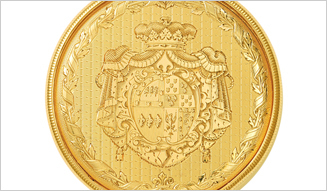
Its owner was Antoine Marie Philippe Louis d'Orleans, Duke of Montpensier, a member of the French royal family and the youngest son of King Louis Philippe I of France. He married Luisa Fernanda de Borbón, sister of Queen Isabella II of Spain, and through this marriage also held the title of Prince of Spain, Antonio.
These familial ties led Peña, the royal purveyor to the Spanish crown, to commission a watch for the French royal d'Orleans family. The case is engraved with a combined coat of arms of Antoine and his wife, Luisa.
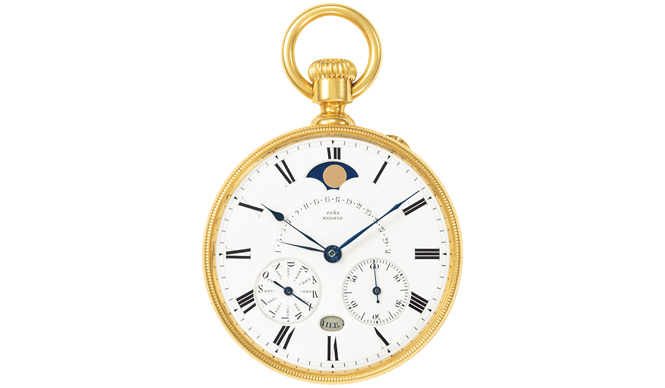
The pocket watch of Antoine d'Orleans features a perpetual calendar, one of the most complex mechanisms. A perpetual calendar automatically corrects and displays the date according to the Gregorian calendar, taking into account the varying lengths of months and leap years every four years.
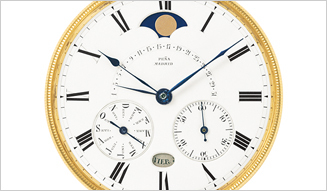
The date is displayed in a fan shape (retrograde) between 7 and 8 o'clock, with the month displayed between 7 and 8 o'clock, and the day of the week at 6 o'clock. In addition to the calendar, it features a moon phase at 12 o'clock and small seconds at 4-5 o'clock, with their placement based on symmetry being a notable characteristic.
Furthermore, what is remarkable about this model is its instantaneous date change. This means that after midnight on the 31st (or 30th), the hand instantly jumps to the 1st. Achieving an instantaneous 180-degree hand movement requires advanced engineering and serves as a testament to the technical prowess of the era.

Yellow gold case, time setting via crown winding and push-piece
Height 72.7mm, Diameter 49.6mm, Thickness 17.1mm