LOUNGE /
TRAVEL
August 9, 2019
To Know Is To Taste: HOSHINOYA Kyoto | TRAVEL
TRAVEL | Hoshinoya Kyoto
To Meet This Dish, Journey to Hoshinoya Kyoto: Kaiseki Cuisine "Gomi Jizai" (1)
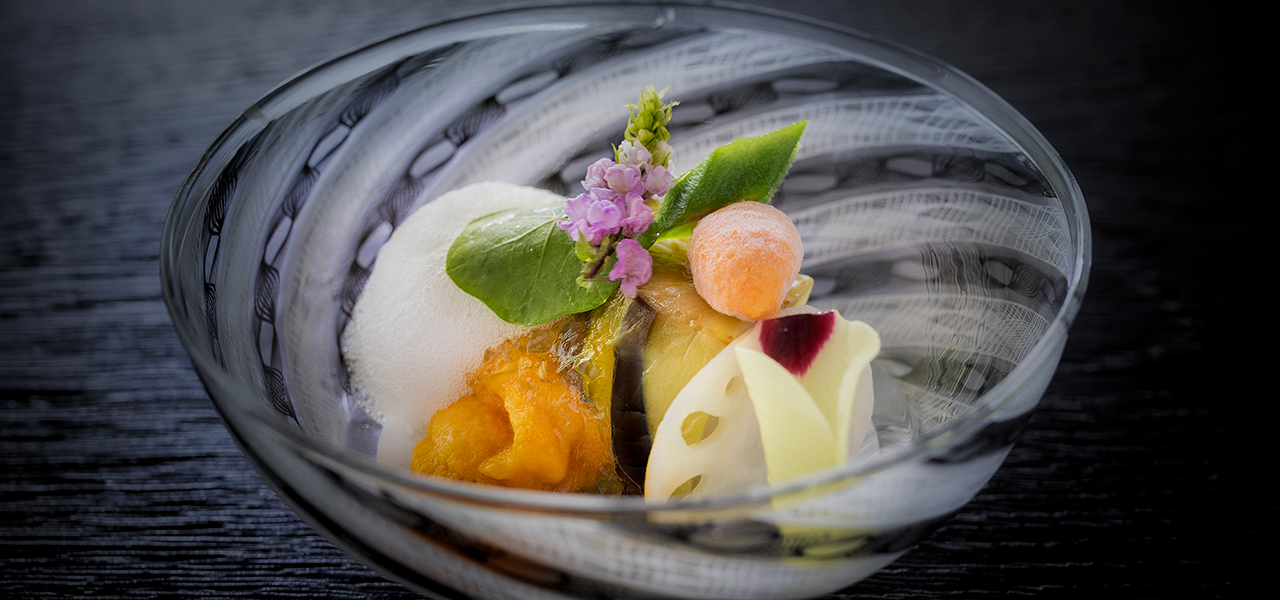
The sakizuke, "Chilled Eggplant Terrine," arrived in a delicate, lace-patterned bowl. The moment I bit into the exquisitely tender eggplant, a gentle, rich dashi broth, based on vegetables, slowly seeped out. I couldn't help but exclaim with delight inwardly. I felt fortunate to be an adult who could appreciate this flavor, savoring the happiness of sensing the season through delicate cuisine.
Photographs by Kaku Ohtaki Text by Aya Hasegawa Edit by Takashi Tsuchida
I believe the definition of Kyoto cuisine is its ability to do anything.
My near vision has worsened, and I've noticed white hairs appearing in my hair... Most distressingly, my metabolism has slowed. No matter how much I diet, losing weight is no longer easy. I also feel like hangovers last longer now. Alas, I cannot fight the tide of aging. But, as one gets older, there are good things too. Take Kyoto, for example. Kyoto has always been a staple for school trips, but I wonder how many of us truly understood the charm of this city in our youth.
It's the same with Kyoto cuisine. While the very name now sounds so elegant that it could intoxicate you, I'm sure I wasn't the only child who thought, "Forget the dashi, I want meat," or "I'd rather eat yatsuhashi until I'm full." But then again, what exactly is Kyoto cuisine? It's a question I'm asking myself now. Is it dishes that utilize dashi and traditional Kyoto vegetables? Like Yudofu or Nishin Soba?
It's the same with Kyoto cuisine. While the very name now sounds so elegant that it could intoxicate you, I'm sure I wasn't the only child who thought, "Forget the dashi, I want meat," or "I'd rather eat yatsuhashi until I'm full." But then again, what exactly is Kyoto cuisine? It's a question I'm asking myself now. Is it dishes that utilize dashi and traditional Kyoto vegetables? Like Yudofu or Nishin Soba?
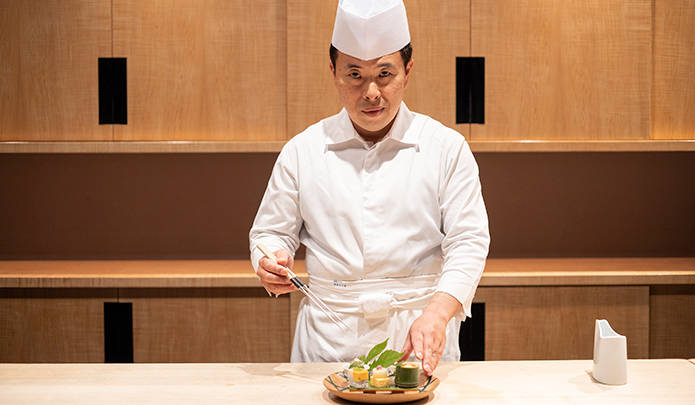
Ichiro Kubota, Executive Chef at Hoshinoya Kyoto.
To such an abstract and ambiguous question, Ichiro Kubota, Executive Chef at Hoshinoya Kyoto, answered without hesitation:
"Kyoto is a city of a thousand years. I believe the definition of Kyoto cuisine is its ability to do anything."
Kyoto, having flourished as the capital for centuries, became a hub where carefully selected ingredients and crafts from all over Japan, and indeed from overseas, were gathered for the Emperor.
"Kyoto is a city that has developed by incorporating various cultures and techniques, both domestic and international. Against this backdrop, combined with its exceptionally soft water, known as 'onna-mizu' (women's water), Lake Biwa, which is also a water source for Kyoto, and Omi rice, it is a remarkably blessed place for cooking, fostering a rich food culture."
"Kyoto is a city of a thousand years. I believe the definition of Kyoto cuisine is its ability to do anything."
Kyoto, having flourished as the capital for centuries, became a hub where carefully selected ingredients and crafts from all over Japan, and indeed from overseas, were gathered for the Emperor.
"Kyoto is a city that has developed by incorporating various cultures and techniques, both domestic and international. Against this backdrop, combined with its exceptionally soft water, known as 'onna-mizu' (women's water), Lake Biwa, which is also a water source for Kyoto, and Omi rice, it is a remarkably blessed place for cooking, fostering a rich food culture."
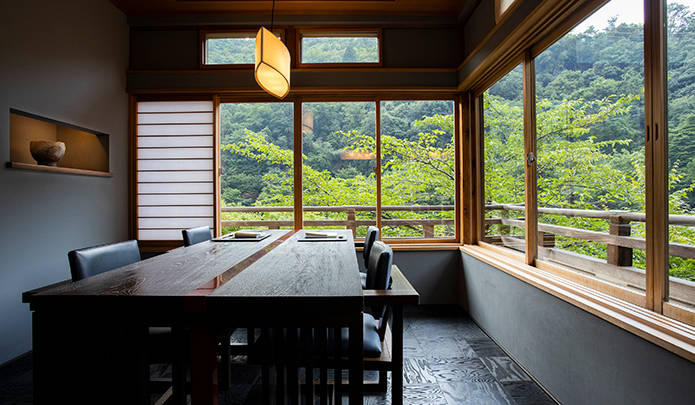
One of the rooms in the main dining area. Opening the window reveals a panorama of the natural beauty of Okurayama.
Perhaps this is part of the reason why Kyoto cuisine captivates so many people.
Born the eldest son of a long-established kappo restaurant in Gion, Kyoto, Kubota was influenced by his grandfather, who lived in Hiroshima and loved cooking, and he aspired to the world of French cuisine from a young age. After studying languages at university and Japanese cuisine at a renowned restaurant in Osaka and his family's restaurant in Kyoto, he embarked on his long-awaited culinary training in France.
"It was the latter half of the bubble economy, a time when Western ingredients like foie gras, caviar, and beef began to be used in Japanese cuisine. I wanted to confirm if this was truly meaningful, and if it was, I wanted to understand how to use them."
His training took place at "HOTEL LA VILLA" in Corsica, France. He eventually became responsible for the appetizers, and then, persuaded by a chef who was captivated by his cooking, he was appointed head chef of "Umu," the first kaiseki restaurant in London, England, in 2004. "Umu" received one Michelin star less than a year after opening and quickly became a popular establishment. However, "the desire to re-examine my own Japanese cuisine grew stronger, and I returned to Japan" (Kubota).
Kubota, who had what could be called a fateful encounter with Hoshino Resorts, became the Executive Chef at Hoshinoya Kyoto in 2011, offering kaiseki cuisine themed around "Gomi Jizai" (Five Flavors, Freely).
"I was born in Kyoto and grew up watching my father, who ran a kappo restaurant. While Kyoto cuisine is my foundation, I want to create dishes within a broader framework, not confined by the boundaries of Kyoto cuisine. The term 'Gomi Jizai' also embodies my desire to explore diversity, including ingredients and tableware. The cuisine at Hoshinoya Kyoto, and my cuisine, uses carefully selected ingredients from all over Japan, based on Kyoto techniques, and incorporating skills learned abroad."
Kubota spoke passionately about his cuisine, choosing his words carefully yet decisively. Each dish was a highlight. The nine-course menu was filled with fresh surprises and storytelling, eloquently conveying his rich experience, diverse techniques, and his love for Kyoto and Japanese cuisine.
Born the eldest son of a long-established kappo restaurant in Gion, Kyoto, Kubota was influenced by his grandfather, who lived in Hiroshima and loved cooking, and he aspired to the world of French cuisine from a young age. After studying languages at university and Japanese cuisine at a renowned restaurant in Osaka and his family's restaurant in Kyoto, he embarked on his long-awaited culinary training in France.
"It was the latter half of the bubble economy, a time when Western ingredients like foie gras, caviar, and beef began to be used in Japanese cuisine. I wanted to confirm if this was truly meaningful, and if it was, I wanted to understand how to use them."
His training took place at "HOTEL LA VILLA" in Corsica, France. He eventually became responsible for the appetizers, and then, persuaded by a chef who was captivated by his cooking, he was appointed head chef of "Umu," the first kaiseki restaurant in London, England, in 2004. "Umu" received one Michelin star less than a year after opening and quickly became a popular establishment. However, "the desire to re-examine my own Japanese cuisine grew stronger, and I returned to Japan" (Kubota).
Kubota, who had what could be called a fateful encounter with Hoshino Resorts, became the Executive Chef at Hoshinoya Kyoto in 2011, offering kaiseki cuisine themed around "Gomi Jizai" (Five Flavors, Freely).
"I was born in Kyoto and grew up watching my father, who ran a kappo restaurant. While Kyoto cuisine is my foundation, I want to create dishes within a broader framework, not confined by the boundaries of Kyoto cuisine. The term 'Gomi Jizai' also embodies my desire to explore diversity, including ingredients and tableware. The cuisine at Hoshinoya Kyoto, and my cuisine, uses carefully selected ingredients from all over Japan, based on Kyoto techniques, and incorporating skills learned abroad."
Kubota spoke passionately about his cuisine, choosing his words carefully yet decisively. Each dish was a highlight. The nine-course menu was filled with fresh surprises and storytelling, eloquently conveying his rich experience, diverse techniques, and his love for Kyoto and Japanese cuisine.
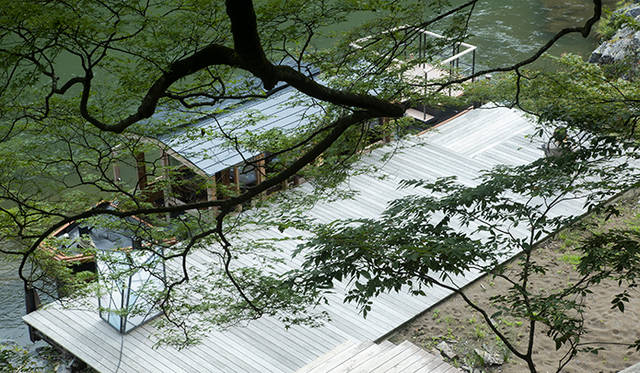
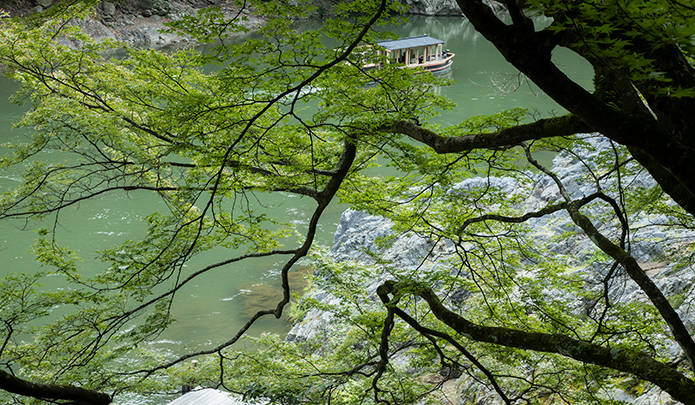
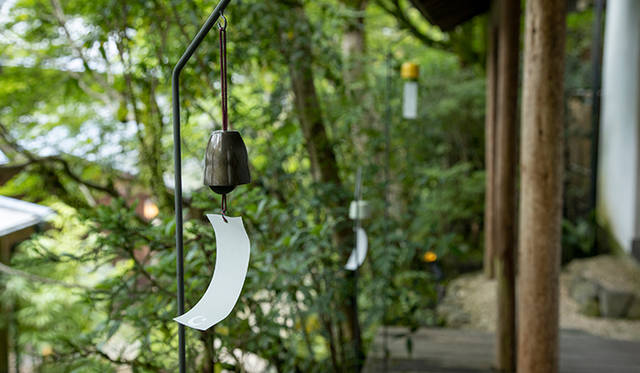
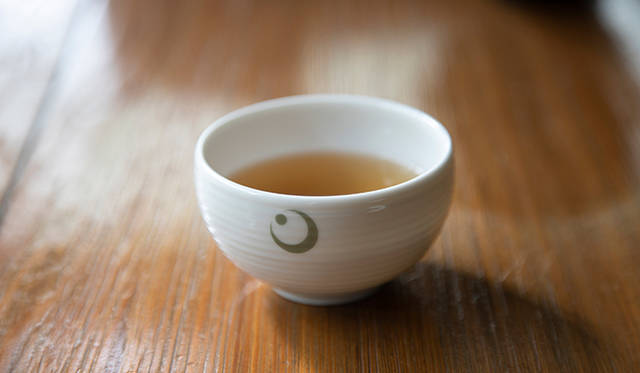
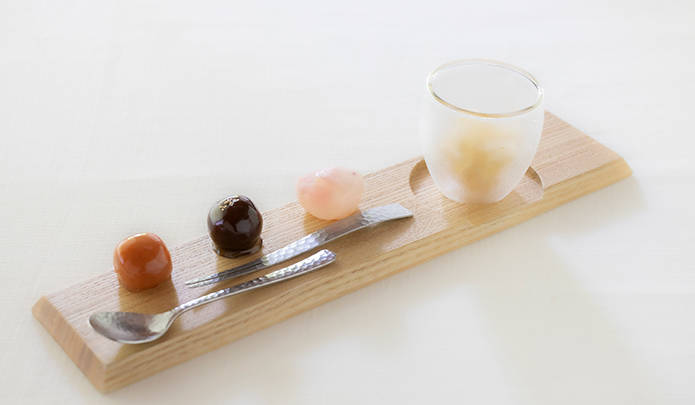
The welcome sweets served at "Salon & Bar Kura," with its impressive large table made of chestnut wood, were "Ubatama," a signature confection from Kameya Yoshinaga, a long-established Japanese confectionery shop with over 210 years of history. These are smooth, koshian (strained bean paste) dumplings made with black sugar from Hateruma Island. In addition to the standard item, original versions available only at Hoshinoya Kyoto are offered seasonally. This time, alongside the classic black sugar, a limited edition "Ubatama" featuring tomato and myoga was presented. The myoga, it is said, is inspired by the lotus flowers blooming in the "Water Garden."
TRAVEL | Hoshinoya Kyoto
To Meet This Dish, Journey to Hoshinoya Kyoto: Kaiseki Cuisine "Gomi Jizai" (2)
Chef Kubota's passion explodes in this dish
For example, the sakizuke "Chilled Eggplant Terrine" introduced at the beginning.
"For the sakizuke, which uses Kamo eggplant, a summer classic, I paired it with bell pepper, also from the nightshade family, frozen to evoke a sense of coolness. It's essentially a Kyoto-style ratatouille. For the dashi, bonito broth would be too strong, so I based it on a vegetable-only broth, with a little second-dashi added."
While delicate, lovely, and perfectly embodying the word 'refreshing,' this sakizuke has a main-dish impact. It also uses consommé jelly on top, and this dish truly explodes with Chef Kubota's philosophy of never being confined by existing boundaries, while still respecting the traditions of Japanese cuisine. Okay, I understand (laughs). I'm bursting with anticipation for the dazzling world that awaits.
"For the sakizuke, which uses Kamo eggplant, a summer classic, I paired it with bell pepper, also from the nightshade family, frozen to evoke a sense of coolness. It's essentially a Kyoto-style ratatouille. For the dashi, bonito broth would be too strong, so I based it on a vegetable-only broth, with a little second-dashi added."
While delicate, lovely, and perfectly embodying the word 'refreshing,' this sakizuke has a main-dish impact. It also uses consommé jelly on top, and this dish truly explodes with Chef Kubota's philosophy of never being confined by existing boundaries, while still respecting the traditions of Japanese cuisine. Okay, I understand (laughs). I'm bursting with anticipation for the dazzling world that awaits.
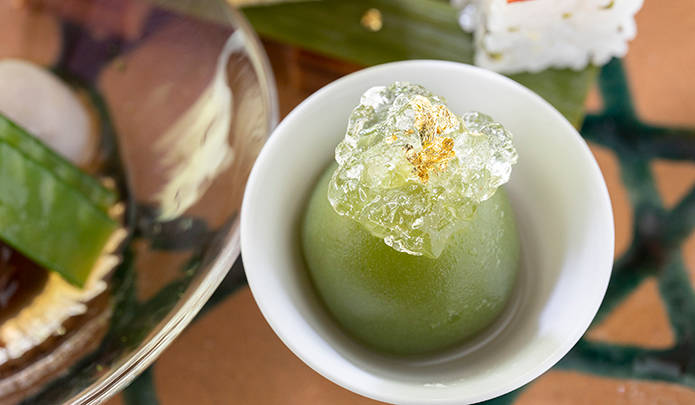
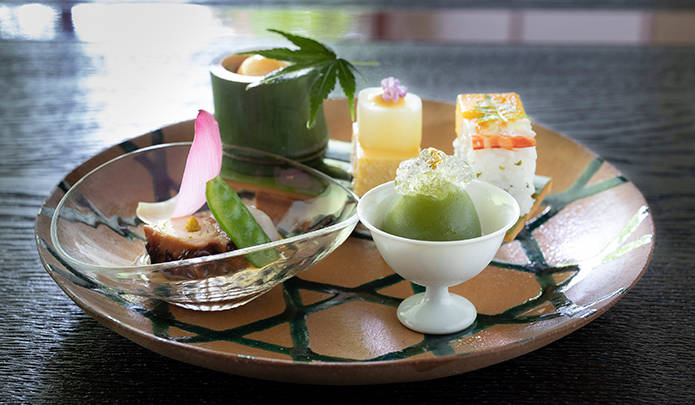
Hassun: Delicacies of a Cool Moon (Somen noodles with fish, simmered octopus, boiled Ishikawa taro, simmered green plums in syrup, pressed sushi, pike conger roe tofu).
The hassun, served on a yakishime (fired stoneware) piece by Shigenari Noguchi, whom Chef Kubota admires, each boasts outstanding individuality. Among them are "Simmered Green Plums in Syrup," meticulously pricked and simmered in a copper pot until the syrup penetrates to the core, made from green plums from Kensaki, Fukui Prefecture; "Simmered Octopus," colored with adzuki beans, then simmered in red rice sake after resting, from Akashi; and "Pike Conger Roe Tofu," made from the roe of pike conger nearing its spawning season. While it's difficult to decide where to begin, Chef Kubota recommends, "It's best to eat the simmered green plums in syrup while the saltiness from the sakizuke still lingers in your mouth. Please savor the flavors of Wakasa here in Kyoto."
Of course, I will!
Of course, I will!
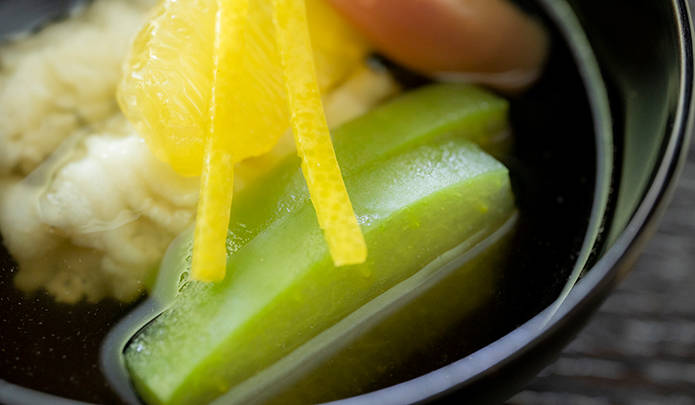
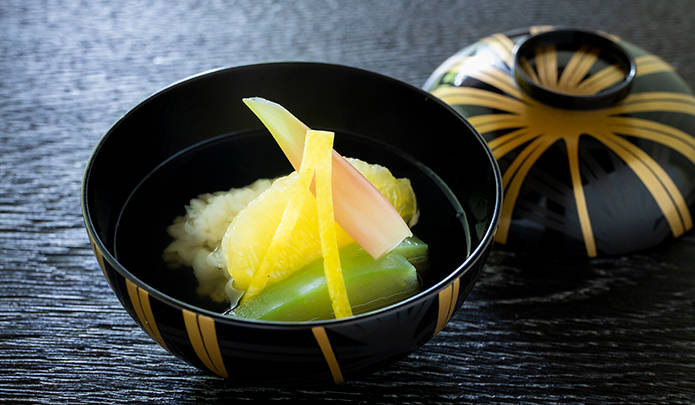
Suimono: Yoshino-style Pike Conger, Jade Winter Melon.
The suimono is "Yoshino-style Pike Conger, Jade Winter Melon." While green yuzu is often used as a summer aromatic for this dish, "I've used green yuzu in the hassun this time, and the aroma of yuzu is a bit too strong for pike conger, so I've used Kawachi Bankan, which is said to be a Japanese grapefruit," explains Chef Kubota. "The refreshing citrus flavor enhances the plum paste, which replaces the usual accompaniment, and complements the pike conger."
"It's also important for the dish and the tableware to converse," says Kubota, who has an exceptional commitment to his tableware. For example, the dish used for the 'strong course' (which on this day was 'Grilled Beef Fillet with Simmered Seasonal Vegetables') is an original creation for Hoshinoya Kyoto. He consulted with the artisan to create a dish with separate compartments for the meat and vegetables, allowing each to fully express its individual character.
"It's also important for the dish and the tableware to converse," says Kubota, who has an exceptional commitment to his tableware. For example, the dish used for the 'strong course' (which on this day was 'Grilled Beef Fillet with Simmered Seasonal Vegetables') is an original creation for Hoshinoya Kyoto. He consulted with the artisan to create a dish with separate compartments for the meat and vegetables, allowing each to fully express its individual character.
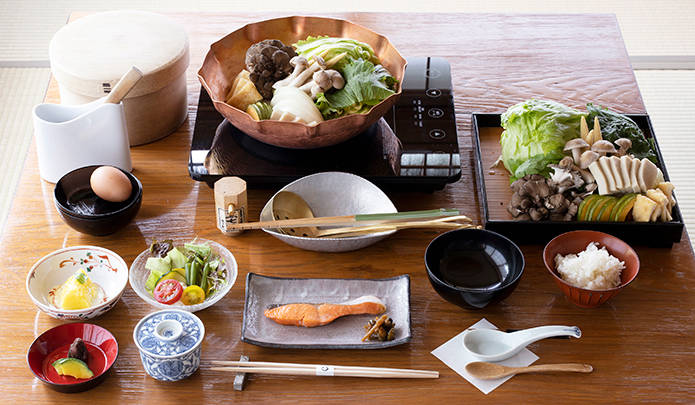
In-room breakfast.
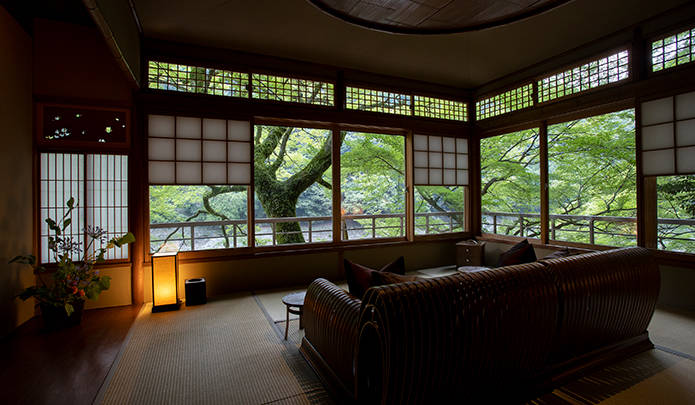
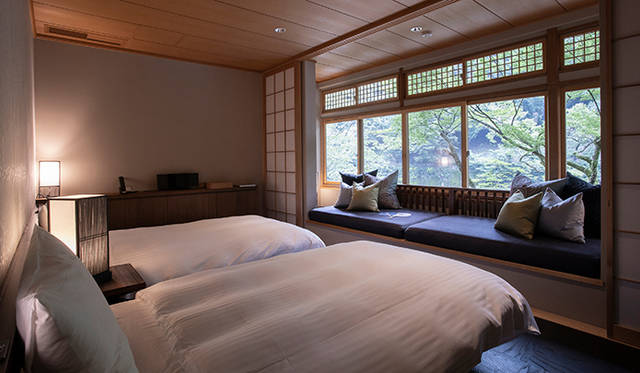
The living space in the "Tsukihashi" room. Breakfast is served in these spaces within each room.
That's right. While dinner at Hoshinoya Kyoto is served in a detached dining room, breakfast is primarily served in your room. This thoughtful consideration allows guests to fully enjoy their breakfast while taking in the unique scenery, as all 25 rooms offer river views. The main dish, a hearty hot pot brimming with vegetables, is also delightfully Kyoto-esque. For the final touch, enjoy the porridge, which has absorbed plenty of broth, with the black shichimi pepper from Ryōkaku, a proud Kyoto condiment. After your meal, recline on Hoshinoya's original "tatami sofa," designed so that the window view is at eye level when seated, and relax while gazing at a landscape worthy of a masterpiece. During cherry blossom and autumn foliage seasons, the view is a riot of color, but even in summer, with the dense deep green pressing in, the scenery is magnificent. Pure bliss.
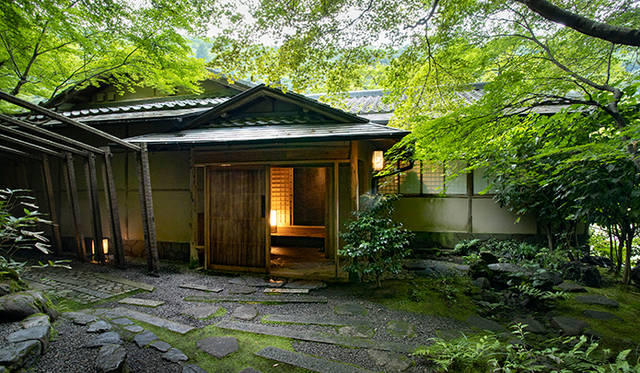
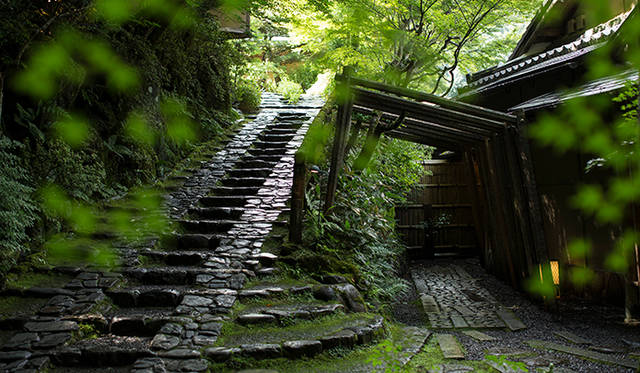
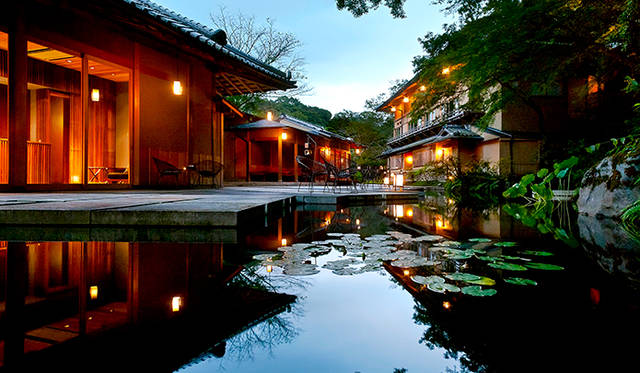
Left: Many rooms are in detached structures. Right: Approach to the garden.
Arashiyama, Kyoto, has been a favored retreat for aristocrats since the Heian period. About 15 minutes by small boat upstream along the Oi River, gazing at the majestic Arashiyama gorge, from the banks of the Togetsukyo Bridge, the area's focal point. This summer marks the ninth year since Hoshinoya Kyoto was established, renovated from a long-established inn founded during the Meiji era. After nearly a decade, the trees newly planted at the time of opening have grown, forming an arch that now covers the path.
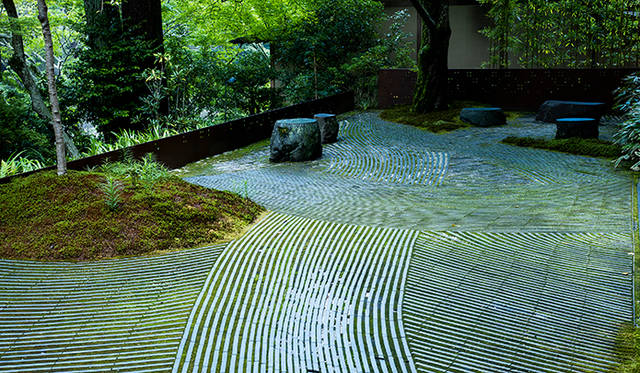
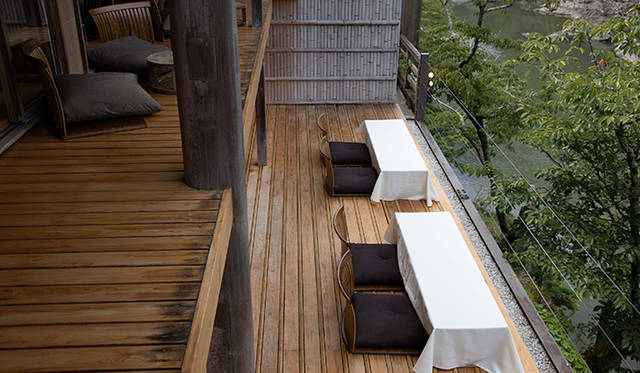
Left: The inner garden. Right: The aerial tea house.
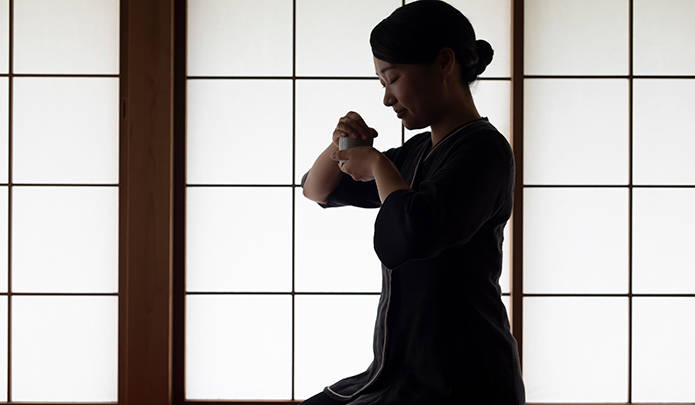
The "Monko" (incense ceremony) held in the morning.
Experience Kyoto's nature and the culture that thrives within it at your own pace at this "waterside private residence." In the "Inner Garden," themed around a dry landscape garden, "Waterside Deep Breathing" is held every morning for guests. The "Aerial Tea House," cantilevered over the Oi River, is a veritable paradise (laughs). Could I take this space home with me? We also offer activities where you can experience "Monko" (incense ceremony), a traditional Kyoto culture dating back to the Muromachi period. Even samurai warriors of old enjoyed it during breaks in battle for relaxation. In the "Water Garden," which recreates the twin waterfalls built in the previous era, you can meditate amidst the sounds of nature and the distant train. Let us enjoy refined culture amidst magnificent nature!
On the boat back to the real world of Togetsukyo Bridge, I was already contemplating future plans, wondering when I could return to fully savor Kyoto's delicious seasons.
"In August and September, returning bonito and rockfish are excellent. We're planning octopus rice in September. October is the season for long eggplants. Autumn mackerel and saury are also good."
Chef Kubota's words echoed in my mind. Oh, I want to try them all! And perhaps, one day, I'd even love to taste the Thai cuisine he makes on his days off.
To travel to Kyoto in anticipation of enjoying a trusted chef's seasonal dishes—if one can indulge in such pleasure, then growing older isn't so bad after all.
On the boat back to the real world of Togetsukyo Bridge, I was already contemplating future plans, wondering when I could return to fully savor Kyoto's delicious seasons.
"In August and September, returning bonito and rockfish are excellent. We're planning octopus rice in September. October is the season for long eggplants. Autumn mackerel and saury are also good."
Chef Kubota's words echoed in my mind. Oh, I want to try them all! And perhaps, one day, I'd even love to taste the Thai cuisine he makes on his days off.
To travel to Kyoto in anticipation of enjoying a trusted chef's seasonal dishes—if one can indulge in such pleasure, then growing older isn't so bad after all.
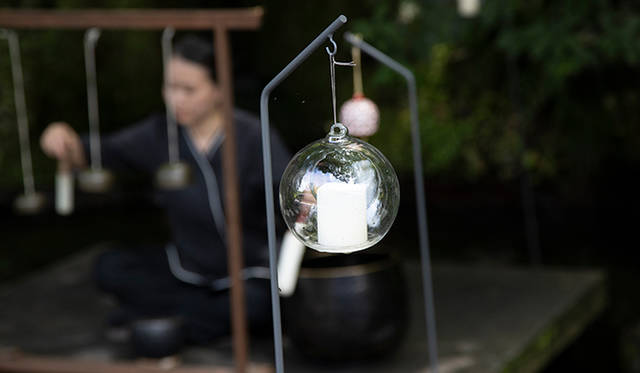
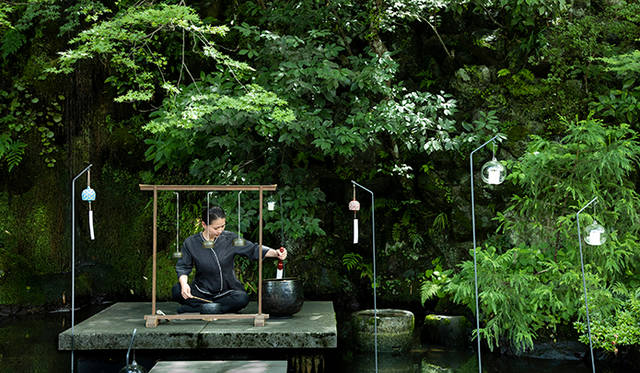
Bell performance at the "Water Garden" to welcome guests.
Hoshinoya Kyoto
Location: 11-2 Motorokuzan-cho, Arashiyama, Nishikyo-ku, Kyoto, 616-8394, Japan
Access: 10-minute walk from Hankyu Arashiyama Station, approx. 30 minutes by car from Kyoto Minami IC
Number of Rooms: 25
Rates: From ¥106,000 per room per night (excluding meals, tax, and 10% service charge)
*Ingredients may vary depending on availability.
Location: 11-2 Motorokuzan-cho, Arashiyama, Nishikyo-ku, Kyoto, 616-8394, Japan
Access: 10-minute walk from Hankyu Arashiyama Station, approx. 30 minutes by car from Kyoto Minami IC
Number of Rooms: 25
Rates: From ¥106,000 per room per night (excluding meals, tax, and 10% service charge)
*Ingredients may vary depending on availability.
Inquiries
Hoshinoya Kyoto
Tel. 0570-073-066 (Hoshino Resorts Central Reservation)
https://hoshinoya.com/