To Meet This Dish, We Journey to HOSHINOYA Tokyo (Part 1)
Finally, the day has arrived to savor the cuisine of Chef Noriyuki Hamada at HOSHINOYA Tokyo. Chef Hamada is undeniably a star chef representing our nation, having achieved the first-ever 3rd place overall in the prestigious Bocuse d'Or competition and a world-first for his fish dish.
Photographs by OHTAKI Kaku|Text by HASEGAWA Aya|Edit by TSUCHIDA Takashi
My Rival: A Jomon Period Chef. His Words Left Me Speechless!
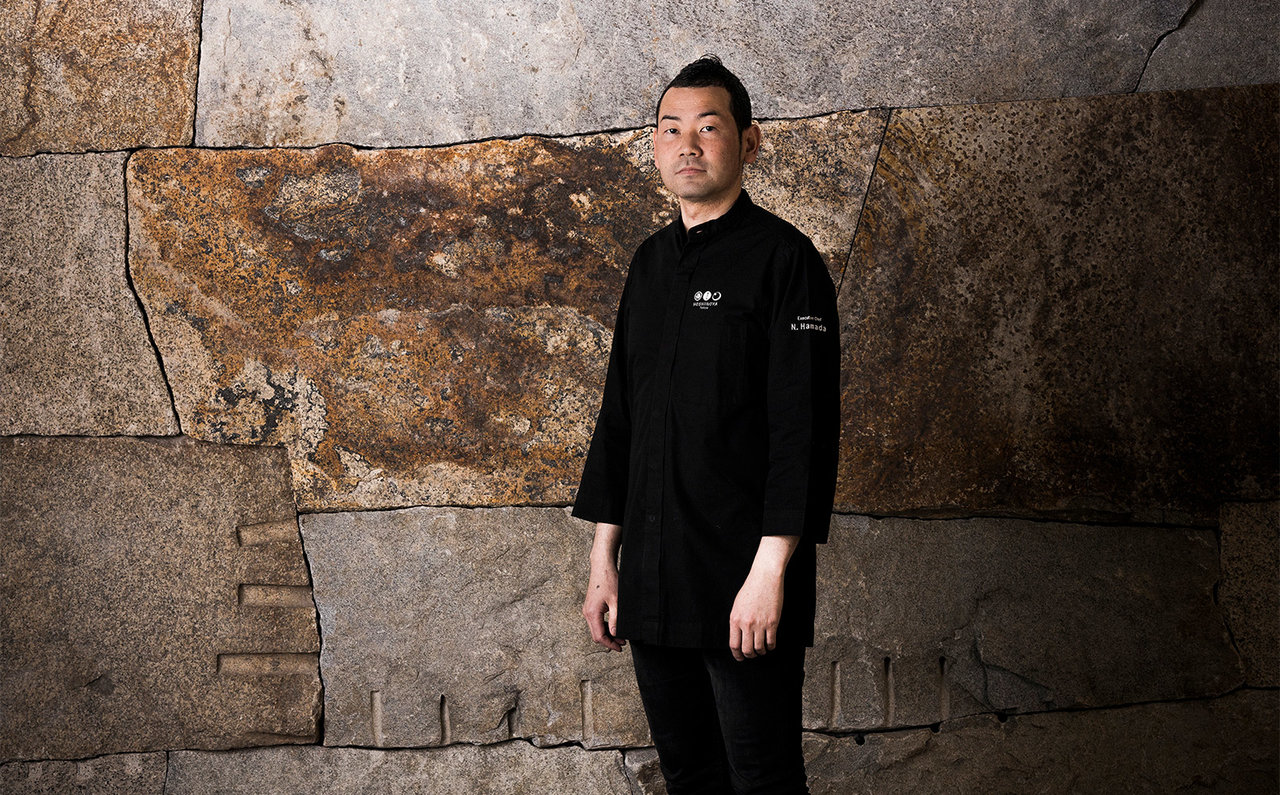
After achieving 3rd place in the Bocuse d'Or, Chef Hamada, as the executive chef of "Yukawatan," the main dining room at Hoshino Resorts' "Karuizawa Hotel Bleston Court" in Nagano, established a new style of French cuisine focusing on Shinshu ingredients such as river fish like carp and ayu, game meats like venison, and local vegetables. In July 2016, he took on the role of executive chef with the opening of "HOSHINOYA Tokyo." In the heart of Tokyo, within the Otemachi business district, he has pioneered a new culinary frontier under the theme of "Nippon Cuisine."
HOSHINOYA Tokyo Executive Chef Noriyuki Hamada
Chef Hamada says he cherishes the words of German architect Mies van der Rohe, "Less is more." "I believe that when working with limited conditions, creativity flourishes. The cuisine at 'Yukawatan' was born from the idea of using Nagano's local ingredients."
Chef Hamada believes that by confronting limited ingredients with utmost dedication, one can approach the essence of things, much like in competitions where dishes are judged based on a set of ingredients.
"The restrictions push me to think deeply about how to best utilize the ingredients. Through deep contemplation, the cuisine evolves."
Considering Tokyo as a "representative city of Japan as seen by the world," Chef Hamada decided to focus on Japanese fish, which are unique to an "island nation" with a "special environment," as the culinary theme for "HOSHINOYA Tokyo." One of his suppliers is "Sasue Maeda Fish Shop" in Yaizu.
"Mr. Naoki Maeda understands the ecosystem of fish and knows how I intend to use them in my dishes. I place my complete trust in him."
Using these carefully selected ingredients, Chef Hamada creates dishes that bring out their best, employing not only his signature French techniques but also a variety of other cooking methods. This is the "Nippon Cuisine" he has arrived at. At "HOSHINOYA Tokyo," the dining experience is a single omakase course (reservations required, ¥18,000, excluding tax, service charge, and accommodation). "I want guests to feel a sense of wonder as they dine," he says, with each course menu featuring a single kanji character symbolizing the ingredient and the dish.
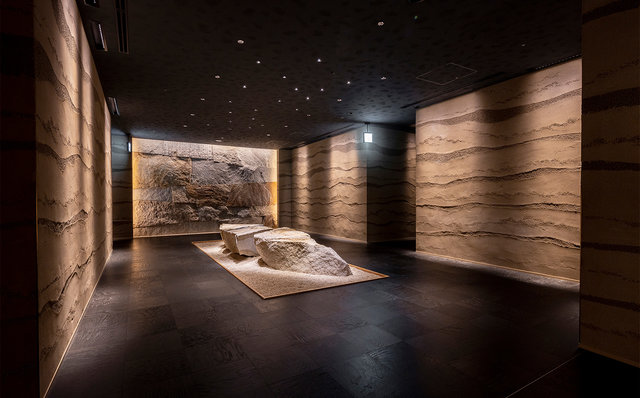
The giant rock at the center of the dining room entrance was chosen by Rie Azuma, the architect who designed "HOSHINOYA Tokyo."
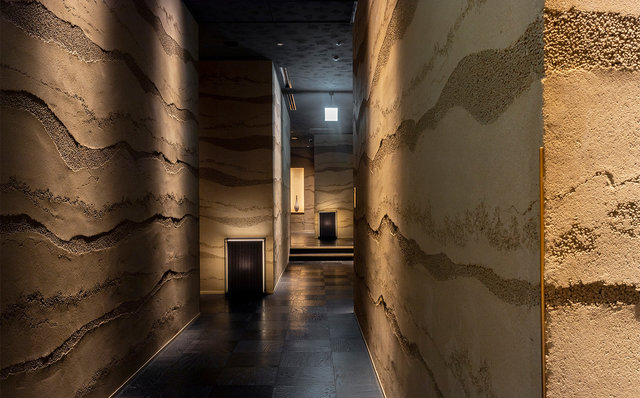
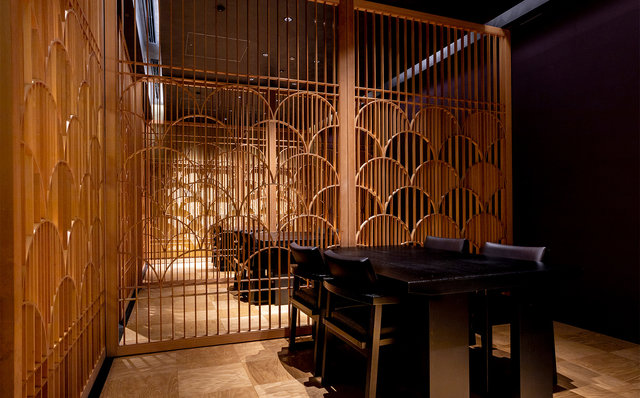
"Nippon Cuisine" is served in the dining room on the basement floor of "HOSHINOYA Tokyo." The space, designed to evoke strata, features an approach through cave-like corridors, creating an exciting sensation akin to infiltrating a secret base at the bottom of the sea!
The tables are located in spaces loosely partitioned by lattice, as well as in several private rooms. By deliberately placing the dining room in the basement, the establishment emphasizes its commitment to showcasing the food itself, rather than relying on scenic views.
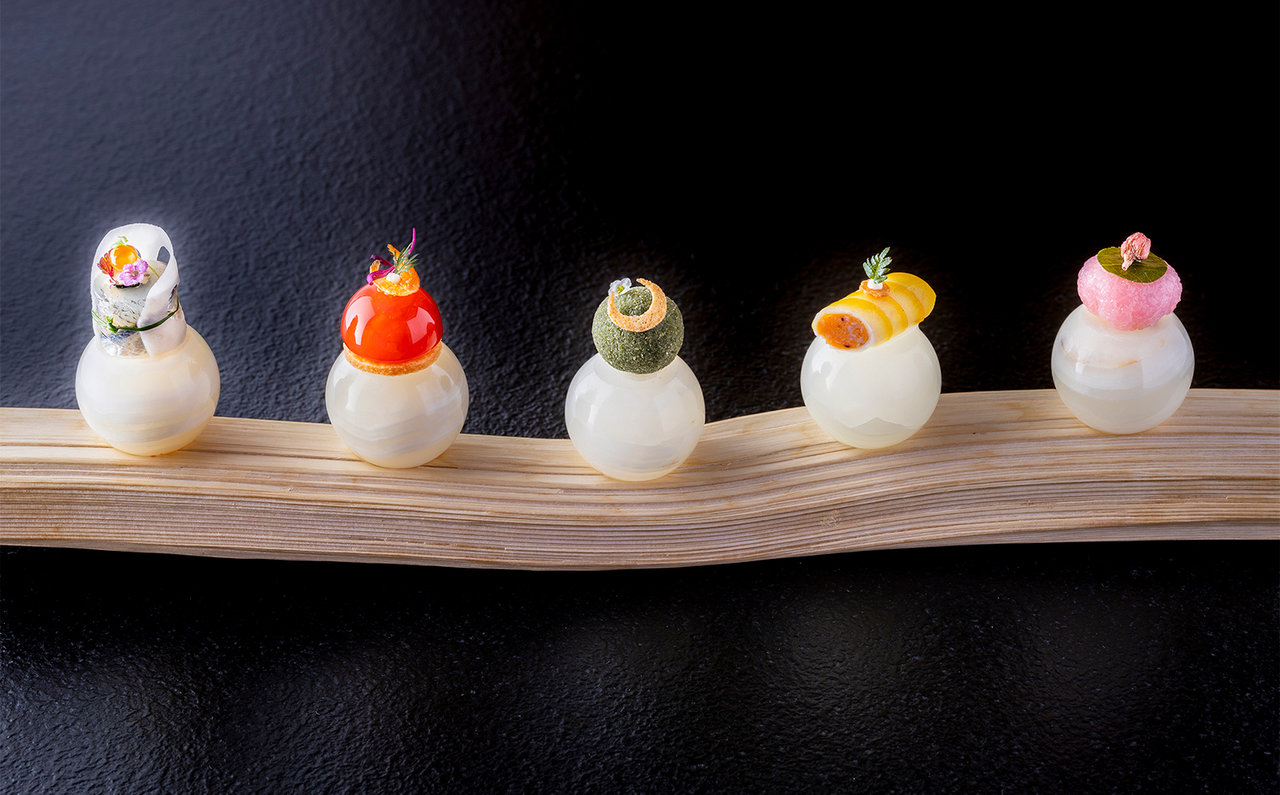
The meal began with a surprise not listed on the menu: a tuile (a thin, crisp wafer) made with bamboo charcoal and powdered fish bones. This was followed by "Shio (Salt) - Hamaguri," a harmonious combination of aonori seaweed and clams that evoked the minerals of the sea. Then came the much-talked-about (among food writers, it's a hot topic) "Ishi (Stone) - Itsutsu no Ishi." This is Chef Hamada's signature dish, featuring bite-sized appetizers arranged on a round marble stone. Many of you may have seen or heard about it through various media outlets.
"Ishi - Itsutsu no Ishi"
"Ishi - Itsutsu no Ishi" is composed of five fundamental Japanese tastes: sour, salty, bitter, spicy, and sweet. On the marble slab, Chef Hamada's creations gleam like jewels. This dish is meant to be eaten in one bite, including the stone base, and the subtle variation in the stone's temperature for each dish is astonishing. Particularly memorable was the "Sakura Ebi no Soup" (second from left), representing saltiness. The flavorful soup, encased in a crispy cheese sablé, burst in the mouth. The "Sakura Mochi" (sweetness, first from right) uses simmered sakura shrimp, offering a taste of the Japanese sea.
The "Sen (Freshness) - Yokowa," featuring young bluefin tuna served with a sabayon sauce made from vegetable broth and a hint of mustard, was a dish bursting with spring. The tender yokowa with its light fat content paired beautifully with the spring vegetables. "Yū (Melt) - Hotaruika" was a "Boudin Noir"-style dish using firefly squid. The sauce, a blend of firefly squid liver and sansho sprouts, was so exquisite I could have eaten it endlessly. It possessed a vibrancy reminiscent of an Impressionist landscape painting. ...It's making me crave sake.
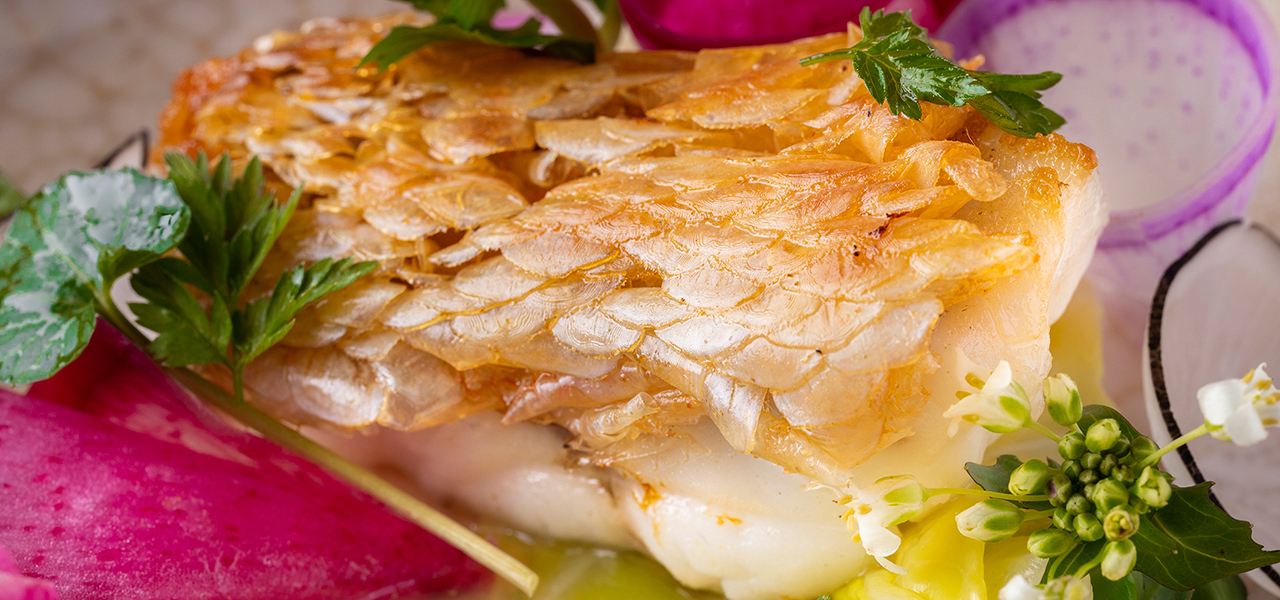
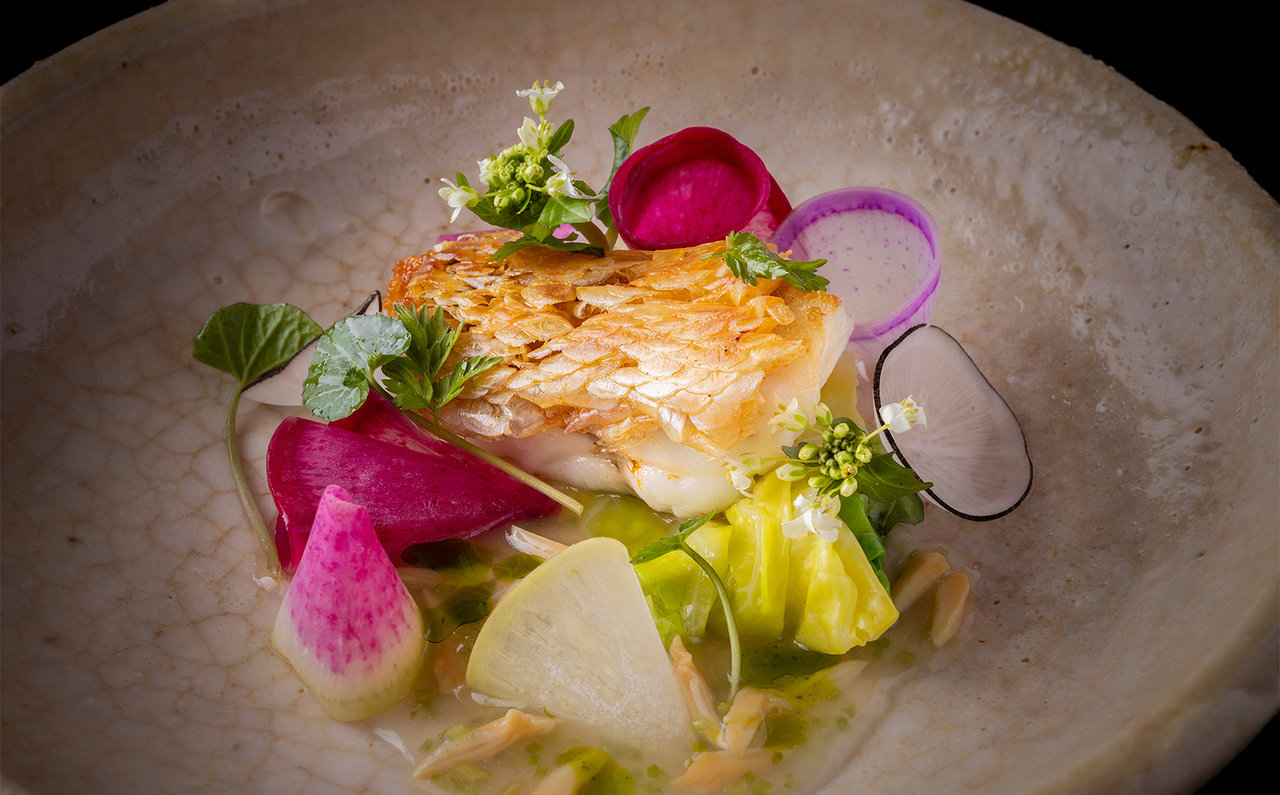
"Jū (Tender) - Amadai"
The "Jū (Tender) - Amadai" features tilefish grilled with its scales until crispy. "I want guests to enjoy the crispiness of the scales," says Chef Hamada. Beneath the tilefish are spring cabbage and spicy red-heart radish, creating a perfect balance of spice and sweetness. The coq au vin sauce, made with clam feet and mitsuba, further enhances the appetite. Honestly, were scales always this delicious? This dish, with its floral appearance and abundant spring vegetables, allows you to experience spring with all five senses.
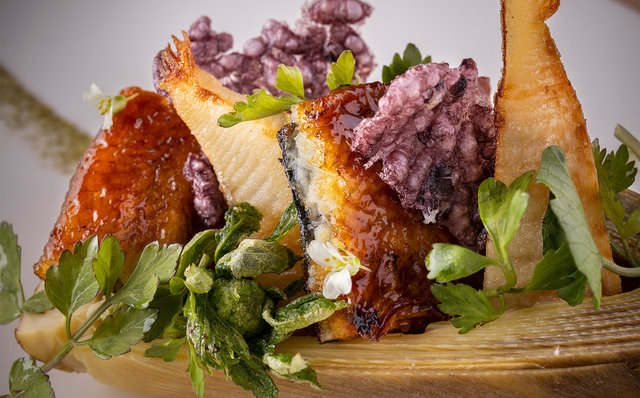
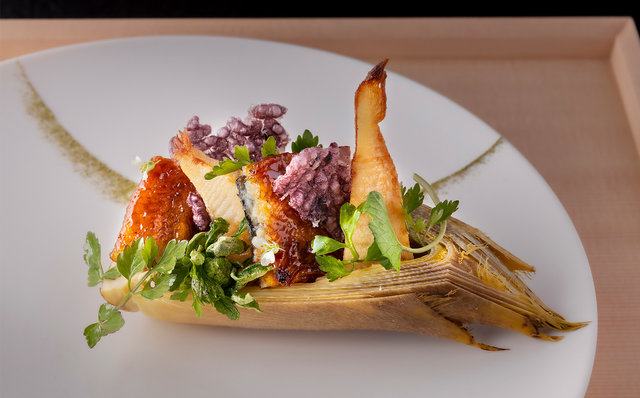
"Wa (Japanese) - Unagi and Takenoko"
"Wa (Japanese) - Unagi and Takenoko"
"Wa (Japanese) - Unagi and Takenoko"
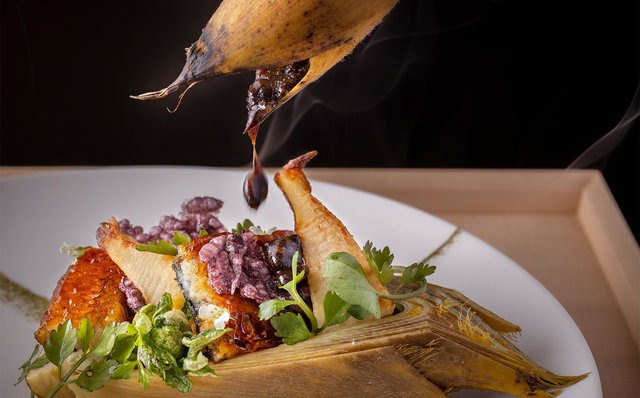
The main fish dish is "Wa (Japanese) - Unagi and Takenoko." The presentation is quite striking. When you open the white wooden tiered box, steam rises, like opening a treasure chest. Apparently, this unique container (an original, of course!) was used by Chef Hamada when he won the fish category at the Bocuse d'Or. It's not just for impact; it also serves to keep the food warm. Truly excellent.
The dish itself features eel with a crispy skin, bamboo shoots, and black rice okowa, all finished with a Périgueux sauce made with shiitake mushrooms, employing French culinary techniques. The serving staff explained, "This dish highlights bamboo shoots." The bamboo shoots, celebrating the sweetness of spring, are enveloped in a French-style sauce, making them even more alluring and sensual. The Japanese parsley, which tightens the rich aroma and caramelized sweetness of the eel while adding freshness, also plays a crucial role.
You can fully enjoy spring with all five senses.
At this point, a staff member made a suggestion: "Would you like to try a little of the sake that is part of the sake pairing?" "Yes, please!" The sake served was "Gikyō Junmai Genshu 50%." The rich Périgueux sauce, made by simmering beef broth with Madeira wine, was in no way overpowered by the robust flavor of Gikyō.
Finally, rice was served to conclude the meal. Another surprise not mentioned on the menu. The rice, a variety called Yukawamaru, was served with a poisson soup, made from the fish bones used in the day's dishes, seasoned with garam masala...
It was divine! The soup soaked into the rice, and the happiness just kept growing. Chef Hamada's cuisine is not only delicious and artistic but also filled with surprises, making it an experiential entertainment. Every detail remains vividly in my memory.
"Nippon Cuisine is still in its early stages. I don't believe the current state is the final form. I hope it will continue to evolve, and in a few hundred years, become a culinary genre that surpasses sushi and sukiyaki as a full-course menu using Japanese ingredients."
Chef Hamada says his rival is a chef from the Jomon period. "I believe Jomon period ingredients are the roots of Japan's natural ingredients. I want to create cuisine that surpasses that of the Jomon people someday, or rather, I'd like to cook alongside them," he says, his eyes sparkling.
...His ambition is on another level. Later, speaking with a PR representative from "HOSHINOYA Tokyo," I learned that "conversations about food can sometimes extend to the universe." I'd love to hear about that too!
TRAVEL|HOSHINOYA Tokyo
To Meet This Dish, We Journey to HOSHINOYA Tokyo (Part 2)
Although I was completely captivated by the "Nippon Cuisine" (excuse me), I should also mention the overall concept of "HOSHINOYA Tokyo," which is a lodging facility occupying an entire building in the Otemachi business district. This was, after all, the Otemachi business district.
Many new hotels in urban centers typically occupy a portion of a large complex, but "HOSHINOYA Tokyo" occupies all floors of a building that is 2 basement levels and 17 above ground. Here, all the elements of a Japanese inn have been incorporated. The concept of "HOSHINOYA Tokyo" is "A Japanese Inn in a Tower."
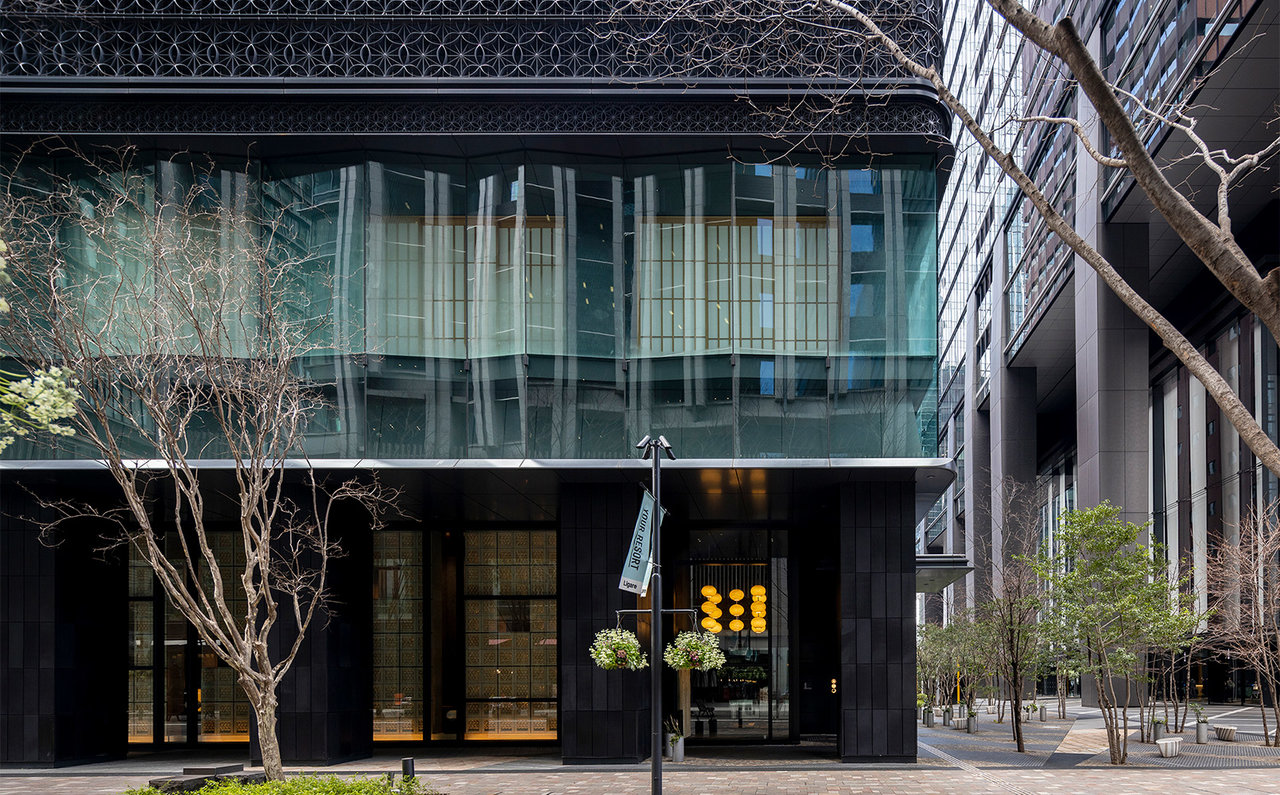
The exterior of "HOSHINOYA Tokyo" is a modern interpretation of traditional Japanese culture. As the sun sets, the Asanoha Kuzushi pattern adorning the building is projected onto the shoji screens, creating a picturesque scene.
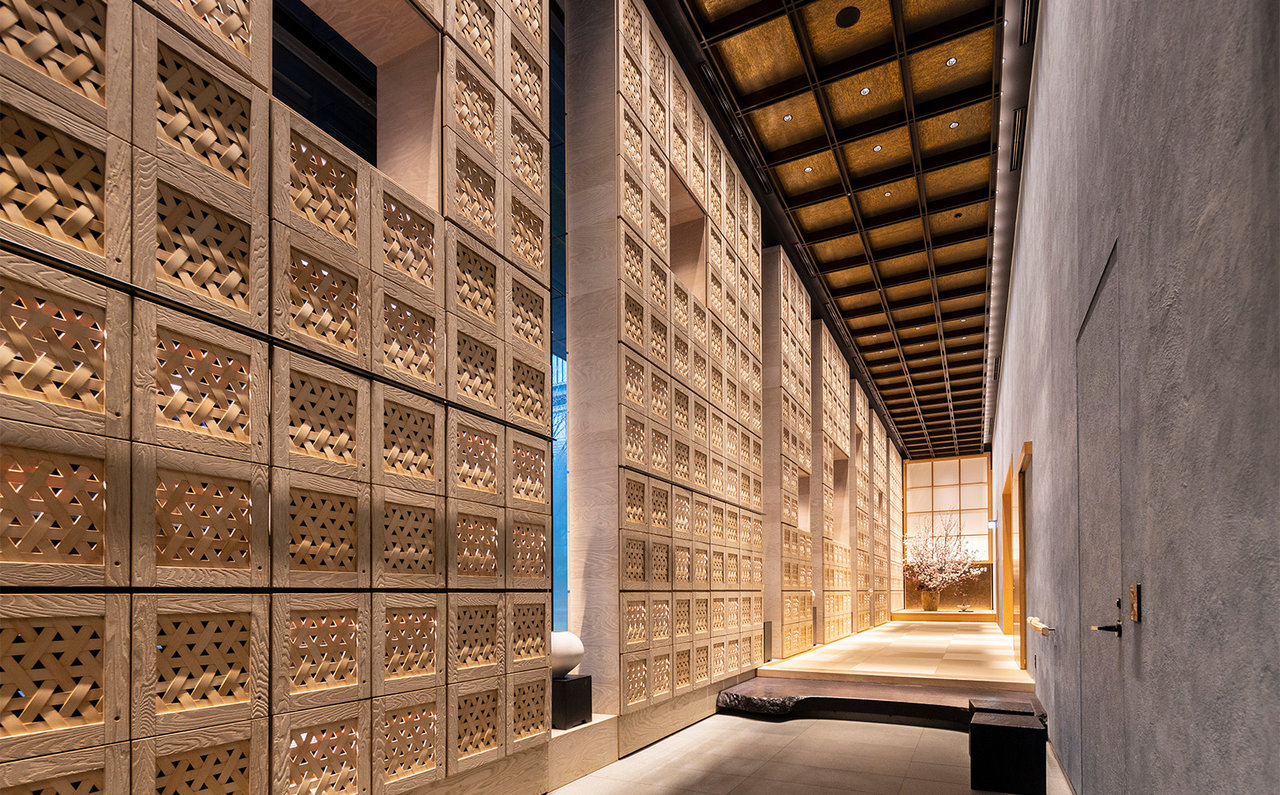
The entrance of "HOSHINOYA Tokyo." The walls, woven from bamboo, also serve as shoe storage for guests. Staff are always present at the entrance to assist guests.
After opening the single door made of Aomori cypress, we first remove our shoes at the entrance. While marveling at the bamboo craftsmanship shoe cabinets that reach the ceiling, a staff member explained, "We hope that the act of removing your shoes here will help you transition into a world beyond the ordinary."
The interior of the building is almost entirely tatami-matted, including the elevators. To allow guests to experience the feel of tatami, footwear is not provided. You even walk barefoot to the dining room, which is surprisingly comfortable.
We are soothed by the scent of "HOSHINOYA Tokyo's" original incense, based on sandalwood, as we head to the elevator. Did I hear something? No, it wasn't your imagination. When the elevator at "HOSHINOYA Tokyo" arrives at a floor, it chimes with the sound of "hyoshigi" (wooden clappers). Isn't that playful!
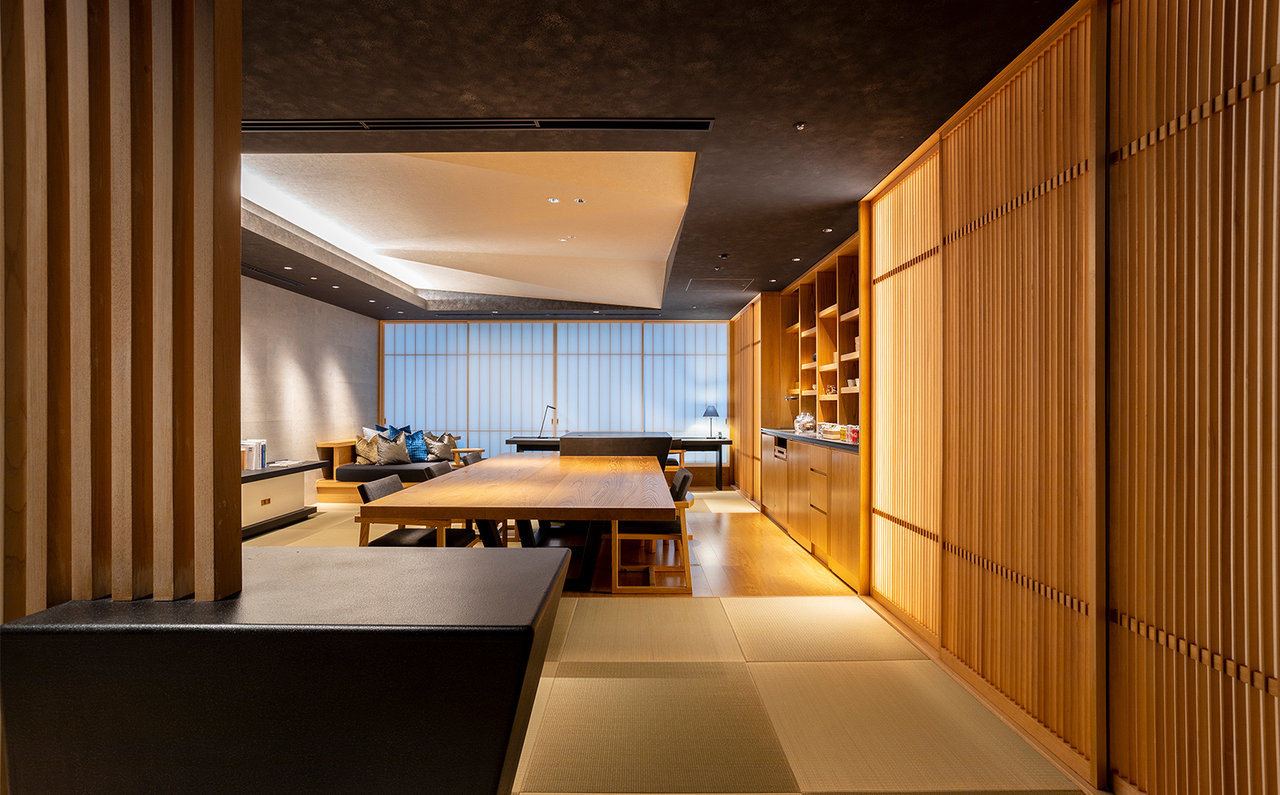
Ochaya Lounge
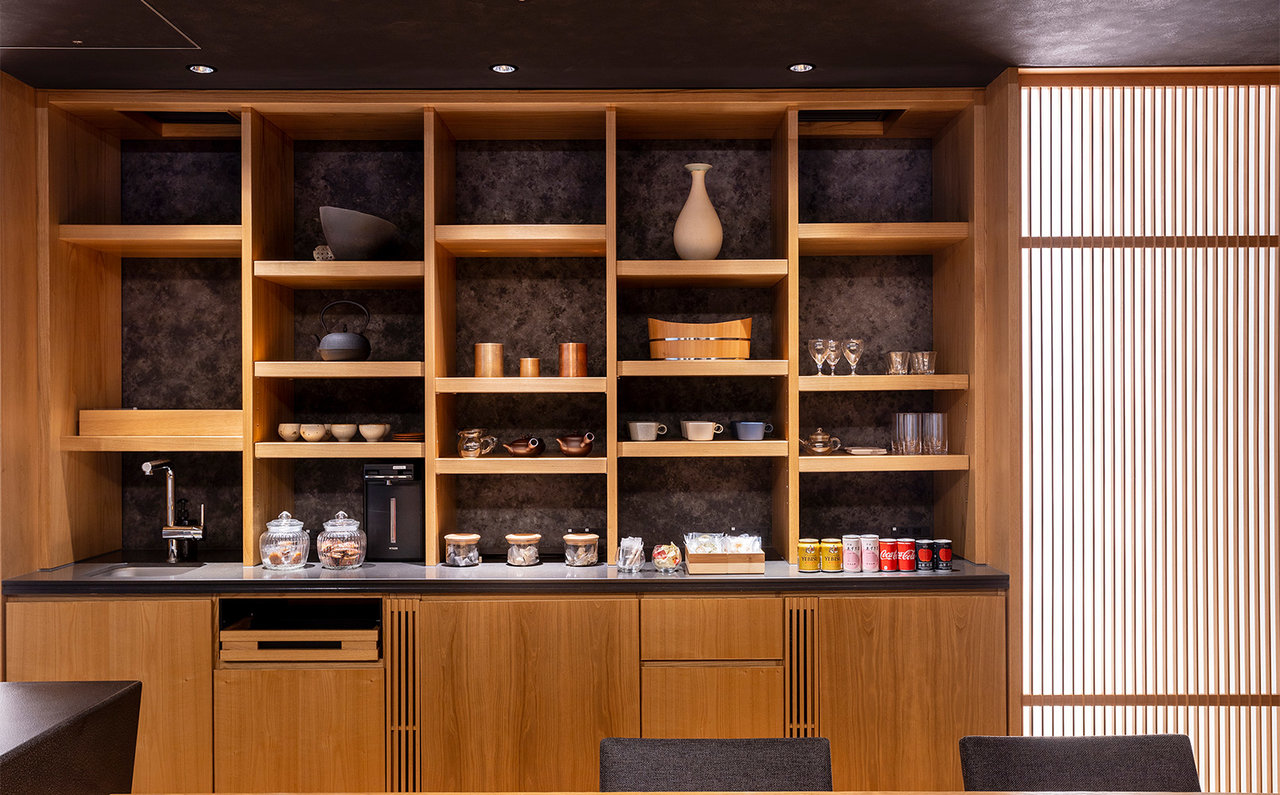
Check-in is not at the front desk, but at the "Ochaya Lounge" located on each guest room floor. This "Ochaya Lounge" is incredibly useful during your stay! It functions like a "club lounge" on each floor, accessible 24 hours a day. If the guest room is the "bedroom," this is the "shared living room." Since only guests staying on that floor (6 rooms per floor) use it, you'll only encounter familiar faces during your stay. Thus, you can relax here just as you would at home. Drinks, such as beer and "Toraya"'s azuki bean tea, along with seasonal sweets, are available and all are free-flowing.
And the service is impeccable. For example, late at night, mini noodle dishes are offered, and in the morning, you can enjoy onigiri and miso soup, satisfying any late-night or early-morning cravings with delicious treats. Personally, I was hooked on the "HOSHINOYA Tokyo" original version of "Senbei Brothers," a popular cracker brand. The combination of these crackers and beer is dangerously good!
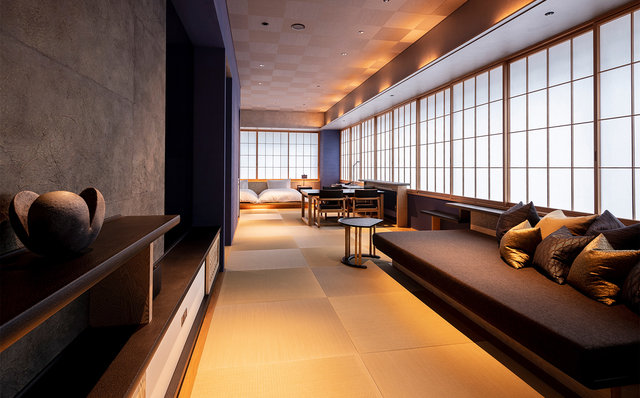
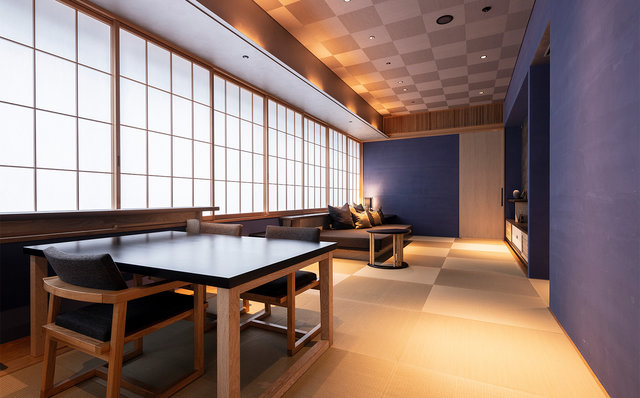
The "Kiku" room type, with a capacity of three people, is located in one room on each floor. It's surprisingly spacious for a ryokan in such a prime urban location!
The "Kiku" room type, with a capacity of three people, is located in one room on each floor. It's surprisingly spacious for a ryokan in such a prime urban location!
There are 84 rooms spread across 14 floors. All rooms are tatami-matted, featuring a blend of traditional Japanese architectural beauty with modern touches, such as shoji screens, closets made of bamboo and wood, and sofas.
Beyond the bathroom door, made of chestnut wood, you'll find a shower space and a deep bathtub, perfect for Japanese preferences. While it's blissful to stay in your room without stepping out, it's time to change into your room wear and venture outside before you get too settled. And the room wear is no compromise either. The loungewear, designed by kimono artist Jotaro Saito, is an original for "HOSHINOYA Tokyo." Made from easy-to-move-in fabric, the obi (sash) is designed to look stylish with a simple tie. Zori sandals are also available for rent on the first floor. Many guests even go for a stroll in them.
Otemachi Onsen
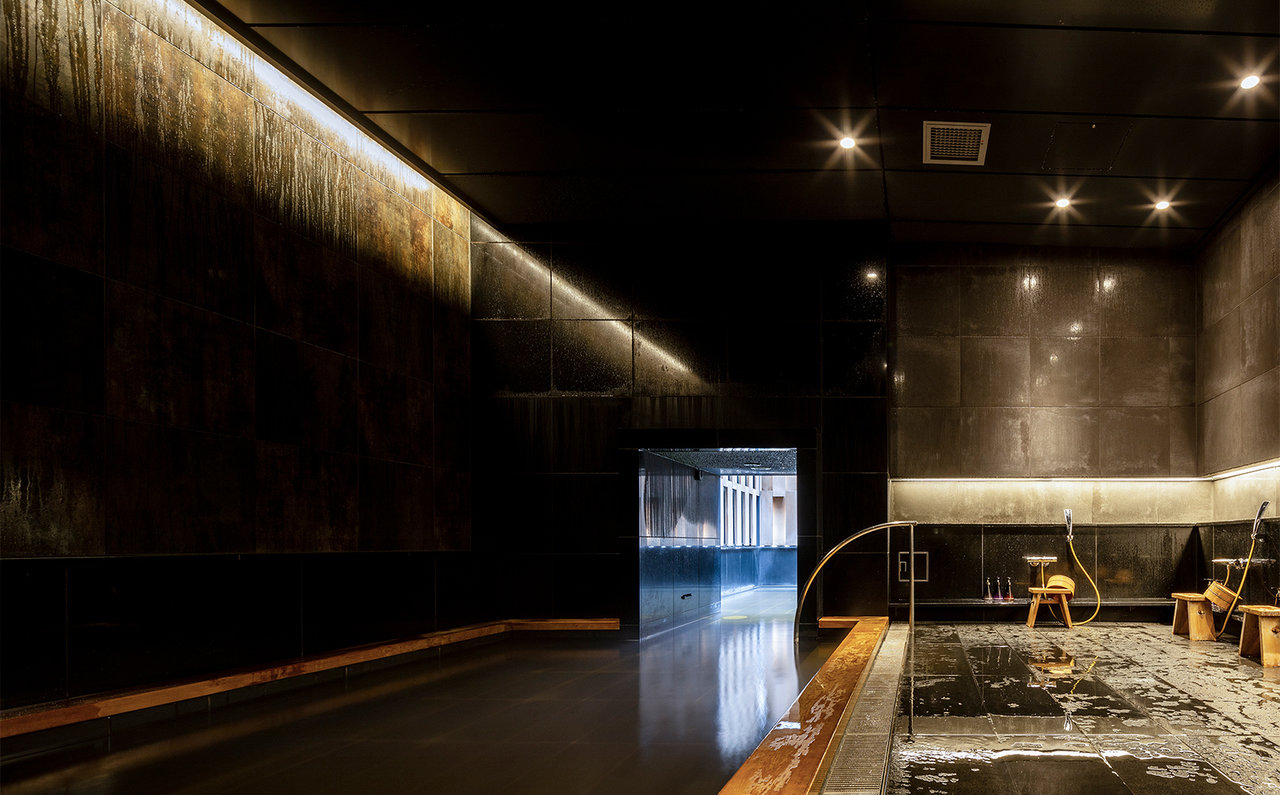
First, let's head to the "Otemachi Onsen" on the 17th floor, the top floor. That's right, "HOSHINOYA Tokyo" has a natural hot spring sourced from 1,500 meters below ground. Drilled in 2014, this highly saline hot spring boasts excellent heat-retaining properties. Perhaps influenced by the fact that this area was once the sea, you can feel the saltiness. The slightly brownish, silky water glows golden when bathed in sunlight at certain times of the day. And no, it's not because I'm tipsy! Looking up from the open-air bath, reached by walking through the indoor bath, you can see a square of the city sky peeking through beyond the high walls. This is also a splendid open-air bath. The outside air feels wonderfully refreshing.
The front desk and lobby are located on the second floor. Various events are held in the lobby and the tatami stage beyond, depending on the time of day.
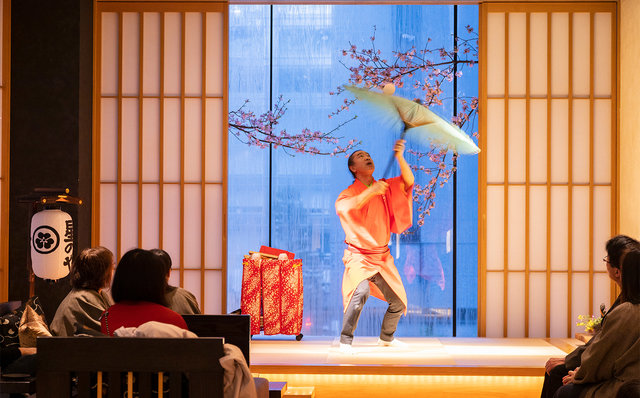
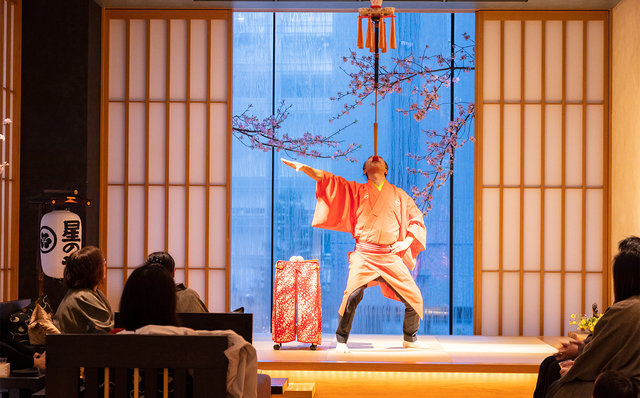
Edo Kagura
Edo Kagura
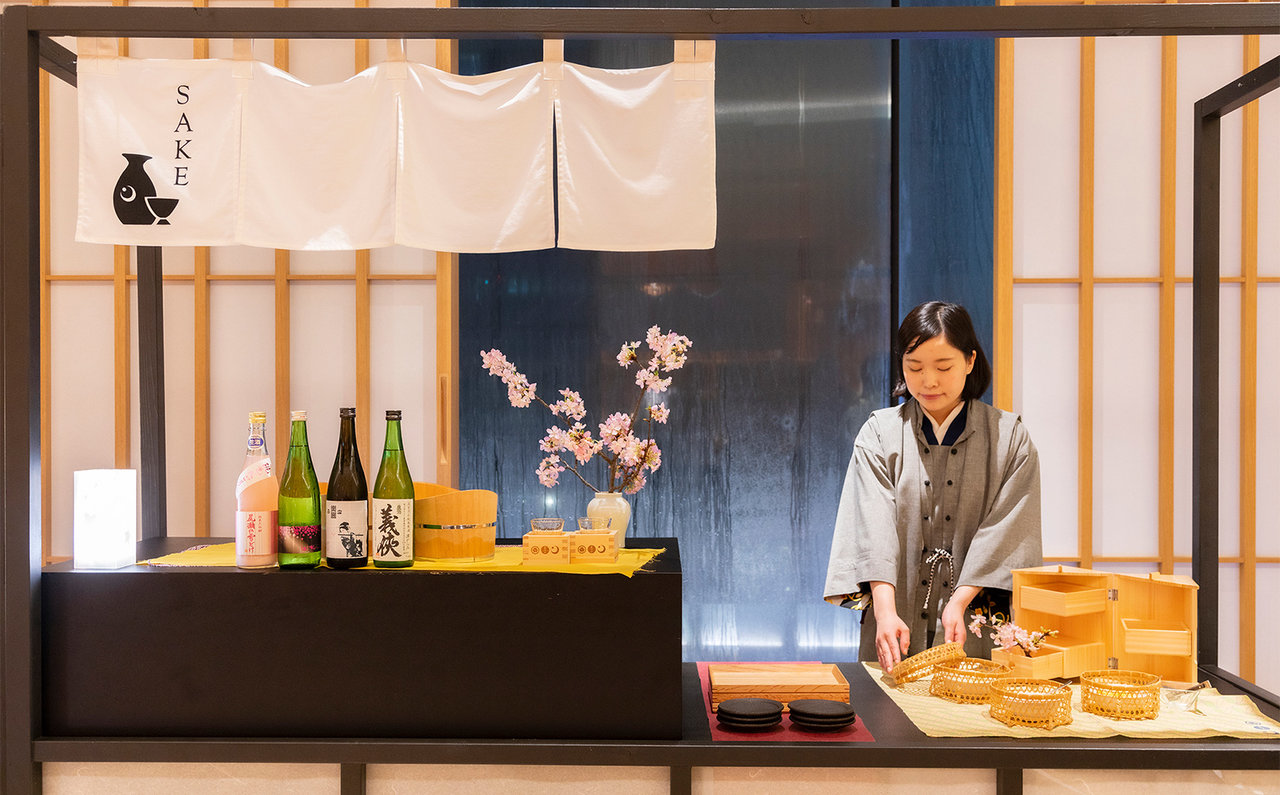
SAKE Lounge
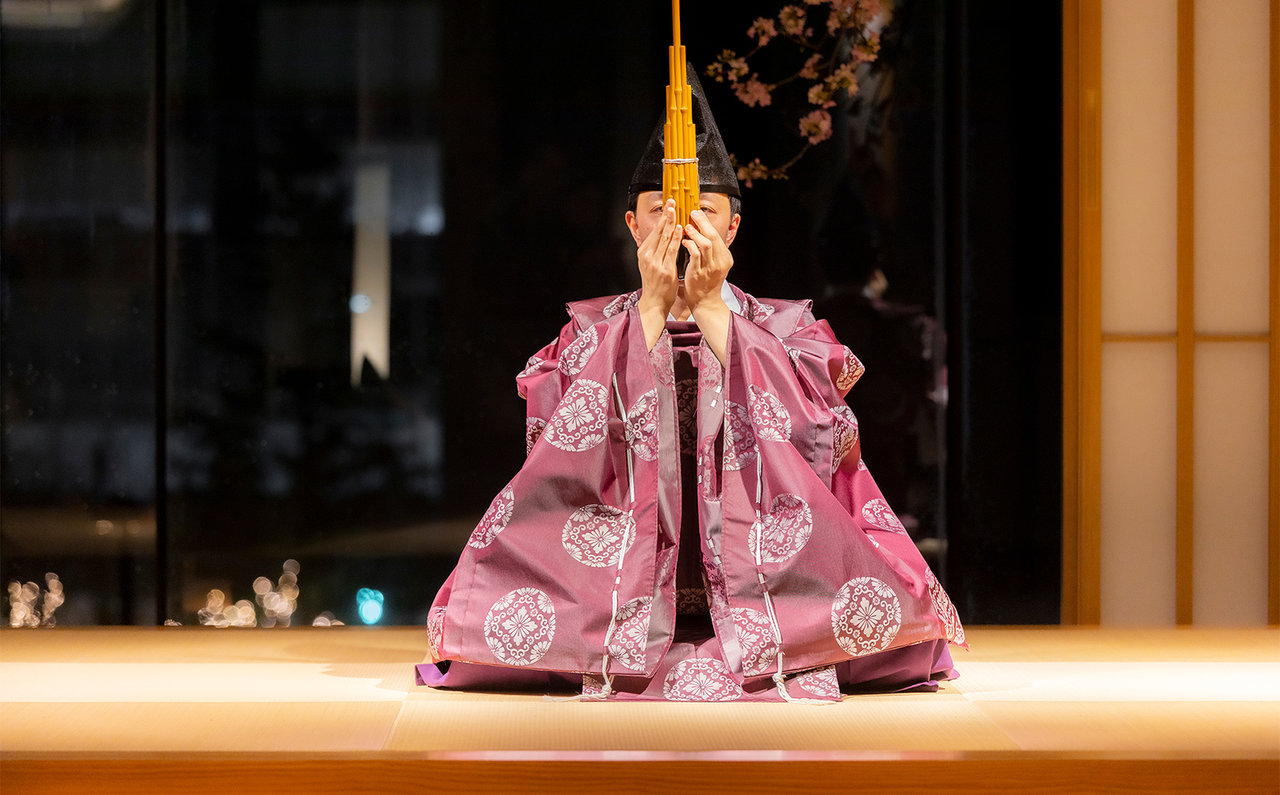
Gagaku
In the evening, there's "Edo Kagura," a traditional performing art. Alongside this, a "SAKE Lounge" appears in the lobby. You can enjoy a complimentary sake tasting with small appetizers. With a glass of sake in hand, why not try spinning an umbrella like a feudal lord? On weekend evenings, Gagaku (ancient Japanese court music) is also performed.
Feeling sleepy yet? Tonight's sleeping place looks like a futon, but it's actually a bed. As it's a Japanese inn, they apparently ordered mattresses with rounded corners and a lower profile. Regarding the sheets, a friend who had stayed here before gave me a rave review: "The sheets are amazing. Divine!" Apparently, the thread density is extremely high. I intended to confirm the texture for myself, but I lost consciousness all too quickly...
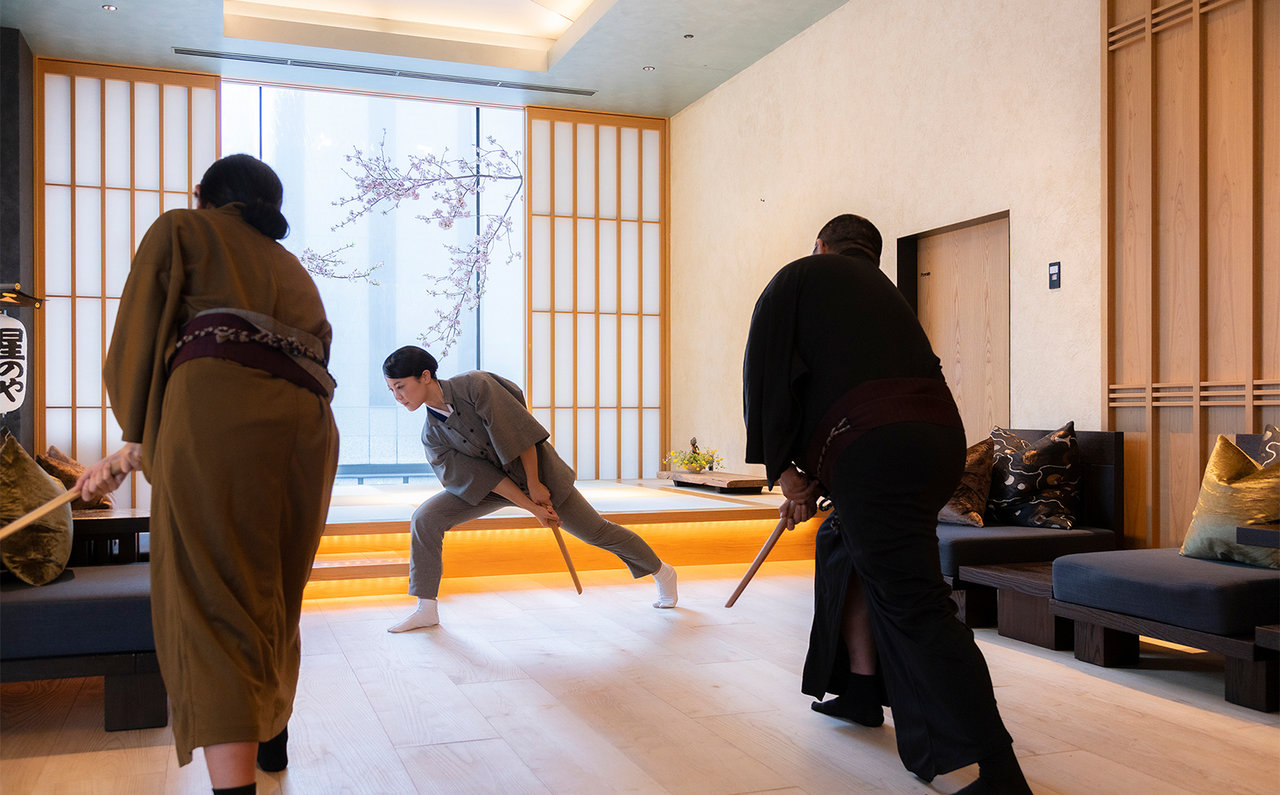
Morning Exercise
On a refreshing morning, you might want to experience the "Mezame no Asa Keiko" (Morning Awakening Exercise) (free). This is an original exercise that combines deep breathing with the movements of the Hokushin Itto-ryu style, one of the three major martial arts schools of the late Edo period, which Sakamoto Ryoma also studied. You'll awaken your body while holding a short wooden sword. It's quite invigorating!
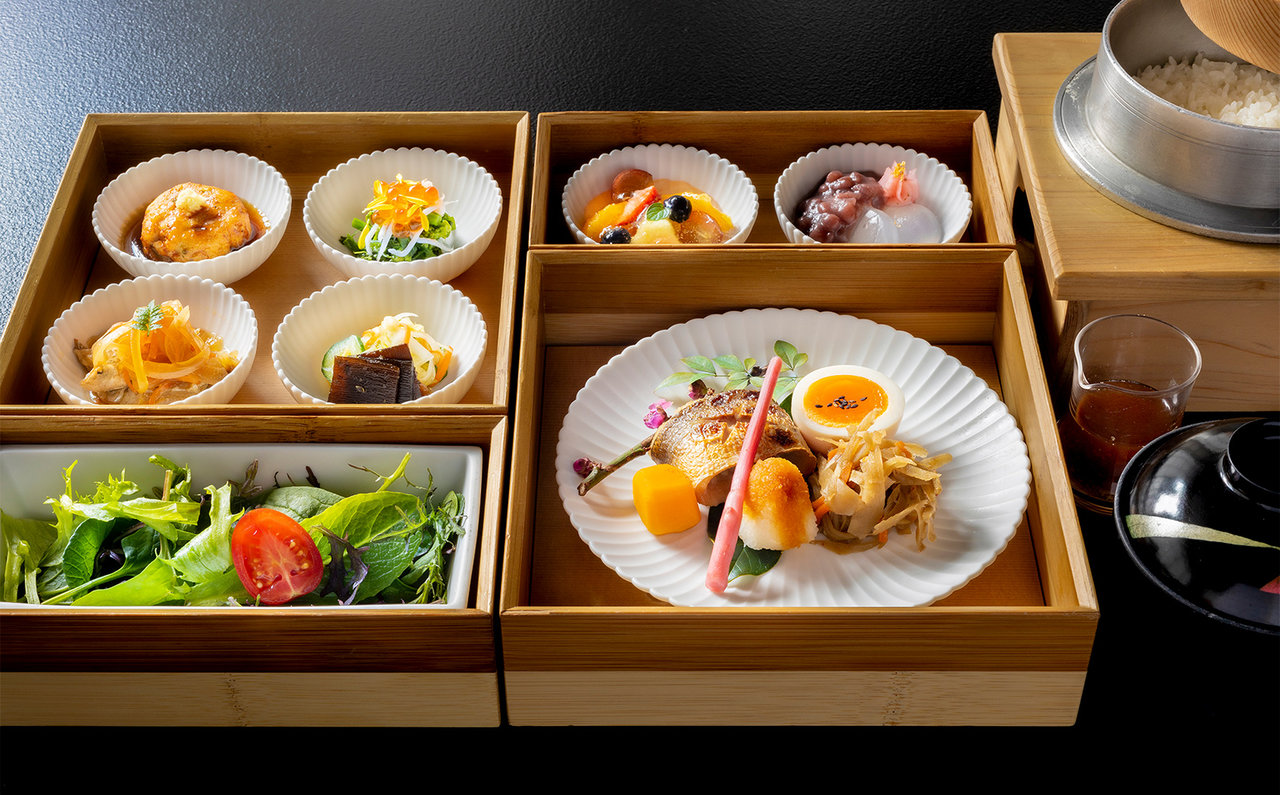
Japanese Breakfast
At "HOSHINOYA Tokyo," breakfast is served in your room. You can choose between "Japanese Breakfast" and "Western Breakfast." The "Western Breakfast" features an omelet with an original clam-based demi-glace sauce as the main dish. For the "Japanese Breakfast," rice is cooked in individual pots and served with a selection of various Japanese side dishes, carefully chosen for their compatibility with the rice. Opening the tiered lacquer boxes, reminiscent of a treasure chest, is a delightful moment. For those with lighter appetites, the "Ochaya Lounge" offers onigiri and miso soup.
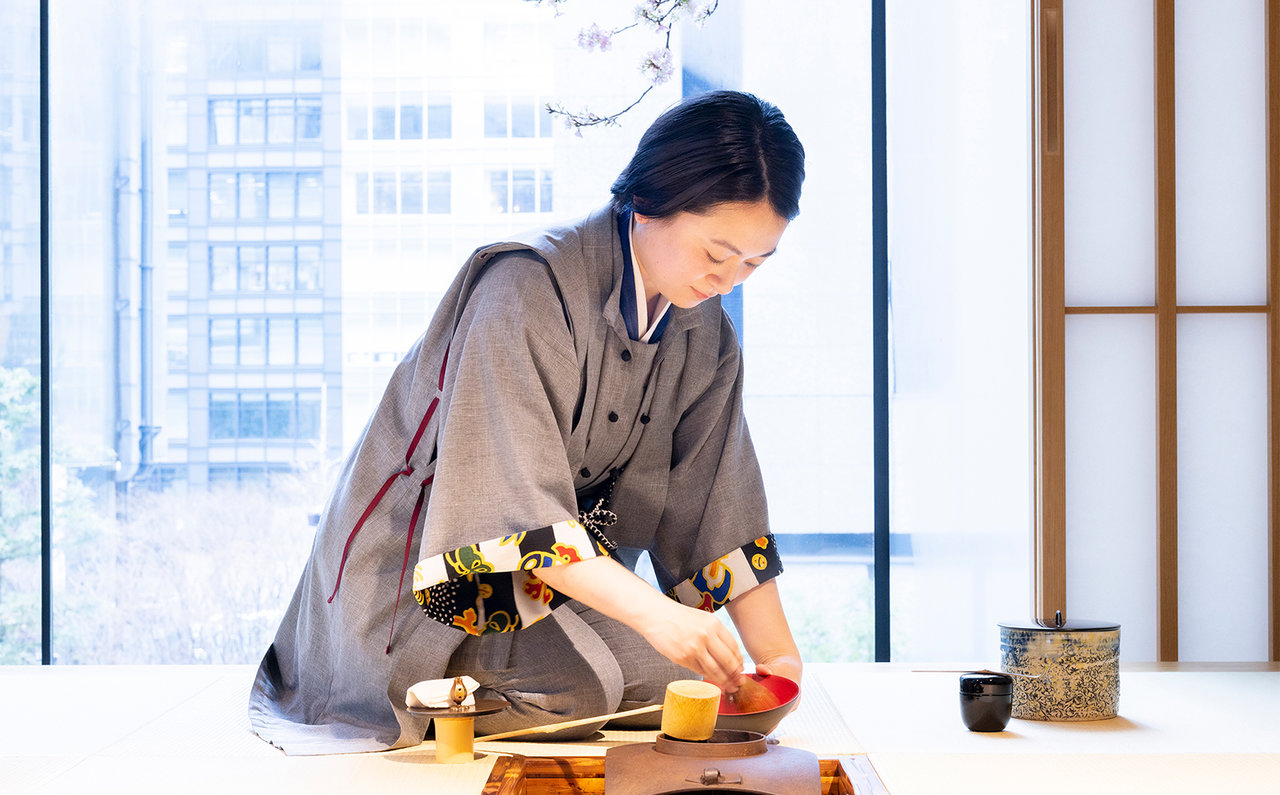
Tea Ceremony Experience
Every day from 10:00 AM to 10:30 AM, a tea ceremony experience (¥8,000 per person, excluding tax and service charge; reservations required; includes a souvenir original tea bowl and whisk) is held in the "Tatami Room." The ability to experience a tea ceremony within the hotel is characteristic of "HOSHINOYA Tokyo," which aims to convey Edo culture to the world. First, you'll slurp the tea expertly prepared by the instructor (slurping is the proper etiquette). Afterward, you can try preparing your own tea.
Now, let's take another bath. After enjoying one last moment of relaxation, it's time to check out.
The moment I left "HOSHINOYA Tokyo," I realized what a happy and dreamlike time the day had been. And I smiled, pleased to know that in the heart of Otemachi, amidst the towering skyscrapers, existed a "paradise" that seemed to transcend time and space.
HOSHINOYA Tokyo Address: 1-9-1 Otemachi, Chiyoda-ku, Tokyo Number of Rooms: 84 rooms Public Facilities: Hot spring, dining, spa, auditorium Check-in / Check-out: 15:00 / 12:00 Accommodation Rates: From ¥84,000 per room per night (excluding tax, service charge, and meals) Access: 10-minute walk from the North Exit of Tokyo Station Marunouchi, 2-minute walk from Tokyo Metro Otemachi Station A1 or C1 Exit