Series | Letters from Kesennuma | March: "Bidding Farewell, Waiting for the Cherry Blossoms and Holding Onto the Next Reunion"
Kesenuma Notes: A Series
March: Waiting for the Cherry Blossoms, Bidding Farewell with Thoughts of the Next Reunion
In April 2014, travel journalist Naoko Terada headed to Kesenuma City in Miyagi Prefecture. Her purpose was to participate in a "fishing boat experience tour," a program offered for the first time in 20 years. Kesenuma, which suffered immense damage in the earthquake, was slowly but surely beginning to move towards the future after three years. Terada states that this new boat represents a "beacon of hope" for Kesenuma, and by extension, for the entire Tohoku region. Guided by the fishing boat, what did Terada discover about Kesenuma's present and future? This series, delivered over eight installments, has finally reached its finale. After completing a fulfilling schedule, the group headed to "Sakana no Eki" (Fish Market) in search of a special item that symbolizes Kesenuma today.
Text & Photographs by TERADA Naoko
Step by Step Towards a New Future
The one-night, two-day "Kesenuma Unmaemon Tour" had concluded.Encounters with Young Fishermen at the Minshuku "Tsunakan",Stories from the Boatman and His Wife Who Protect Their Home at Karakuwa Goten, and a Feast at Kesenuma Bar,andBoarding the Newly Built Long-Line Tuna Fishing Boat "Dai 18 Shofuku Maru"andA Man-to-Man Talk Between Head Boatman Wataru Maekawa and Actor Ken WatanabeUnder clear skies and thanks to the efforts of many people in Kesenuma, all scheduled activities were completed. It was time for our bus to return to Ichinoseki, our starting point. The bus carrying us departed.
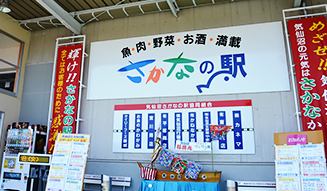
Kesenuma's Kitchen: "Sakana no Eki"
Before the talk, we decided souvenirs were essential for commemorating the trip, so we headed to "Sakana no Eki" in Kesenuma. This establishment, which opened on December 10, 2011, is a supermarket-like complex featuring nine stores: five that reopened after being affected by the earthquake at the Kesenuma Fisheries Distribution Center, plus four others that wished to resume operations. It comprises fresh fish markets, grocery stores, and food shops. While it attracts many group tourists arriving by bus due to its large parking lot, it feels more like a local supermarket, with many residents shopping there, creating a delightful, local atmosphere.
During our free time, participants dispersed to browse for bargains. Beyond the desire to find delicious and unique items, one could sense their wish to contribute to the local economy, however modestly, through their purchases. First, for my father who enjoys sake, I purchased and arranged for delivery Kesenuma's renowned sake, "Otokoyama." As it was late, the selection of fresh fish, particularly tuna, was limited. However, as expected of Kesenuma, I was surprised by the variety, quality, and affordability of the tuna sold in pre-cut portions. An elderly shopkeeper recommended a handmade salted fish innards, saying, "It's really delicious!" I bought some.
Then, my attention was caught by a "Kesenuma Tuna Can" with a striking red label. Made with albacore tuna caught by Kesenuma's long-line fishing fleet, it cost more than double a typical tuna can, but I couldn't resist its packaging and bought three cans. Back in Tokyo, I opened one immediately and was astonished by its incredible deliciousness!
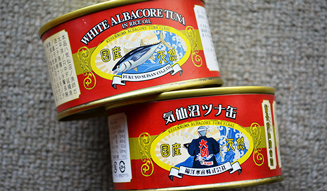

This is the Kesenuma Tuna Can I bought for its packaging. It's packed in rice oil, and the oil itself is also delicious. It's exquisite in tuna pasta!
The tuna's inherent flavor was dramatically different from ordinary canned tuna, leaving me genuinely impressed. Tuna salads and tuna sandwiches were devoured in no time. The oil in which the tuna was preserved was also infused with flavor, making the tuna pasta unbelievably exquisite. I couldn't forget its taste and even reordered it from Tokyo. If you visit Kesenuma, this is a must-buy item.
"Don't forget to try the Kesenuma specialty cream sandwich!" advised Yoko Kageyama from JTB, who served as our tour guide. She is a key figure in planning support tours, particularly the "Kesenuma Unmaemon Tour," at JTB Corporate Sales' "Tohoku Furusato Ka" (Tohoku Hometown Division). Her gentle, cheerful demeanor and professionalism, always considering the traveler's perspective, were truly admirable throughout the tour.
In fact, this "Kesenuma Unmaemon Tour" received the "Minister of Land, Infrastructure, Transport and Tourism Award" in the domestic travel category at the "Tour Grand Prix 2014," sponsored by the Ministry of Land, Infrastructure, Transport and Tourism, the Japan National Tourism Organization, the Japan Association of Travel Agents, and the Japan Association of Travel Writers. It was highly praised as a travel product that contributes to ongoing reconstruction support, a testament to the sincerity and passion of the planning team.
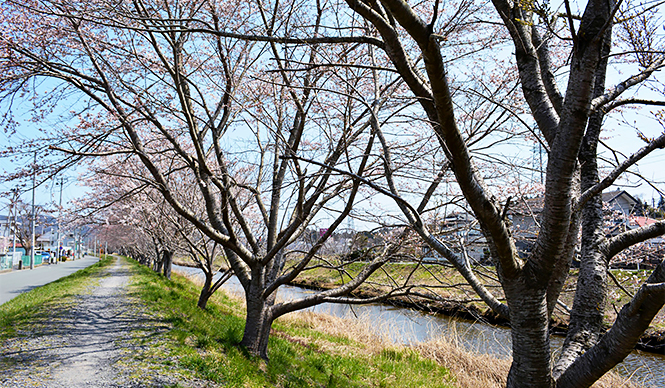
Her recommended cream sandwich is a hidden local favorite known to all Kesenuma residents. It's a simple treat: a soft roll filled generously with cream, evoking a nostalgic taste. It sometimes sells out, so I felt lucky to get one today. I savored it on a bench outside while waiting for the bus. Though a bit too sweet for my palate, the nostalgic flavor, reminiscent of school lunches, and the unique experience of enjoying it in Kesenuma were satisfying enough. Cherry trees line the street around "Sakana no Eki," and their buds were just beginning to open. They would be in full bloom soon.
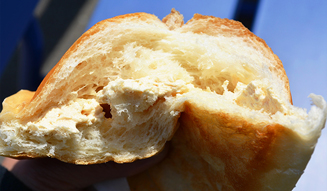
Kesenuma's signature cream sandwich, generously filled with rich cream.
In the evening, we boarded the bus, finally leaving Kesenuma. I suspect all the participants felt a sense of reluctance to depart. I certainly did.
The doors closed, and the bus, parked near the harbor, slowly pulled away and turned the corner. Kazue-san and Noriko-san, who had taken such good care of us, waved enthusiastically. The tour participants waved back from inside the bus. Across the road stood the "Team Kesenuma" staff who had supported our tour. Some waved large "Bantyo" (good catch) flags, reminiscent of traditional send-offs for departing fishing boats.
Although I didn't have the chance to speak with everyone, I felt a surge of gratitude for their behind-the-scenes efforts in managing logistics and confirming schedules, which ensured the entire itinerary proceeded smoothly and without incident. The team held a banner that read, "Thank you. We look forward to your next visit." The illustration of Kesenuma's mascot, "Hoyaboya," brought a smile to my face. At the same time, tears welled up.

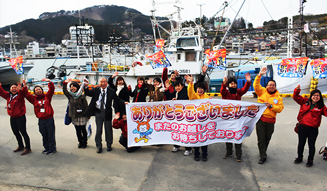
Heartfelt thanks to the "Team Kesenuma" staff bidding farewell to the tour bus.
Actually, it is we who should be saying "thank you." Though our stay was short, how many times did we receive warm smiles and kind words from the local people? The generosity and resilience of the people of Kesenuma, who naturally welcome and host visitors, are immeasurable.
Kesenuma possesses a magnetic charm. Its top-class catches of bonito and saury are due to fishing boats from all over the country landing their catches here. Actor Ken Watanabe's frequent visits and his creation of the cafe K-port suggest something compelling draws him here as well. Our tour was no different. Participants, including JTB's Kageyama-san and others, included repeat visitors. While heartfelt hospitality and encounters with kind people can be found elsewhere, I felt Kesenuma has an even stronger power that draws people from various places.
This year marks four years since the earthquake. Challenges remain, but I want to believe that, like the arrival of spring and the blooming of cherry blossoms, a new future will gradually unfold. What we can do is visit Kesenuma and other parts of Tohoku, again and again. Staying overnight, savoring local cuisine and sake, and buying souvenirs all contribute to the local economy. I strongly hope that people will connect with the local community.
I will likely visit Kesenuma again this year. I also intend to visit other parts of Tohoku as much as possible. I am sure many more encounters await. So, when I go, I plan to say this:
"I've come again to see the cherry blossoms."
Sakana no Eki
http://sakananoeki.com/
Naoko Terada
Travel journalist. Spends about 150 days a year living in hotels abroad. Has visited approximately 60 countries, including Australia, Asian resorts, and Europe. Primarily contributes to magazines, weekly publications, and newspapers. Her books include "Hotel Brand Monogatari" (Kadokawa Shoten), "London Gourmet Guide" (Nikkei BP, co-authored), "British Garden Travelogue" (Nikkei BP Kikaku, co-authored), and she produced "Wagamama Aruki Bali" (Jitsugyo no Nihon Sha).