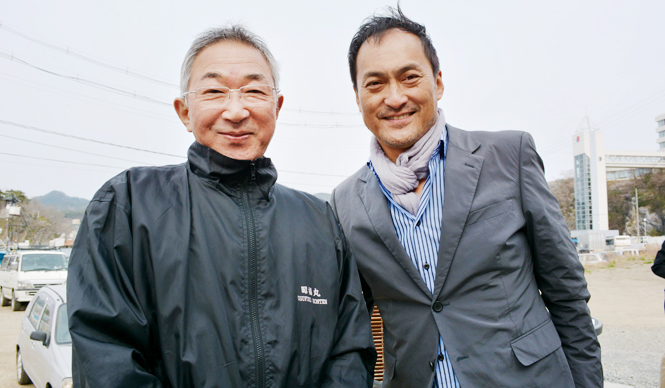
Series | Letters from Kesennuma | February: A Conversation with Legendary Master Fisherman Wataru Maekawa and Actor Ken Watanabe
Kesenuma Notes: A Series
February: A Conversation with Legendary Captain Maekawa and Actor Ken Watanabe
In April 2014, travel journalist Naoko Terada headed to Kesenuma City in Miyagi Prefecture. Her goal was to participate in a "fishing boat experience tour" aboard a new fishing vessel, reportedly the first built in 20 years. Three years after the devastating earthquake, this area, which suffered immense damage, was steadily and surely moving towards the future. Terada believes this boat represents a "beacon of hope" for Kesenuma, and indeed for the entire Tohoku region. Following the lead of the fishing boat, what did Terada discover about Kesenuma today and tomorrow? The journey is finally drawing to a close. After savoring the flavors of Kesenuma, the group headed to the venue for the tour's final highlight: a conversation between actor Ken Watanabe and the legendary captain, Wataru Maekawa.
Text & Photographs by TERADA Naoko
A Harbor of the Heart for All to Return
After indulging in tuna caught by Kesenuma's tuna fishing boats, we proceeded to the venue for the tour's final highlight: a conversation between actor Ken Watanabe and Wataru Maekawa, the captain of the "Dai 18 Shofuku Maru," on which we had the experience of sailing.
The venue was K-port, a cafe facing Kesenuma Port. This place was established in November 2013 by Ken Watanabe. With the concept of "connecting," it embodies the hope of becoming a place that connects the people of Kesenuma with each other, with people from outside the prefecture, and even with the world. K stands for Kesenuma, Ken Watanabe, Kizuna (bonds), and Kokoro (heart). It was also named "Port" with the desire to be a harbor of the heart where anyone can return at any time, just as long-distance fishermen aim for their hometown port after a long voyage.
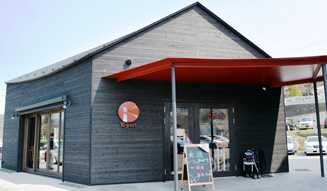
K-port, facing Kesenuma Port. Next door is "Isoriya Suisan," where even professionals come to buy seafood; this building was also designed by Toyo Ito.
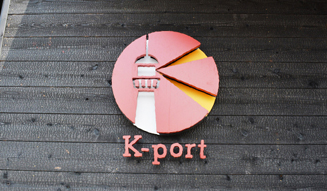
The K-port logo, designed like a lighthouse. Ken Watanabe's feelings for Kesenuma are imbued in its name.
The building, simple yet stylish, was designed by Toyo Ito, an architect who received the Pritzker Prize, often called the Nobel Prize of architecture, in support of Ken Watanabe's vision. Its stylish exterior has now become a symbol of Kesenuma Port. Furthermore, the cafe's menu is overseen by Chef Seizo Mikuni, a master of French cuisine representing Japan.
We arrived at K-port a little before the conversation began. Staff were already setting up the venue in the cafe. Ken Watanabe was among them. With the concept of "Kesenuma Port as the backdrop" for a conversation with a man of the sea, a captain, tables and chairs were brought outside the cafe. A resort-style parasol was also set up at the conversation seats. Although the wind was chilly, the clear blue sky made for perfect event weather. As others from Kesenuma were also invited to listen to the conversation, people began to gather shortly before the start time. The participation fee for the general public was 1000 yen, including one drink. Half of this fee, 500 yen, was donated to the "K-port Piggy Bank," established for the children of Kesenuma.
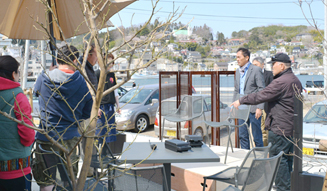
Staff preparing for the talk, with Ken Watanabe among them.
Watanabe blended in naturally with the people around him. When he noticed a dirty table in front of the participants, he sprayed it himself and wiped it with a cloth, revealing his consideration for others.
Eventually, Maekawa arrived. Unlike his demeanor on the boat, he chatted with Watanabe with a bashful smile. We also took our seats, holding K-port's signature original blend coffee.
What Drives Captain Maekawa to the Sea
The conversation lasted about an hour and a half. Maekawa, blushing, admitted he had never spoken in front of people before. Yet, he is a great captain who has achieved numerous feats, earning him the reputation of being "the man in Kesenuma." Not only does he possess an exceptional intuition for locating schools of fish, but he is also a man of virtue, admired by his crew for wanting to work under him and nurturing younger generations. His appointment as captain of the newly built "Dai 18 Shofuku Maru" is a testament to his achievements and character.
Watanabe likened the role of a captain to that of a film director and actor when asking about the captain's duties.
"Fishing depends on the captain. If the captain lacks confidence, the crew won't follow," said Maekawa. Setting lines in rough seas takes six hours. After a few hours of sleep, retrieving them takes another six hours. The length of the longline can be an astonishing 130 to 150 kilometers – comparable to the distance from Tokyo to Shizuoka. Furthermore, other fishing boats compete for the same tuna grounds. The captain decides where and when to set the lines, based on reading the currents and accumulated experience. The pressure must be immense. Yet, Maekawa explained with a beaming smile that what keeps him going is the sense of accomplishment when they achieve a large catch.
"They must be hunters. When you outsmart other fishing boats and make a big catch, there's nothing quite like it."
To Watanabe's question, "What's the most you've ever caught?" Maekawa replied instantly, "10 tons." A murmur of astonishment rippled through the audience at the sheer volume, far beyond their imagination. Maekawa's high catch rate as a captain is legendary. And earning a commensurate reward is a point of pride for him as a man of the sea. Building a home with his own earnings, raising a family, and protecting his hometown port – this is the pride and responsibility of a hearty seaman.
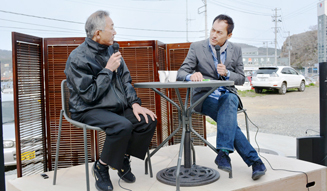
The talk began in a relaxed atmosphere. Unlike his demeanor on the boat, Captain Maekawa's relaxed expression was striking.
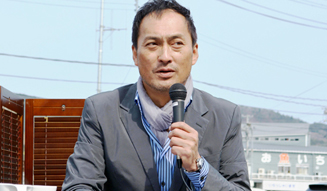
Throughout the conversation, Watanabe's extensive knowledge, as he posed various questions to Maekawa about his work, and his respect for the man of the sea were palpable.
Creating an Environment Where Crew Members Can Work Comfortably
When asked about the qualities required of a captain, Maekawa answered, "Kindness."
This was a surprising answer. I had expected keywords like "decisiveness" or "leadership." Instead, he suggested that kindness, the opposite, is what a leader at sea needs. Maekawa continued:
"The captain's role is to create an environment where the crew members can work comfortably. Sometimes arguments arise, but it's important to listen to them then."
Philip Marlowe, the protagonist of Raymond Chandler's hardboiled novels, once mused, "A man has to be tough to survive. But he has to be gentle to be worthy of survival." This sentiment rings true. Behind kindness lies strictness and strength. Maekawa, too, must have learned this through his many years as a captain.
A longline fishing boat carries about 25 crew members who live and work together for nearly a year and a half. While there are some Japanese crew members, many are now from Indonesia. This is due to factors such as high labor costs in Japan and labor shortages. In this environment, Indonesian crew members are highly valued for their diligence and the fact that many do not drink alcohol due to their religious beliefs. Nurturing the next generation for the fishing industry, a challenging yet rewarding occupation, is also a future challenge.
About two weeks after this conversation, on May 3, 2014, Maekawa set sail from Kesenuma Port as the captain of the "Dai 18 Shofuku Maru." The vessel first headed to Bali, Indonesia, where it took on Indonesian crew members, and then set out for the world's oceans in pursuit of tuna. It is still operating today.
Captain and actor. Although their professions are entirely different, both share a resolve to accept their given missions and lead them to success through maximum effort. In the calm expressions and clear eyes of Maekawa and Ken Watanabe, who possess pride and conviction in their work, lay that strength.
Naoko Terada
Travel journalist. Spends about 150 days a year living in overseas hotels. Has visited around 60 countries, including Australia, Asian resorts, and Europe. Primarily contributes to magazines, weekly publications, and newspapers. Her books include "Hotel Brand Monogatari" (Kadokawa Shoten), "London Gourmet Guide" (Nikkei BP, co-authored), "A Journey Through English Gardens" (Nikkei BP Kikaku, co-authored), and she produced "Wagamama Aruki Bali" (Jitsugyo no Nihon Sha).