Pursuing the Ideal Vintage Style with Modern Technology | NH WATCH & Co.
NH WATCH & Co. | NAOYA HIDA & Co.
An Interview with Naoya Hida, President of NH WATCH & Co.
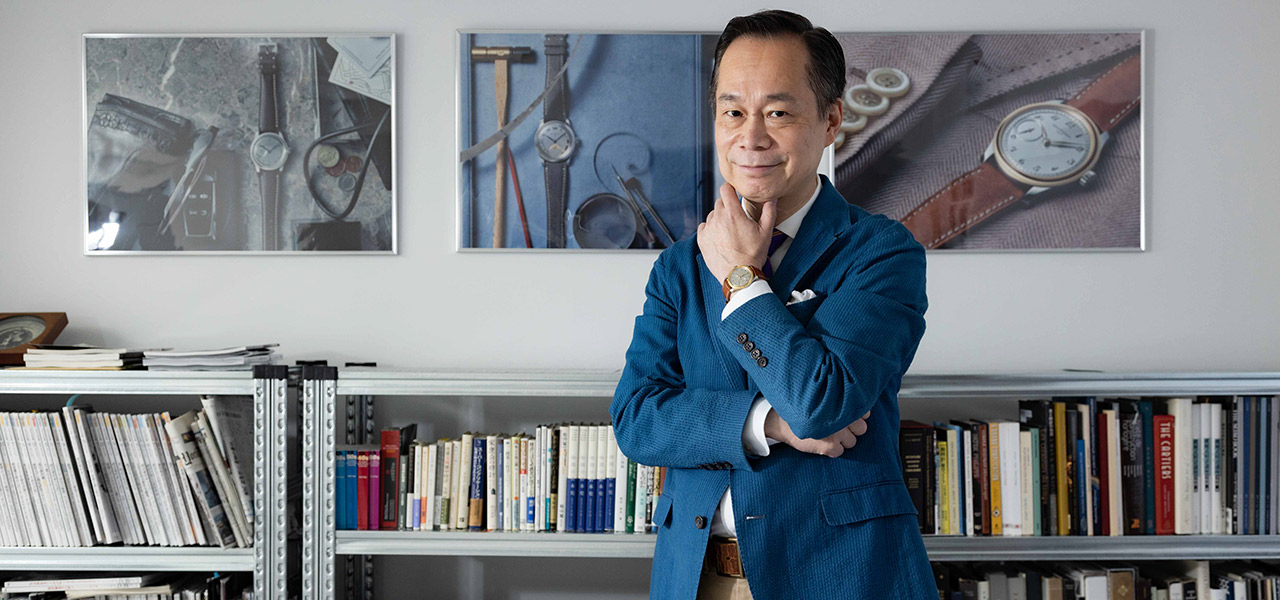
Naoya Hida entered the watch business in 1990, working for several foreign-affiliated specialized trading companies. In 2018, he established his own brand, "NAOYA HIDA & Co." He is widely known in the watch industry for his profound expertise and is highly respected by many watch journalists. We asked him to guide us through the revival of Swiss mechanical watches since the 1980s and their current prosperity, and what kind of watches he proposes with "NAOYA HIDA & Co."
Photographs by Kaku Ohtaki | Text by Yoko Koizumi | Edit by Takashi Tsuchida
How Did the Swiss Luxury Watch Industry Revive?
Following the quartz crisis of the 1970s—when the development of quartz watches pushed mechanical watches into a corner, forcing many Swiss luxury watch brands into dormancy or bankruptcy—the industry began a gradual revival in the late 1980s.
"I joined the watch industry in 1990, so I don't know about the 80s from an industry insider's perspective," Hida prefaced, before explaining the circumstances of the revival.
"The notion that 'expensive watches were accurate and cheap watches were inaccurate,' which existed until the early 1960s, was shattered by the advent of quartz. However, Swiss watchmakers began to realize that the value of mechanical watches, whether hand-wound or automatic, lay elsewhere."
This value lay in the "beauty of design" cultivated over a long history, and the "intricate and precise mechanisms" assembled within a small space.
In the 1990s, the watch industry saw increasing consolidation into groups, such as SMH (now the Swatch Group) and Vendôme Luxury Group (now Richemont). This provided several watch companies with substantial capital. The development of in-house movements progressed, and more brands aimed to become manufactures.
"At the time, even established and prestigious brands no longer had the capital to develop their own movements. Grouping allowed for development funding. The result was the numerous in-house movements introduced from the late 90s into the 2000s."
Subsequently, unique pieces that astonished enthusiasts appeared one after another. The decade from the early to late 2000s was particularly vibrant. This was also the period when fundamental new technologies for brands, such as Omega's Co-Axial escapement, emerged.
Another notable development was the emergence of "trends" in watches, much like in fashion.
"Panerai reappeared in the late 90s, which gave rise to the 'big and thick' trend. Many brands were influenced by this, and watches began to get larger. The trend cycle in the watch industry used to be very slow, but since then, trends have started to 'change'."
Running parallel to these movements was the birth of "microbrands"—very small watch companies, where producing only a few watches a year, or even one every few years, is not uncommon.
"There was a boom in independent watchmakers in the 90s, but as their presence became more normalized, people who weren't watchmakers—for example, those working in marketing departments—began to leave major watch manufacturers to start their own brands."
These watches, brimming with the energy to create entirely new timepieces without being bound by existing concepts, captivated many watch aficionados. Development concepts became increasingly specific, and a niche market emerged with a distinct appeal from mass-market brands. It's not unusual for custom orders to have waiting times of several years for completion.
"NAOYA HIDA & Co.," created by Hida himself, is a brand enthusiastically supported by such a select group of people.
Naoya Hida. After handling sales and marketing at multiple foreign-affiliated specialized trading companies since 1990, and serving as the representative in Japan for F.P. Journe and Ralph Lauren Watch & Jewelry, he established NH WATCH Inc. in 2018.
Relentlessly Pursuing What One Loves
If Hida were to be described in one word, it would be "a watch enthusiast who has worked in the watch industry." With this inherent quality, he has collected numerous watches, both contemporary and vintage, throughout his career. Naturally, his knowledge is both broad and deep—to the extent that, as mentioned earlier, watch professionals seek his guidance.
Even for an enthusiast like Hida, a certain question arose: "What is the ideal watch for me?" This was a question he posed to himself.
Hida realized, "After looking at vintage watches for 20 years, I found that there isn't a watch that is perfect for me." Even in his previous roles, he had proposed ideas for contemporary watches numerous times, but they never materialized into the form he envisioned. The conclusion he reached was simple.
"The ideal watch doesn't exist in contemporary or vintage models. Therefore, I will make one."
Hida's preferred watches are characterized by a relatively small case housing a large hand-wound movement, fitting snugly within the case. While vintage watches span a wide period from pocket watches to the 1960s, Hida is particularly drawn to motifs from the 1930s to 1960s—the so-called golden age of mechanical watches.
From the vast elements that constitute a watch, Hida meticulously selected those that embody his preferences, condensing them into "NAOYA HIDA & Co."
The founding members are Hida, watchmaker Kosuke Fujita, and engraver Keisuke Kano—three individuals.
"It's unusual for one of the founding members to be an engraver," Hida himself remarks. However, upon seeing the watch faces, it becomes immediately clear that "NAOYA HIDA & Co." could not be completed without engraving expertise.
"In the 17th and 18th centuries, pocket and wall clocks often had hand-engraved indices filled with enamel because printing technology was not yet advanced. The three-dimensionality was incredibly cool. But now that printing technology has improved, no one does hand-engraving anymore. I thought I'd like to do it myself, and that's when I met Kano (the engraver)."
Beyond the dials, the hands, cases, small second sub-dials, and even the tactile feel of the hand-winding mechanism—all are filled with episodes that tantalize the enthusiast's heart. While the full details of these meticulous efforts are best left to specialized watch magazines, the flawless craftsmanship has captivated enthusiasts worldwide.
The impact is evident: the seven units of the first model, "NH TYPE 1B," released in 2019, sold out immediately. In 2020, 25 units of two models were sold; in 2021, 40 units of three models; and in this, the fourth year, all 70 units across five models were sold out in the blink of an eye.
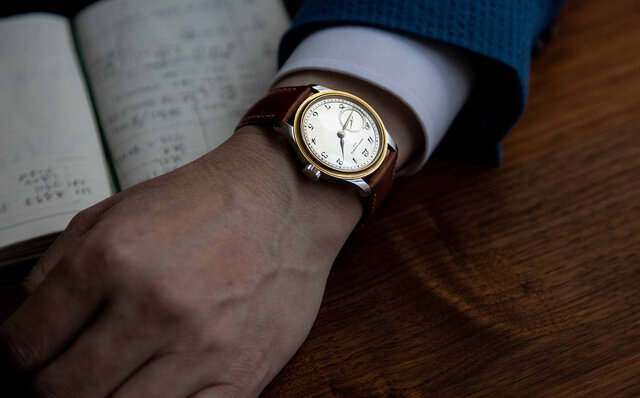
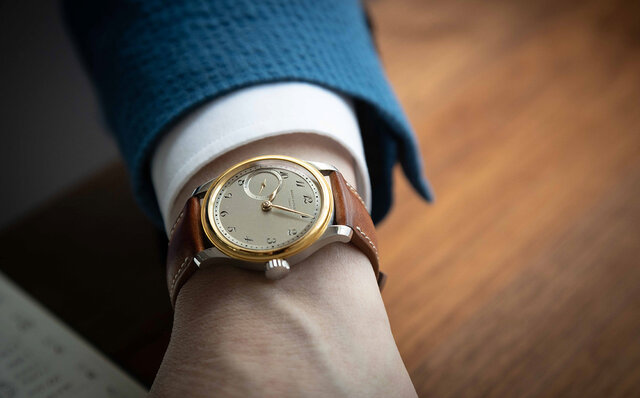
The 2022 model, "NH TYPE1D-1." The 37mm case diameter is one of Hida's specific requirements. Starting this year, all models feature a screw-down case back. "At the start, we lacked the experience to implement this, but after two years of preparation to bring my 'love' for screw-down backs to fruition, it's finally complete," says Hida. The hour numerals are hand-engraved by Kano. After engraving, synthetic lacquer is applied. It is powered by the hand-wound movement Cal.3019SS, based on the Valjoux 7750. Limited production of 15 units. Sold out.
The 2022 model, "NH TYPE1D-1." The 37mm case diameter is one of Hida's specific requirements. Starting this year, all models feature a screw-down case back. "At the start, we lacked the experience to implement this, but after two years of preparation to bring my 'love' for screw-down backs to fruition, it's finally complete," says Hida. The hour numerals are hand-engraved by Kano. After engraving, synthetic lacquer is applied. It is powered by the hand-wound movement Cal.3019SS, based on the Valjoux 7750. Limited production of 15 units. Sold out.
Watch Companies Grow Larger and Smaller
"Over my 30 years in the watch industry, I've had a gut feeling that there's a market for the vintage style I prefer, not just among Japanese people, but globally. I felt this potential when two of the seven watches I released in the first year were purchased by overseas customers."
The number of international customers has gradually increased, now accounting for 70-80% of sales for this year's models. Most of them learn about new releases through social media and the web.
"I saw independent watchmakers like Masahiro Kikuchi, Hajime Asaoka, and KIKUCHI NAKAGAWA (Yusuke Kikuchi, Tomoyuki Nakagawa) effectively using social media, so I thought it would work to some extent, but the speed of expansion has been far faster than I anticipated. The pandemic also accelerated this, and honestly, I'm struggling just to keep up (laughs)."
Even microbrands have customers spread across the globe. So, what does the future hold for the watch industry?
"I believe that while brands focusing on niche themes like ours will continue to emerge, mass-market brands will further explore new markets and expand. Globally, the middle class, who can afford to spend on high-value hobbies, is growing, so the watch market is expected to grow steadily."
Hida anticipates that more microbrands will emerge creating watches in the same genre as "NAOYA HIDA & Co.'s" vintage style. "There are countless things I want to create," he says.
"When an idea I've imagined becomes a watch, it brings immense joy, and at the same time, it sparks a desire for more. This pursuit never ends."
During the interview, he casually mentioned, "I might even make an automatic winding watch." What will be the next 'favorite' of Hida's to take shape? The 2023 models are scheduled to be announced around May of next year.