Creating a New Paradigm by Freely Navigating Between Reality, 2D, and the Metaverse, Using "Flowers" as Inspiration | PLANTICA
PLANTICA
Ikebana Artist Takashi Kimura: An Interview
After joining an advertising agency and meeting creators from various fields, Takashi Kimura's desire to "become a creator" was ignited. It was then that he recalled ikebana, one of his hobbies from university. Sixteen years later, Kimura has become someone who freely navigates "flowers" between reality, 2D, and the metaverse.
Photographs by OHTAKI Kaku | Text by KOIZUMI Yoko | Edit by TSUCHIDA Takashi
From a Mere Hobby to a Lifelong Vocation
Kimura says his mother's invitation was the initial spark that got him hooked on "flowers."
"My mother invited me to a Sogetsu school ikebana class. At the time, Mr. Shogo Kariyazaki, who was also from Sogetsu, was very active, and there weren't many men in the classes, so she suggested I try it. I initially attended the same class as my mother, but after about six months, I transferred to a specialized class for men within Sogetsu and attended for all four years of university."
However, at that time, Kimura had no intention of making a living from flowers. After graduating from university, he joined an advertising agency and became a project manager. Through his work, he deepened his relationships with many creators and artists in fashion, graphics, and video. It was during this time that Kimura developed a "longing for the act of creating something and moving others."
"When I thought about what I could do, flowers came to mind. I genuinely enjoyed the idea of sublimating the motif of flowers into art and presenting it."
Underlying this was his own conviction that "I am most absorbed when I am creating with flowers." In 2006, he became independent as an ikebana artist and flower designer. Today, he showcases his "flowers" in two distinct realms.
Curating "Flowers" Across All Media
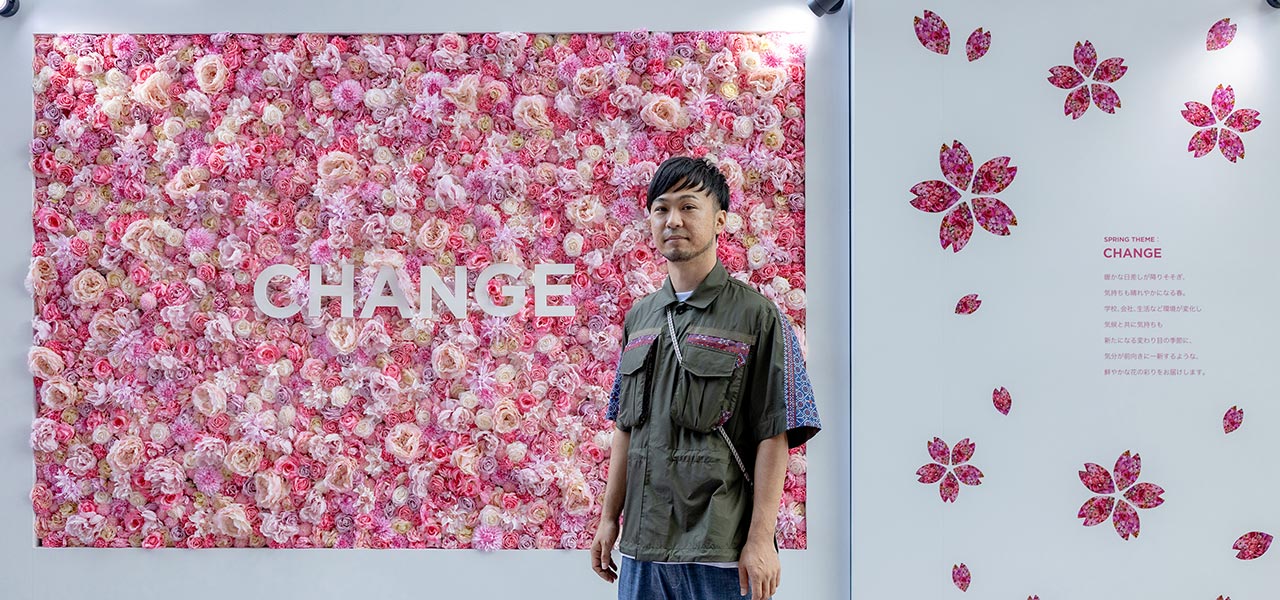
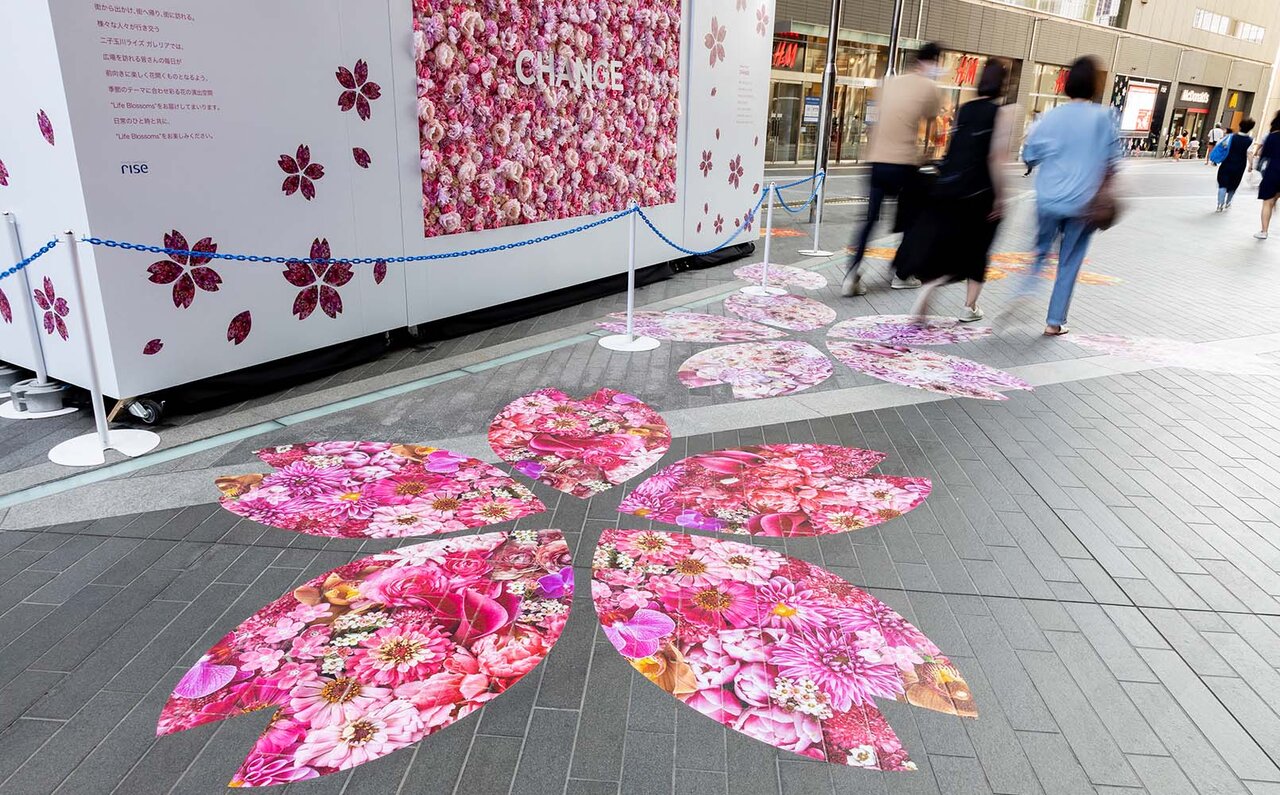
Starting this spring, Kimura has taken on the environmental design for Futako-Tamagawa Rise in Setagaya Ward, Tokyo. His role is to create seasonal floral displays in this high-traffic public space.
The first thing that catches the eye is a wall art installation overflowing with flowers. Beside it, a tagline is displayed, a floor is covered with floral print sheets, and the upper area is draped with a floral tarp. The artwork is a composite of various media.
"This time, I've used sheets and tarps, but I also use video and photography depending on the installation environment. I personally enjoy using flowers and plants as motifs without being restricted by the medium, and thinking about what kind of impression can be conveyed through them."
While floral art often seems to carry an unspoken rule of "do not touch," it was striking to see children freely interacting with the diverse flowers Kimura had expressed in this piece.
"Even if people can't enjoy flowers at home, they can feel the season and interact with them here. That's the intention."
Ikebana artist Takashi Kimura is also exploring new forms of expression.
"As I call myself an ikebana artist, my goal is to add a new layer to the 600-year history of ikebana. Tradition is a culmination of innovation; it has continued because it has captivated people in every era, kept them interested, and increased the number of practitioners. I believe it is the responsibility of an ikebana artist living today to continue adding to that history."
That's why, Kimura continues,
"If my output is perceived as just 'ikebana' or 'flower arrangement,' it's not innovation. Only when others wonder, 'Why is he doing this?' can we feel a new vitality. Therefore, I believe that using video, photography, prints, and layering various techniques are all valid forms of expression."
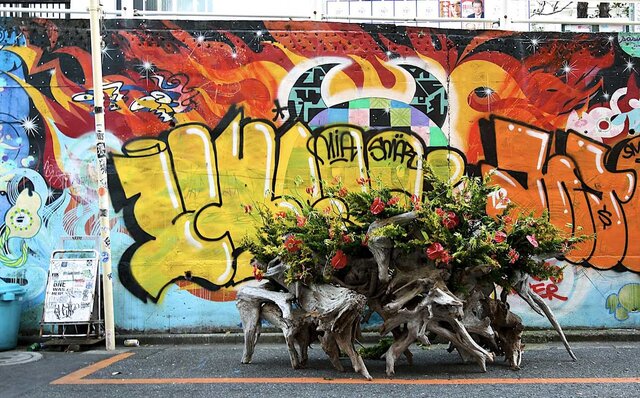
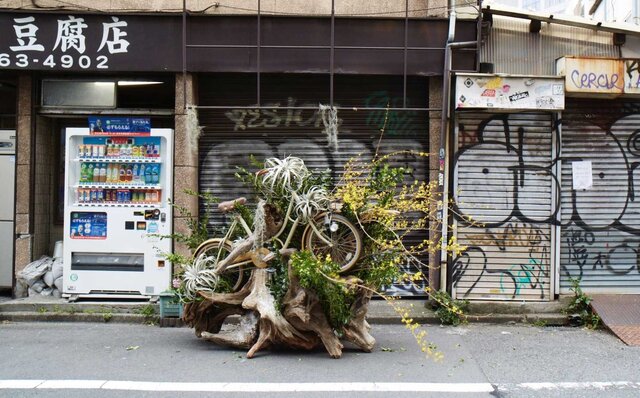
Kimura's ongoing series is the "Nomadic" series. Nomadic means unrestrained, and its concept is "to not just beautifully arrange flowers in a conventional space, but to boldly place them in new environments and let them exist assertively."
"Typical flower art is mainly displayed indoors, but what happens if we take it outdoors? The focus is on reinterpreting ikebana for each location. I create ikebana on the street and then photograph it. I use the urban landscape as a vase, borrowing the scenery of roads and building ivy, and consider how flowers would look when placed within that landscape."
It's meaningless if the landscape doesn't harmonize with the flowers. Kimura loads flowers onto a truck, drives around, stops when he finds something interesting, improvises an arrangement, and takes a photo. The photographs of flowers are also "ikebana" for him.
Towards an Expressive World Beyond Borders, Time, and Gravity
After the COVID-19 pandemic, his next vision became clear: venturing into the metaverse.
"The characteristic of my work is its spatial presentation, which is why it aligns well with the metaverse. In fact, since the metaverse allows for the expression of worlds without physical constraints, it's possible to create environments where flowers are constantly in bloom, defying gravity. I always want to try bringing new perspectives to how flowers are seen and perceived as art."
People are not only captivated by "fresh flowers." They are moved by artificial flowers, floral print shirts, and even light patterns resembling flowers, finding them "cute" and "beautiful."
"People sometimes use flower names for stage names or pseudonyms. This is also a form of conceptual expression. Flowers are enjoyed conceptually and exist as symbols—I believe the metaverse is an environment where the multifaceted nature of flowers can be easily expressed. Conversely, how to interpret and utilize the concepts and symbols that flowers embody is also one of my current pleasures."
Since the metaverse project began, his ideas have continued to expand, he says.
"Right now, I'm just doing what interests me!" declares Takashi Kimura with a smile. Let's explore his next creations, reflecting his "interests," by experiencing his reality and peeking into the metaverse.
Takashi Kimura graduated from Aoyama Gakuin University's School of Business and graduated from Keio University's Graduate School of Media Design. After working as an exclusive florist at The Venetian Macao®, he formed the creative studio "plantica" in 2008, which disseminates the appeal of flowers using diverse methods. While mindful of the approximately 600-year tradition and aesthetics of ikebana, he pursues new forms of expression for the next generation, seeking venues in public spaces. In recent years, he has developed textile designs for floral fashion and directed large-scale flower art exhibitions in China. He has also provided floral direction for facilities such as Hoshino Resorts and Huis Ten Bosch, as well as events for cosmetic and fashion brands, commercials, and advertisements, engaging in activities unbound by the traditional framework of ikebana.
https://www.instagram.com/plantica_jp/