Chapter 4 TOYOTA BLADE meets Music | Naruyoshi Kikuchi selects exquisite driving music
Chapter 4
TOYOTA BLADE meets Music
Naruyoshi Kikuchi Selects Gem-like Driving Music
The Toyota Blade & Modern Jazz: A Sharpened Individuality
The Toyota Blade transforms mere transit into a special experience. And music adds further color to such moments. Naruyoshi Kikuchi, a cutting-edge musician and an "adult who is not quiet," has curated a selection of exquisite jazz, inspired by the Toyota Blade.iMix for TOYOTA BLADE by KIKUCHI NaruyoshiWe present it under the title.
Text by Michiyo AzumaPhotos by Takahiro Igarashi
An Urban Pier, Sunset, Saxophone, and a Black Short Premium
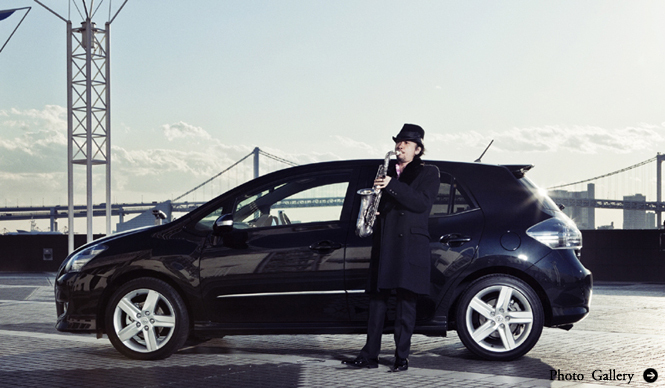
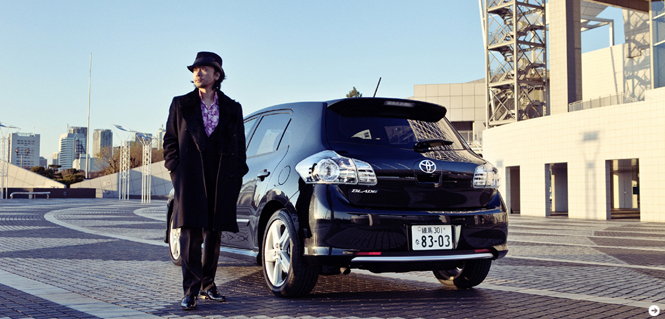
An urban pier, sunset, saxophone, and a black short premium. Perhaps the conditions were too perfect. When Naruyoshi Kikuchi improvises on his saxophone, even the Harumi Pier can seem like Manhattan. The Toyota Blade, in its cool black, harmonizes with the grayish atmosphere of the pier. As the sun dips lower, the mica-painted body accentuates the subtle particles of light. In contrast to the warm, mellow brass of a well-worn saxophone, the Toyota Blade's body resonates coolly with the evening scene.

"It's so quiet at Harumi Pier today. When the saxophone and the car come together, it feels a bit like the '80s. Well, cities are strange; any urban pier can look like Manhattan, and those big buildings in Yoyogi you see from Shinjuku, they look like the Empire State, don't they? Things can look like anything."
Throughout the hour or so of shooting, Mr. Kikuchi played his saxophone continuously. Without anyone needing to prompt him, the improvisation continued, weaving together the city, the camera, the saxophone, and the Toyota Blade. It was unstoppable.
The Toyota Blade, standing behind Mr. Kikuchi, was like a stage prop. Its voluptuous rear volume, the roofline that seems to soar towards the sky, and the two-tone color scheme of silver trim and black body created an ambiance befitting jazz.
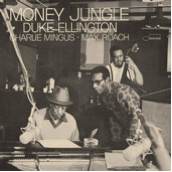
Duke Ellington
“Money Jungle”
from Money Jungle

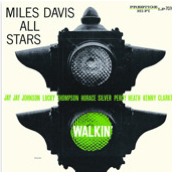
Miles Davis
“Solar”
from Walkin’
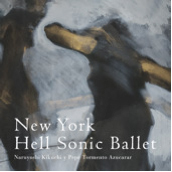
Naruyoshi Kikuchi and Pepe Tormento Askarar
Toki Sae Wasurete
from New York Hell Sonic Ballet
Shared Values Between the Toyota Blade and Modern Jazz
What kind of jazz would suit a drive in the Toyota Blade? We asked Naruyoshi Kikuchi, a musician and an "adult who is not quiet," to select driving music for two scenes: day and night. Among his selections, "Money Jungle" and "Solar" were particularly striking. They possess a powerful rhythm, much like the engine of a car speeding down a highway. The robustness within their lightness, the passion, evokes the drive and spirit of the Toyota Blade's 2.4-liter engine.
"Duke Ellington's 'Money Jungle' was incredibly aggressive music for America in the 1960s. There's an anecdote: the bassist and drummer were fighting right up until the performance. They had a huge argument, but then they went straight into playing and recording. This kind of thing happened often in jazz performances in the '50s and '60s. There was immense tension. But that barely contained emotion didn't hinder the music. It's precisely the music of an 'adult who is not quiet.' And Miles Davis's 'Solar' is minimalist music, typical of modern jazz. It's a small ensemble, simple, yet it has a sense of speed and power."
The speed and sharp, intense individuality of modern jazz might also resonate with the "short premium" concept of the Toyota Blade. With a short body of 4260mm, it condenses powerful performance from a 2.4-liter engine producing 167ps, along with excellent quality and attention to interior detail. Mr. Kikuchi agreed, noting that the dashboard, with its leather-like texture, and the futuristic center stack felt like "a living room on wheels." This, he suggested, is why jazz can be enjoyed so comfortably while driving. It's about condensing a certain sensibility without unnecessarily expanding the scale. This also reveals a shrewd individuality.
Jazz and Motorization: Synchronized
"But one of the reasons for the shift in jazz styles was also the change in motorization. Before the war, swing music with big bands was mainstream, and travel in those days, the '40s, was by train. That gorgeous music, it's like, 'Let's go on a train,' right? But after the war, it became small combos. It was an era when long-distance driving and personal cars became common, and people moved around in cars with a small group. It was fast. So the sound became minimal and fast. Jazz musicians all love a sense of speed."

—Do you also like a sense of speed, Mr. Kikuchi?
"I feel speed even when I'm playing. It's a kind of sacred time. Maybe two hours, or if it's short, about 40 minutes. But I live for those mere 40 minutes. That time has a completely different meaning from my other life's work. You don't know what will happen, and things don't always go as planned. If it goes well, there's something extremely wonderful and irreplaceable."
Pouring passion into even the briefest moments of life—this is the mark of an "adult who is not quiet." Perhaps spending time with the Toyota Blade, experiencing that sacred, speed-filled moment, wouldn't be a bad idea.
KIKUCHI Naruyoshi
Musician, writer, and music educator. Born in Choshi City, Chiba Prefecture, in 1963. Debuted as a musician in 1985 as a saxophonist for the Fifth Dimensions, the backing band at the Yokosuka US naval base. He subsequently honed his skills as a member of groups such as the Yosuke Yamashita Group, establishing his reputation not only in the jazz scene but also across pop, avant-garde, and club music circles. In 2007, he formed the Naruyoshi Kikuchi Dub Sextet. As a music educator, he leads his private school, "Penguin Music University," and has been the head lecturer for the Music Theory and Arrangement course at the "Film School / Music Aesthetics Program" operated by Atheneum Francais since 2002. From 2004 to 2005, he lectured at the University of Tokyo's College of Liberal Arts as an adjunct instructor (teaching "Jazz - 20th Century American History" and "Miles Davis Studies"). In 2006, he became an adjunct instructor (Jazz Theory and History) at Kunitachi College of Music. Entering new academic fields, his diverse talents as a "musician," "writer," and "journalist" are sometimes described as "a visionary leading the era," "a contemporary charismatic figure," and "a sprinting genius." His daily routine includes walks and stretching. He is a Gemini, blood type AB. His latest work is "New York Hell Sonic Ballet" (Naruyoshi Kikuchi and Pepe Tormento Askarar / ewe records), and his recent book is "Jung's Soundtrack: Naruyoshi Kikuchi's Book of Films and Film Music" (East Press).
