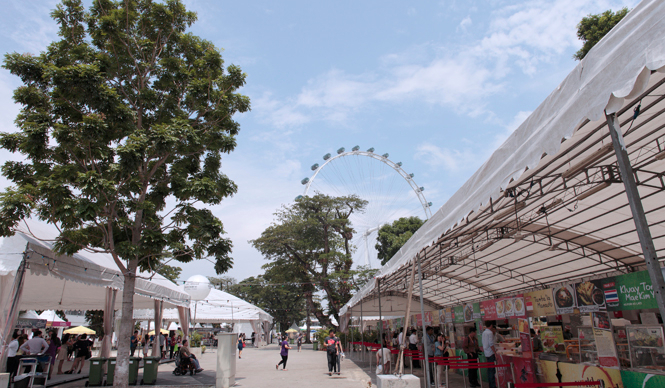
Feature: Singapore is a Hawker Heaven! | Day 1: Diving into a Festival of Hawker Food!
Feature: Singapore, a Hawker Paradise
A 3-Day Culinary Journey
Day 1: Infiltrating the 'World Street Food Congress' (1)
Singapore, a nation where Chinese, Malay, and Indian cultures coexist. Though small enough to fit within Tokyo's 23 wards, its embrace is vast. While cherishing their roots, people here accept different cultures within reasonable bounds. This unpretentious connection between ethnic groups weaves the fabric of the nation. Food, and specifically hawker fare—the soul food of each community—serves as a microcosm of this. To explore its allure, we embarked on a 3-day, eat-till-you-drop journey, sampling dishes from various hawkers. We hope you'll join us till the end.
Our journey begins at the 'World Street Food Congress,' a festival gathering hawker dishes from around the globe. We're particularly excited because this is the first event of its kind, organized by Makansutra, a renowned hawker food guide publisher in Singapore. Let's dive headfirst into hawker culture here.
Photographs by JAMANDFIXText by TANAKA Junko (OPENERS)Special Thanks to Singapore Tourism Board
Affordable, Fast, Fun──What Offers All Three?
What do you seek in food? If your answer is "affordable," "fast," or "fun"—or all three—then hawker food is unparalleled. Anyone who has visited Taiwan, China, or Southeast Asia has likely experienced it: that unique, vibrant atmosphere of hawker stalls teeming with people and energy.
The true joy of hawker food lies in the freedom to savor diverse flavors without breaking the bank. Enjoy an appetizer at one stall, the main course at another, and dessert elsewhere—this kind of culinary exploration is possible precisely because hawker food is wallet-friendly and quick. And the open, welcoming atmosphere, where both first-timers and regulars feel embraced, is another significant charm.


Hawker Delicacies from 10 Countries Gathered
The appeal of hawker food, so familiar yet often overlooked, is something we rarely pause to reconsider. To unravel this, KF Seetoh and his Makansutra team organized the 'World Street Food Congress,' a 10-day festival. Seetoh, an expert in hawker cuisine, is highly regarded by the Singaporean government. Beyond publishing the hawker-focused guide 'Makansutra,' he's involved in producing food shows and managing hawker centers, essentially overseeing all aspects of hawker culture.
Makansutra's mission is singular: to convey the joy of hawker food. The 'World Street Food Congress' can be seen as the culmination of their efforts. The inaugural event was held at the F1 Pit Building and Paddock in the Marina Bay area, the very venue that transforms into a street circuit for the Singapore Grand Prix each September. The paddock, typically used for race car maintenance, was reimagined as the 'World Street Food Jamboree.' For ten days, from May 31st to June 9th, hawkers from ten countries showcased their signature dishes.
Thirty-seven stalls lined the elongated paddock. Malaysian 'Laksa,' a noodle soup with a tangy seafood broth perfect for summer; Indonesian 'Nasi Kapau,' featuring jackfruit curry and slow-cooked meats in coconut milk and spices; and Indian 'Bhajia,' a delightful combination of vegetables, spices, and yogurt sauce. While Asian offerings were prominent, there were also participants from the Americas and Northern Europe. From spicy dishes to burgers and desserts, the diverse selection tantalized our eyes and taste buds.
Feature: Singapore, a Hawker Paradise
A 3-Day Culinary Journey
Day 1: Infiltrating the 'World Street Food Congress' (2)
Considering the Future of Hawker Food
After indulging in global street food, we moved inside the Pit Building opposite the paddock. On June 3rd and 4th, the midpoint of the event, experts deeply familiar with hawker culture gathered for the 'World Street Food Dialogue,' a forum for learning and discussion about hawker food.
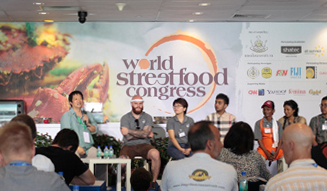
On the stage set up at the front, prominent journalists and chefs, including experts active in Southeast Asia, Anthony Bourdain (renowned globally for his series 'Anthony Bourdain: No Reservations'), Pauline Lo, editor-in-chief of China Daily, and Claus Meyer, co-founder of the Danish restaurant Noma, delivered presentations on hawker culture in their respective countries. Hawkers participating in the paddock also took the stage, engaging in passionate discussions about the current challenges facing hawker food and its ideal future.
A Glimmer of Hope
The theme of "succession" was frequently discussed on stage: how to pass down recipes and techniques, honed over generations, to the next without interruption. When Seetoh asked about their thoughts on the future, hawkers voiced anxieties: "We might not be able to operate our stalls in a few years," "Running a hawker stall requires physical strength," "We can't compete with fast-food chains open 24 hours," and "There's no one to take over."
Many warned the audience that hawker culture is fading. As the hawkers themselves expressed concerns about the future, these warnings felt increasingly real. Unless the current challenges are addressed, hawker culture, like endangered species, seems destined to decline.

Abdus Salam (right), who decided to take over his family's stall after graduating from university. "Seeing my father work so hard every day, I felt I couldn't let it end with my generation."
While the harsh realities were evident, there was also a small ray of hope. A notable number of next-generation hawkers possess both academic qualifications and a passion for their craft. Abdus Salam, who runs an 'Indian Rojak' stall in Clementi, western Singapore, is one such individual. After graduating from university, he had intended to join a corporate company. However, witnessing his father's dedication changed his mind. "My father works 13 to 14 hours every day. This stall has been carefully preserved, but it will disappear if no one takes it over. Seeing him work so hard, I felt I couldn't let it end with my generation."
Hearing him speak with a smile, the future of hawker food seemed to brighten just a little.