
Feature: BLUE NOTE NOW! Chapter 3: Where is Blue Note Heading?
Feature | BLUE NOTE NOW!
A Look into the Appeal of Blue Note, the Esteemed Label Approaching its 75th Anniversary
Chapter 3 | Thinking with "Mr. Blue Note"
Where is Blue Note Heading? (1)
Blue Note, a jazz label born in New York in 1939. This venerable label, which will celebrate its 75th anniversary next year, is now drawing renewed attention. What makes Blue Note so special? To explore the answer, OPENERS has enlisted the help of Hitoshi Namekata, known as “Mr. Blue Note,” a key figure in popularizing jazz in Japan. We aim to delve into the charm of a label where youth and tradition coexist.
Concluding the feature is a talk session with Don Was, who became president of Blue Note last year, and new addition to the label's roster, musician José James, alongside Namekata. As the 75th anniversary approaches, where is Blue Note headed?
Photographs by Ryota MoriText by TANAKA Junko (OPENERS)
Hitoshi Namekata Reflects on Blue Note's History
Blue Note is approaching its 75th anniversary next year. Since its founding in 1939, it has been based in New York. It has consistently been at the forefront of modern jazz, and in 1970, it moved its office to Los Angeles, participating in the dawn of "fusion" (*). Then, in 1985, it returned to New York. There, it spearheaded the revival of "acoustic jazz," a new movement born in New York, also referred to as the "jazz renaissance" or "Blue Note renaissance." As time moved on to 1992, Us3's "Cantaloop (Flip Fantasia)," born from the club jazz scene, became a global hit. "Hip-hop jazz" emerged with Blue Note as its stage.
In 1998, to commemorate its 60th anniversary, engineer Rudy Van Gelder(See Q7 in Chapter 1 "Blue Note in 30 Minutes" for details on his involvement with Blue Note)launched a major project to remaster past masterpieces. This remaster series, "RVG Edition," was extremely well-received worldwide and continues to this day. Then, in 2002, the 21st-century era of Blue Note began with the arrival of Norah Jones.
Looking back at its history, I believe Blue Note has consistently shaped the future of jazz since its founding to the present day. Amidst this, EMI merged with Universal Music, giving birth to the new "Universal Music" in 2012. The procedures were completed in Japan this April. Blue Note, which was under EMI's umbrella, is also entering a new era.
The person leading this new era of Blue Note is Don Was. Many of you likely know Don from the band Wos (Not Wos), formed with David Weiss, or as a producer for The Rolling Stones and Bob Dylan. In 2012, he added the title "President of Blue Note" to his resume.
Actually, Don and I are almost the same generation. Our generation spent its formative years in the 1960s, where jazz and rock were often blurred together. I sometimes explain it as 'home address: The Beatles, current address: Jazz' (laughs). I heard that the album that first blew Don away was Joe Henderson's Blue Note record, "Mode for Joe." He apparently didn't know about Jimi Hendrix or Queen until a friend (Doug Fieger of The Knack) told him.
I believe his sensibility will shape the future of Blue Note. From here, we'll invite Don to join us and hear his thoughts on these matters.

Feature | BLUE NOTE NOW!
A Look into the Appeal of Blue Note, the Esteemed Label Approaching its 75th Anniversary
Chapter 3 | Thinking with "Mr. Blue Note"
Where is Blue Note Heading? (2)
What Was the New President Don Was's First Task?
Don Was (hereinafter, Was)Thank you for the introduction. Honestly, when I'm introduced as 'the president of Blue Note,' it feels a bit awkward, like it's not quite me yet (laughs). As Namekata (Note: referring to Hitoshi Namekata) mentioned, the 1960s in my hometown of Detroit were my youth. I loved and listened to The Beatles, The Rolling Stones, and Bob Dylan, but at the same time, my friends and I were drawn to Blue Note records.
I admired everything: the music, the cool artwork, the cigarettes and saxophones on the covers, the black walls... I wanted to be like a Blue Note musician.—I spent my youth with those aspirations. So, 45 years later, I never dreamed I would end up leading Blue Note.
Hitoshi Namekata (hereinafter, Namekata)You joined Blue Note about a year ago, right?
WasYes, that's right. It was in January 2012, so it's been about a year and a half. Since starting work at Blue Note, the first thing I considered was how to preserve the wonderful qualities of those records that I was so passionate about. To do that, simply remaking 1960s jazz isn't enough. The previous generation, including Namekata, has already left behind wonderful reissues.
What Hasn't Changed Since Its Founding
So, what can we do now, in 2013? When I pursued this, I realized it's about continuing to express the radical spirit that has remained constant since the label's founding, a spirit of constant change. It's about continuing to showcase the approach of records and musicians who, while rooted in tradition, have always strived to break down boundaries. A prime example of this is Wayne Shorter (*), and my first task as president was to welcome him back to Blue Note.
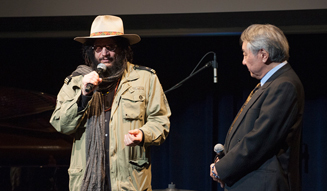
Don Was (left) and Hitoshi Namekata
NamekataHis return after 42 years caused quite a stir, didn't it?
WasFor Wayne, it's not so much that he's rooted in tradition; he *is* tradition. Although he's a veteran reaching 80 this year, he never looks back. His performances change almost every night, based on intuition. He's constantly aiming for something new, never settling. He embodies the very essence of Blue Note's approach. His presence was indispensable for creating records from 2013 onwards.
Also, as I'll introduce later, we've brought in exciting young musicians like José James. That was one of the first things I tackled. He grew up listening to musicians like Billy Eckstine, Bill Withers, and Marvin Gaye. While rooted in tradition, he adds elements of hip-hop and jazz to create his own unique music. It's always completely new and wonderful music that only he can create.
NamekataJosé James will surely be a leading jazzman of the future. We've gained a truly wonderful artist. By the way, are you planning anything special for next year's 75th anniversary?
Tomorrow is Built on Yesterday
WasWe have many new releases planned. I'll read a few. As far as I know, Wayne Shorter (out now), Joe Lovano (out now), Terri Lyne Carrington (scheduled for July release), Terence Blanchard (scheduled for August release), Derrick Hodge (scheduled for August release), Gregory Porter (scheduled for September release), Ambrose Akinmure (date TBD), Jason Moran (date TBD), Chris Dave (date TBD).
There will also be an unreleased DVD of a live performance by Thelonious Monk in Paris, and Robert Glasper's new album. He's also producing Chaka Khan's new record. In 2014, we plan to hold a 75th-anniversary concert at the John F. Kennedy Center in Washington, D.C. We're also considering various reissues, and I'd like to ask for the help of everyone, including Namekata, at that time.
NamekataThat's wonderful. Blue Note has always looked towards the future, but that future is built upon its past assets. I believe there's a relationship where uncovering those assets allows the future to better respect the past. In that sense, I imagine you have many plans for unearthed and reissued recordings.
WasJapan's unearthed and reissued Blue Note recordings are at an exceptional level. We are currently working to bring other regions, including the US, closer to that level.
NamekataActually, we're currently producing a series in Japan called "BNLA," which collects works from the 1970s. This corresponds to Blue Note's Los Angeles era. Since you are based in Los Angeles, Don, it feels like a second Los Angeles era has arrived. I look forward to seeing what kind of Blue Note you will show us.
Feature | BLUE NOTE NOW!
A Look into the Appeal of Blue Note, the Esteemed Label Approaching its 75th Anniversary
Chapter 3 | Thinking with "Mr. Blue Note"
Where is Blue Note Heading? (3)
A New Relationship with Blue Note
WasI would like to introduce the genius of modern music, José James.
José James (hereinafter, James)It's an honor to be here. Japan feels like a spiritual home, a place of solace for me. As some of you may know, I often visit temples and shrines when I come to Japan. It makes me feel like I've become a part of Japan. Since my first visit in 2006, many people have supported me, and I'm truly grateful. I have many friends and acquaintances here now, and I feel very at peace when I'm here.
NamekataFirst, I'd like to ask, "Trouble" reached number one on the radio charts and was very well-received in Japan. How has it been received in other countries?
JamesFortunately, people in other countries have also been receptive to my style, which blends various genres. And most importantly, they seem to be happy about my new relationship with Blue Note.
NamekataI actually saw your live performance at the "iTunes Festival" in London last year. It was incredibly stimulating. It felt like singing with groove. You write songs as well as sing, don't you?
JamesYes, I write songs too. While the final form might be jazz, I use contemporary beats, like those in hip-hop. I believe this makes it easier for people who haven't listened to jazz before to accept it. In fact, I first discovered jazz through hip-hop sampling. I hope my music can also serve as an entry point for young people to listen to jazz.
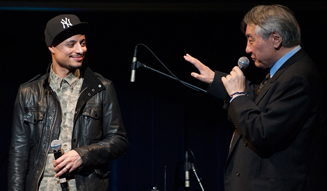
A New Era for Jazz Singers
Namekata"Trouble" is a truly great song with the power to transcend genres and generations. There are many great singers in the jazz world, but few who write great songs.
JamesI think a new era is dawning for jazz singers as well. In the past, wonderful singers like Nat King Cole and Billie Holiday had songwriters who provided them with great songs. Now, it seems singers are moving towards writing songs as a personal expression.
Of course, in writing them, I'm influenced by Bill Withers, and I have people like Emily King who help me with songwriting, but overall, I think singers are heading in a new direction.
NamekataI feel like you're bringing a fresh breeze to jazz. One last thing: I heard you also do production?
JamesActually, there's a Japanese trumpeter named Takuya Kuroda who also performs with me on tour. We've been working together for about three to four years. I'm currently recording his record in New York.
NamekataWhich label will it be released on?
JamesBlue Note Records.
NamekataReally? Does Don approve?
WasYes. The contract was just finalized (laughs).
NamekataSo, trumpeter Kuroda's record will also be released on Blue Note (laughs). Please look forward to it.

Don Was
Born in Detroit, Michigan. Musician, producer. Achieved widespread fame in the 1980s with the group Was (Not Was), formed with David Weiss (David Was). Concurrently, he has produced numerous major artists such as Bob Dylan and The Rolling Stones. In January 2012, he assumed the position of President of Blue Note, achieving continuous success.

Jose James
A jazz singer born in Minneapolis, residing in New York. He became engrossed in jazz after hearing Duke Ellington's "Take the 'A' Train." His beautiful voice, said to have redefined vocal jazz, has been highly acclaimed worldwide, dominating jazz and club charts both domestically and internationally. In 2012, he moved to Blue Note. In January 2013, he released his fourth album, "No Beginning No End."

Hitoshi Namekata
Record producer. Has released numerous works to the world through "Blue Note" and its sister label "Somethin' Else." His edited and translated works include "21st Century Edition Blue Note Book" (Jazz Critique Books) and "Introduction to Blue Note Revisited" and "Blue Note Records" (both Asahi Bunko). He is currently promoting a campaign titled "BLUE NOTE NOW 2013" in anticipation of next year's 75th anniversary. http://www.emimusic.jp/jazz/bluenotenow2013/