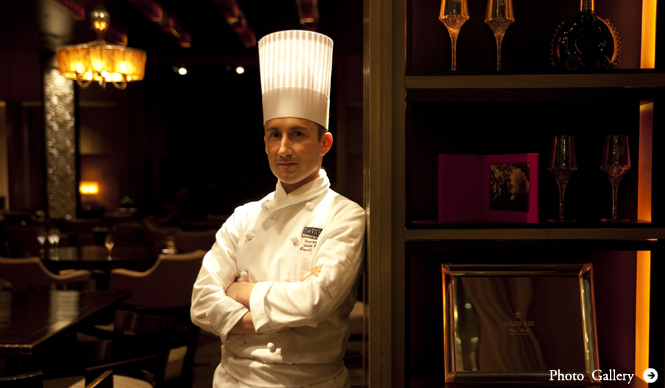
LOUIS XIII Chapter 8 Ambassador David Blanc
LOUIS XIII
Ambassador Interview 5
David Bellin
(Vice President, Culinary Operations, Western Cuisine; Chef of The French Kitchen, Grand Hyatt Tokyo)
A project where 13 ambassadors resonate with the uncompromising craftsmanship of LOUIS XIII, the finest brandy, and convey its allure. We bring you interviews from "Maison Louis XIII," a limited-time pop-up at "Maduro" bar in Roppongi's Grand Hyatt Tokyo. For our fifth installment, we feature David Bellin, Vice President of Culinary Operations, Western Cuisine, and Chef of The French Kitchen at the same Grand Hyatt Tokyo.
Text by MATSUO DaiPhotographs by IGARASHI Takahiro
Raised with Brandy in Daily Life
In Japan, I often drink wine, and don't have many opportunities to drink brandy. But when I return to my family home in France, I always drink brandy. The town where I was born and raised, Poitiers in the Vienne department, is only about 80km from the Cognac region, known for its brandy production. So, I remember my grandparents always drinking brandy after family meals when I was a child. I imagine it's a similar experience for most families in Poitiers. When I'm in France, I often drink it after finishing my coffee, and enjoying brandy with a cigar is a daily ritual.
Yet, even for us French, who are familiar with brandy, LOUIS XIII is a special spirit that everyone knows. It is a brandy that has undergone a painstaking process over 100 years before it can be bottled. There is a "passion" in its production that transcends the realm of work.
An Aroma That Lingers for Over 30 Minutes
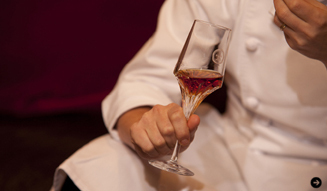
Actually, the first time I tried LOUIS XIII was with a friend after I moved to Japan. The general image of brandy is that it's strong, but this was different. I wanted to savor its pure taste, so I drank it neat. As expected of brandy, I felt its strength, but it didn't burn my throat. It was incredibly smooth. The aroma is also superb. Unlike the sharp, pungent alcohol aromas you might expect, it has a woody, or "boisé" as we say in French, impression from the barrel. Following that, there's an aroma like candied fruit. It's surprising that a spirit aged for 100 years can be so fruity. How can it be so refreshing? Even after drinking, a pleasant aroma lingers in the mouth, allowing me to enjoy the moment for over 30 minutes. If I were to pair it with food, it would naturally be with dessert, given it's brandy. Perhaps baked fruit or a jelly made with Sauternes, known as one of the world's three great botrytized wines.
Two Cultures France is Proud Of
I feel a sense of French pride with LOUIS XIII. It shares a similar philosophy with my cooking: simplicity and respect for ingredients. There might be ways to make delicious brandy without such a long aging process, but they choose not to add anything. I believe this uncompromising stance is crucial for a chef as well. Encountering a first-class spirit like this refines one's sensibilities. French cuisine is undoubtedly a culture that France is proud of, and I believe LOUIS XIII is similarly a culture that France is proud of.
David Bellin
Born in 1974 into a farming family in Poitiers, Vienne department, in western France. Raised amidst the vast nature and fresh ingredients of Poitiers and his mother's delicious home cooking, he naturally gravitated towards a culinary career. He served as sous-chef at two three-Michelin-starred restaurants in Paris, "Restaurant Alain Ducasse," and "Louis XV - Alain Ducasse à l'Hôtel de Paris" in Monaco. In 2004, he became Executive Chef from the opening of "Beige Alain Ducasse Tokyo" in Ginza. From 2010, he also served as Chef at the bistro "Benoit" in Aoyama. For 15 years, he held important positions within the global Alain Ducasse group, cherishing the philosophy of respecting ingredients, a teaching from Mr. Ducasse. Since 2011, he has been Vice President, Culinary Operations, Western Cuisine, and Chef of The French Kitchen at Grand Hyatt Tokyo. He is committed to simple cuisine that brings out the natural flavors of seasonal ingredients with minimal intervention.