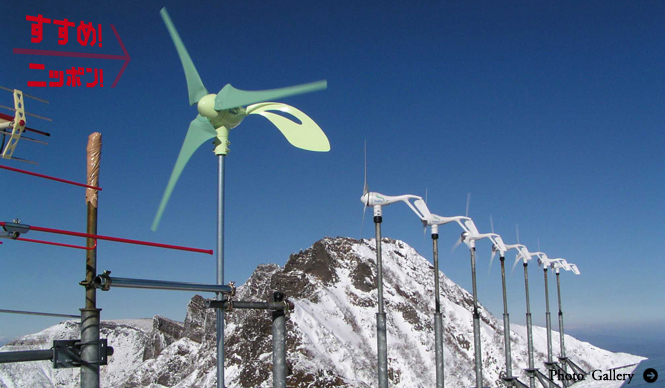
People and Companies Building a New Era—Zephyr Edition | SHIFT JAPAN
People and Companies Building a New Era──Zephyr
Small Wind Turbines Hold Great Potential (1)
Wind power is often discussed as a form of natural energy. It's a system that converts wind energy into electrical energy, and the image of large systems lined up along coastlines is strong. However, systems suitable for schools and individual homes also exist.
Text by Fumio OgawaPhotos (Portraits) by Kenta Yoshizawa
Energy for a New Era
Zephyr is considered a pioneer in small wind power generation systems. Founded in 1997 as a specialized manufacturer focused on new energy, the company has its offices in a corner of Tokyo's Shinjuku sub-center. Since then, it has developed its own unique small wind power generation systems, with a track record of over 5,000 installations in more than 40 countries worldwide. We spoke with Zephyr's President and CEO, Tomoya Endo, about the future potential of small wind power generation systems.
──What led you to develop and sell wind power generation systems?
Our founder came from an audio equipment manufacturer background and started the company with the aspiration to contribute to society through manufacturing. At that time, he focused on what signatory nations would do in response to the Kyoto Protocol (regulations setting targets for greenhouse gas reduction) in December 1997.
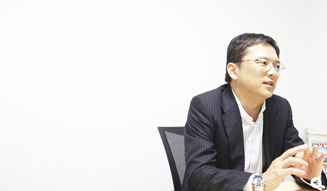
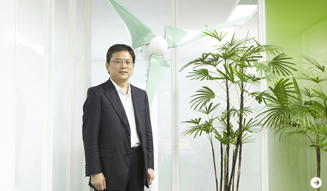
Tomoya Endo, President and CEO of Zephyr
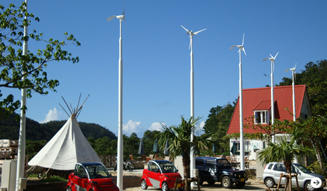
Compact size means it can be installed anywhere (Iriomote Island).
──So you decided to make power generation your business.
With the support of the Ministry of Economy, Trade and Industry, we believed it was important to create energy for a new era. There were two conditions: first, no CO2 emissions, and second, utilizing natural energy. We thought these were the means to achieve the goals set by the Kyoto Protocol.
──It's interesting that Zephyr focuses on small wind power generation systems, aiming for installation in companies and schools.
We're receiving many requests to install systems on company and school grounds even within Tokyo. I believe this is related to the increasing number of individuals taking action for the environment. For example, driving a hybrid car can be seen as an expression of a personal desire to do something good for the environment. Such individuals are showing interest in our products.
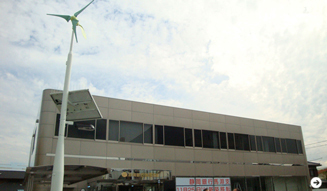
An increasing number of companies are adopting wind power (Shizuoka Bank).
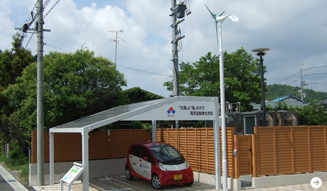
It can also charge devices with storage functions, such as EVs.
──Furthermore, are concerns about power supply, such as planned blackouts after the earthquake and current power conservation efforts, also driving purchases?
I believe more people are feeling anxious about power supply or have become interested in the nature of power supply itself, prompted by the recent earthquake. I suspect more people are seriously considering securing power sources for emergencies.
──Have there been any changes in sales?
Interest in the market seems to be growing. The number of inquiries has increased tenfold compared to before the earthquake. Many people are now thinking of securing multiple energy sources, rather than relying on just one, as a form of 'insurance' for emergencies. I believe this is one of the reasons for the upward trend in sales.
People and Companies Building a New Era──Zephyr
Small Wind Turbines Hold Great Potential (2)
Sales in FY2011 Expected to Triple from the Previous Year
──How is the wind power generation system configured?
Taking our product 'Air Dolphin' as an example, we propose optimal systems tailored to customer needs by combining a wind turbine, a pole to erect it from the ground, solar panels, cables, a remote monitor, an inverter, and batteries. Our company's specialty is not just selling wind turbines, but designing self-generation systems according to customer needs. The Air Dolphin system, by the way, costs around 2 million yen.
──What are the product's features?
The core of our development is to convert as much wind as possible into electricity. And to make it usable anywhere. We've focused on making it lightweight and durable. For example, the blades are made of carbon fiber, co-developed with Toray. At 380g per blade, they are incredibly lightweight. They track the wind well, stop easily when the wind picks up, and significantly reduce the risk of injury to people or property in the unlikely event of an accident compared to other materials.
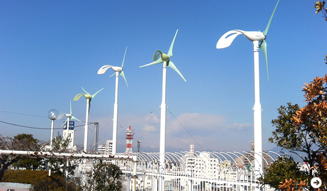
Rooftops of well-ventilated buildings are ideal for installation (Takasaki Takashimaya).
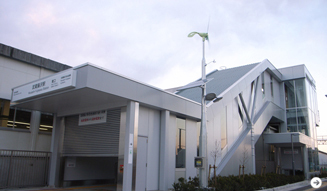
An example of powering streetlights with wind energy.
──What about its performance?
The rotors of conventional wind turbines can become unstable in excessively strong winds, so they are typically stopped at wind speeds of 25m/s. However, we felt this was a waste, so the Air Dolphin is designed to continue generating power regardless of wind speed. In terms of performance, its rated output is 1.1kW (at 12.5m/s), but we consider this a 'passing point for output,' and it can produce a momentary maximum of 4.0kW (at 20m/s or higher). Even in gale-force winds (20m/s or higher), it continues to operate by reducing rotor speed and throttling output.
──What is the actual sales situation?
The Air Dolphin was released in 2007. Since then, shipments have reached 1,500 units each domestically and internationally. This later increased to 5,000 units, and for fiscal year 2011, we anticipate a threefold increase compared to the previous year.
──What is the breakdown of customers?
In Japan, corporate and individual customers are almost equal. Individual customers appreciate the Air Dolphin's capability to generate 100kWh with an average monthly wind speed of 5m/s, which can cover about one-third of household electricity consumption. They also value the fact that with a battery, it can serve as an emergency power source. For corporations, it's used for electrification in areas without power or for energy saving purposes. A recent example is its use for lighting at the 'Mercedes-Benz Connection' opened by Mercedes-Benz Japan in Nogizaka.
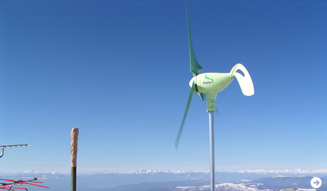
Installed at Akatake Tenbou-so in Yatsugatake.
“The importance of power generation through a circular system has been re-recognized by the public.”
──Are there also needs in special regions?
Even in areas without electricity, its ability to be installed quickly, its cost-effectiveness compared to diesel fuel, and its significantly lower CO2 emissions are highly valued. In Japan, for instance, it's installed at Akatake Tenbou-so in Yatsugatake. Its broad coverage also contributes to strong overseas sales. We have established a wholly-owned subsidiary in Colorado, USA, and even opened an office in Stockholm, Sweden.
──Concerns are often raised about wind power, such as noise pollution with very low frequencies and threats to birds.
While noise cannot be eliminated entirely, we are confident that Zephyr's products are overwhelmingly quieter compared to products of the same standard. Taking the Air Dolphin as an example, we use 'Silent Disruptor Blades,' which feature a surface treatment inspired by the silent flight of owl feathers, to significantly reduce noise caused by airflow. Regarding bird strikes, our products have reportedly resulted in only one incident in the past three years.
ZEPHYR CORPORATION
Development, manufacturing, and sales of equipment related to wind, solar, and hydroelectric power (including design, construction, leasing, and maintenance for installation, handled as a complete package), as well as consulting. Business development in fields such as home use, industrial use, school education, commercial use, marine use, and large-scale power generation.