Chapter 5 Ruinart | Dazzling Femininity
Ruinart
Dazzling Femininity
Ruinart, founded in 1729, is the oldestChampagnehouse. Much of its production is consumed domestically, so it was little known in Japan except among connoisseurs. However, with the release of a transparent-bottled Blanc de Blancs in 2001, it quickly became the talk of Champagne lovers who, despite the limited imports, felt a dizzying femininity in its elegant and delicate flavor, asking each other, "Have you tried Ruinart?"
Photo & Cooperation by Kenichi SaitoEdit & Text by Yumiko Akita
Chalky Soil Imparting Beautiful Minerality
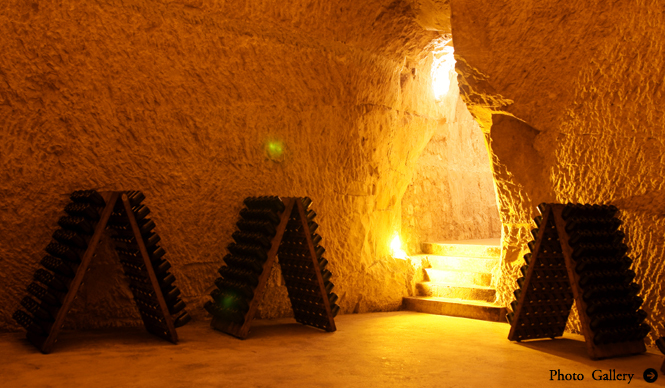
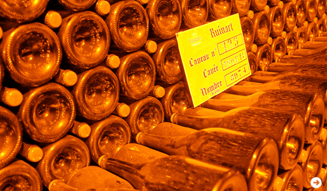
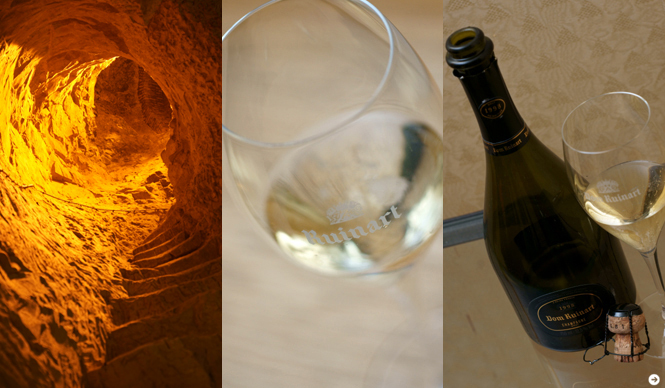
To unravel the mystery of its taste, we were first guided to the crayères (chalk cellars) dug deep underground. These cellars have existed since the Gallo-Roman era, 2-3 centuries ago, and were excavated over centuries as quarries. Deeper underground than other cellars, free from vibrations, and with a humidity of 85% – ideal for wine preservation due to the chalk's moisture-retaining properties.
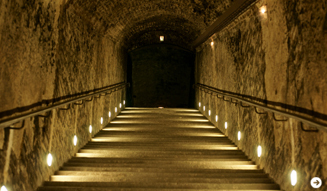
This chalky soil, forming the 8km-long cellar, imparts a beautiful minerality to the Champagne and is a crucial element defining the terroir of the Champagne region. The closer the chalky soil is to the surface, the higher the classification; the more layers of sand, gravel, and clay soil deposited on top, the lower the rank. We descended 100 steps to a depth of 24 meters from the entrance. From there, we went another 12 meters deeper, to 36 meters below ground. Although accustomed to the cool, damp air of underground cellars, this cave attraction (?) elicited cheers from everyone.
A Commitment to Blanc de Blancs – 100% Chardonnay
At Ruinart, all other cuvées use at least 40% Chardonnay. While Pinot Meunier adds body easily, it ages quickly and produces larger bubbles, so the base is typically Chardonnay and Pinot Noir. Furthermore, both the 100% Chardonnay Blanc de Blancs and the blended Rosé undergo at least three years of bottle aging. This is because Chardonnay ages slowly and tends to be delicate. For the 100% Chardonnay Dom Ruinart, there are at least eight years of bottle aging. The current 1998 vintage uses grapes from 100% Grand Cru, with 66% Chardonnay from the Côte des Blancs, known for its fresh acidity and airy profile, and 34% Chardonnay from the Montagne de Reims to provide structure, power, and fruitiness.
Leaving an Unforgettable Impression
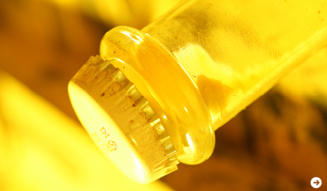
The increased use of Chardonnay began in the 1960s, with the first vintage of Dom Ruinart being 1959, released in 1967. This dedication to a delicate and elegant style, characteristic of Chardonnay, is evident in the release years of its finest cuvée, the 100% Chardonnay Dom Ruinart. For example, in 2000, a year noted for its exceptional power among Champagne houses with various blended styles, Ruinart decided not to release a 100% Chardonnay Dom Ruinart, stating that "the ideal delicate elegance cannot be expressed." Instead, they are using it as a liqueur de vin for dosage. This is a natural judgment for a maison that maintains a firm style. The resulting dizzying flavor of the Champagne, its unforgettable aftertaste, is like the lingering scent of a beautiful woman as she departs.
Tasting Notes
Ruinart Blanc de Blancs
Grape Variety | 100% Chardonnay
Suggested Retail Price | ¥9,240
The 2001 transparent-bottled Blanc de Blancs offers fresh notes of apple, peach, and citrus, with a pleasant roundness and lightness like mousse. A hint of butter is followed by a fruity, refreshing finish.
Dom Ruinart 1998
Grape Variety | 100% Chardonnay
Suggested Retail Price | ¥25,200
Remarkable freshness and delicacy for a 10-year-old wine. Rich floral aromas, not overpowering at first impression, but with an exceptionally long finish. A stony minerality, with a fruity softness despite the acidity. Here, we can see the beautiful crystallization of 100% Grand Cru Chardonnay.
With the cooperation of:
Ruinart
http://www.ruinart.com/
Salon de Vinofull
Tel. 03-5795-2553
Japan Inquiries:
MHD Moët Hennessy Diageo (Ruinart)
Tel. 03-5217-9738