A Champagne Journey in France | Chapter 2 | Overwhelmed by a Style Favored by Connoisseurs
Jacquesson
Overwhelmed by a Style Favored by Connoisseurs
ChampagneWhen indulging in the pleasure of drinking Champagne, one doesn't typically ponder the philosophy behind the bubbles. To do so would be rather uncouth. If you encounter a Champagne that truly moves you, the only appropriate response, as a hedonistic Frenchman would, is a quiet, wide-eyed "Magnifique!" (Wonderful!). Jacquesson's Champagne transcends imagination with its profound flavors and enigmatic character. From the very first sip, you are captivated by its unique, groundbreaking style—a style that could be called the "Jacquesson philosophy." In fact, during a tasting, the room was filled with a hushed reverence, a shared experience of intense impact that left us speechless, struggling to articulate what we were tasting.
Photo & Cooperation by Kenichi SaitoEdit & Text by Yumiko Akita
A Competitor Among the Top Five Champagne Houses
Now counted among the top three Champagne houses alongside Krug and Bollinger, Jacquesson is a maison lauded alongside Egly-Ouriet, Jacques Selosse, and Salon. Founded in 1798 by the Jacquesson family, the maison was favored by the powers of the era, even served at Napoleon's wedding and awarded the Médaille d'Or. It is also known for pioneering the use of the muselet (cagework) and cap seal on Champagne bottles. Joseph Krug, the founder of Krug, even studied winemaking techniques at Jacquesson before establishing his own house. After facing financial difficulties in the 1800s, leading to downsizing and sales, the cellars were expanded in 1974 by the father of the current owner, Jean Hervé, who then passed the reins to his son in 1988, leading to the maison's present state.


Unwavering Dedication and Bold Challenges
Jean Hervé's exceptional quest for knowledge and pursuit of terroir, coupled with his statement that he "sought to surpass my father's Champagne-making methods," has led him to undertake numerous challenges during his tenure. "I have changed everything—the vineyards, viticulture, winemaking, bottling," he explains.
The vineyards now employ lutte raisonnée (reasoned viticulture), eschewing herbicides. Grass is intentionally allowed to grow between the rows, with specific seeds sown to encourage competition for nutrients, prompting the vines to absorb them more effectively. Of the 30 hectares of vineyards, 20 are owned by the maison, comprising three Grand Cru villages—Aÿ, Avize, and Oiry—and Premier Cru villages of Dizy, Hautvillers, and Mareuil-sur-Aÿ. The contract growers' vineyards are located near the maison's own, ensuring meticulous oversight of grape development. The finest grapes from the Grand Cru and Premier Cru vineyards are carefully pressed, and only the best of the first press juice is used. The rest is either used as "waste wine" to neutralize the flavor of large oak barrels or sold to other négociants. Fermentation occurs in large oak barrels for 90% of the production and in stainless steel for the remaining 10%. These are just a few examples of the meticulous processes involved.
Innovative Champagnes Expressed Through Cuvées
Wine journalist Kenichi Saito remarks, "It is remarkable that a maison of this scale can sustain itself without resorting to industrial production methods. They do not have a standard cuvée, their best-selling staple product. Even their non-vintage offerings, which blend wines from multiple years, clearly indicate which year's wine serves as the base and which are blended in. This level of expertise, pushing the boundaries of what is possible in Champagne, results in a unique minerality, like licking crystal, and a distinctive brilliance."
The Pleasure of Drinking 'Time'
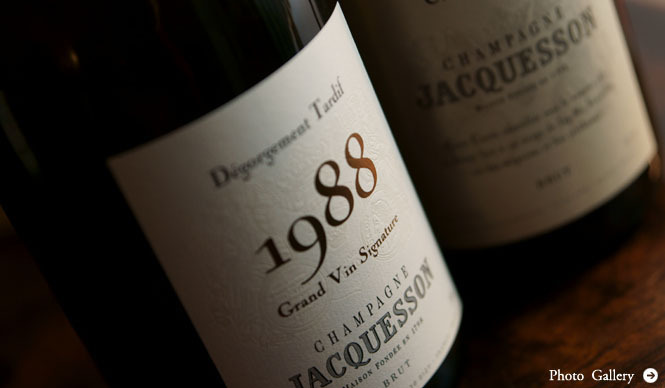
This time, we had the privilege of tasting a Dégorgement Tardif from the significant 1988 vintage, the year Jean Hervé became the owner. After 21 years of aging, it had transformed into the "Magnifique!" Champagne mentioned earlier. Perhaps it was the anticipation, or perhaps it was the magic added by Mr. Hervé's service, but the experience was truly extraordinary. Wine is meant to be a drink of 'time,' and the intensity of our gustatory memories changes depending on the time we drink it, who we are with, and the occasion. Encounters with Champagne that allow us to understand this special pleasure are rare.


Tasting Notes
Cuvée 733
Grape Varietals: 50% Chardonnay, 25% Pinot Noir, 25% Pinot Meunier
Suggested Retail Price: ¥7,875
This series, named with cuvée numbers, offers distinct tastes depending on the base vintage. Adopted since 2000, the concept is to create the best Champagne of the year with stable quality. Cuvée 733 is a product blended with wine from the 2005 vintage as its base. They plan to release wines with different aging periods from the same wine four years later. Intense fruit aromas rise, accompanied by a lively effervescence and notes of custard.
Vintage 2000
Grape Varietals: 50% Chardonnay, 50% Pinot Noir
Scheduled for release next year
Uses Chardonnay from Avize Grand Cru, and Pinot Noir from Verzenay (20%), Dizy (20%), and Aÿ (10%). Aromas of brioche, rich fruitiness, and an elegant, long finish.
Avize Grand Cru 2000
Grape Varietals: 100% Chardonnay
Suggested Retail Price: ¥12,600
Uses 100% Chardonnay from three organically farmed plots (La Fosse, Champ Caïn, Nemery) in Avize Grand Cru. An enveloping aroma of flowers and cigar, a magnificent balance of volume and acidity, and a sense of maturity.
Dizy Terres Rouges Rosé 2004
Grape Varietals: 71% Pinot Meunier, 29% Pinot Noir
Suggested Retail Price: ¥23,100
This deep color is achieved through maceration to extract color from the black grapes, similar to the Saignée method used by Drappier. Aromas of raspberry and apple, reminiscent of eating ripe grapes, yet with a crisp finish. It possesses vibrant acidity and a power that is surprisingly light and charming.
Dégorgement Tardif 1988
Grape Varietals: 42% Pinot Meunier, 37% Chardonnay, 21% Pinot Noir
Reference Product
The first vintage in a trilogy of long-aged styles, produced only in exceptional years. The 1988 vintage, with a production of 600 bottles, is a blend of three grape varietals. 1989 and 1990 have been released subsequently. This particular bottle, disgorged in October 2009, surprisingly retains its freshness despite 20 years of bottle aging. It offers a complex and rich flavor profile with a strong floral aroma, reminiscent of jasmine perfume, and notes of custard.
With the cooperation of:
Jacquesson
68 rue de Colonel Fabien 51530 Dizy
www.champagnejacquesson.com
Salon de Vinofull
Tel. 03-5795-2553
Inquiries in Japan:
Vin Passion
Tel. 03-6402-5505