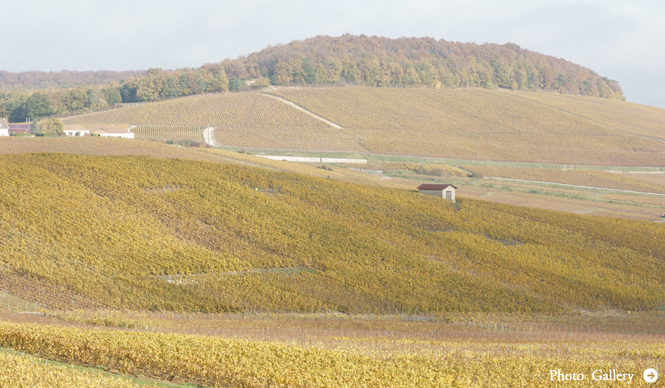
A Champagne Journey in France | Chapter 1 | Introduction & Bollinger
Chapter 1 | Introduction & Bollinger
In times of joy, in times of sorrow,Champagneis what we drink.
We drink it when we are lonely.
It is indispensable when we are with someone.
We sip it when we are not hungry, and drink it when we are.
Otherwise, we do not touch Champagne.
Unless we are thirsty.
— "Madame Lily," wife of Bollinger
(October 17, 1961, The London Daily Mail)
Photo & Cooperation by Kenichi SaitoEdit & Text by Yumiko Akita
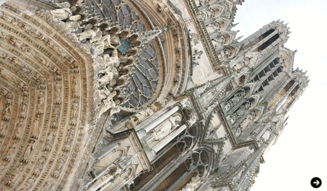
Notre-Dame Cathedral of Reims, a World Heritage site
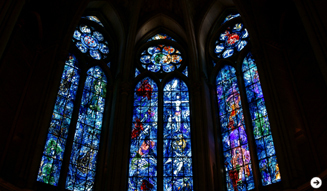
Chagall's stained glass
A Journey Through Seven Houses
In early November, the Champagne region, 150 km east of Paris, was already painted in the colors of fallen leaves. While it varies by house, this is a time when preparations are made for the first stage of tasting to assess wine quality, after the crucial process of fermenting the year's harvest. For the houses, it's also a time when the tension that has built since before the harvest slightly eases, making it an ideal period for visits. "Visits might be turned down during the busy period of important wine production," says wine journalist Kenichi Saito. Indeed, due to scheduling conflicts, visits to several small-production houses with cult followings had to be postponed until next year.
This visit, however, focused on seven houses that operate as 'Négociant-Manipulant' (NM), producing Champagne using grapes from their own vineyards and those from contracted growers. The historical significance of each house, their reputation for consistent high quality and commitment to grapes, the vastness of their centuries-old underground cellars alongside modern winemaking facilities, vintage wines aged for years in their cellars, and tastings in salons with fireplaces – this selection of seven houses offers a more than sufficient luxury lineup to understand the miraculous bubbles of Champagne.
Among the houses visited, only Ruinart and Moët & Chandon accept general visitors. The visiting team, led by organizer and wine journalist Kenichi Saito, comprised nine people including an interpreter. Their base was Reims, a city famous for its Notre-Dame Cathedral, a site of coronations for French kings in the Middle Ages, featuring stained glass by Chagall and renowned for Joan of Arc. Beyond the sheer value of admiring this beautiful Gothic architecture, the subsequent tastings of prestige Champagnes at these esteemed houses made for an unexpectedly rewarding tour. We aim to document the valuable insights and tastings from visits to these seven houses over several installments.
Bollinger
A Powerful and Stylish Palate Seeking Maturity
Simply put, there are feminine and masculine types of Champagne. The former evokes softness and roundness, while the latter expresses overwhelming power and fullness. Bollinger, founded in 1829, is a house that emphasizes the latter type, as evidenced by James Bond's preference in "007." Had we heard that Bond preferred Ruinart's Blanc de Blancs, known for its feminine elegance among the houses visited, the casting might have been different. Perhaps it's the Bond image, but I suspect I'm not alone in feeling that men (and women) who favor Bollinger possess a certain stylishness, as if they could pull off a Tom Ford suit (as worn by Bond in "Quantum of Solace").
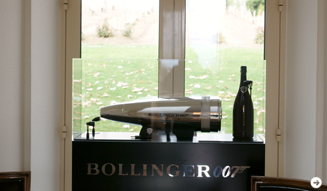
A salon decorated with collector's items released last year to commemorate the premiere of the 007 film "Quantum of Solace." The case, inspired by a Walther PPK bullet, contains La Grande Année 1999.
The Secret Behind the Glamorous Flavor Loved by Bond
Furthermore, the volume and the mushroom-like aroma and creamy effervescence, resulting from Bollinger's signature "barrel fermentation and aging," undeniably enhance a glamorous mood. Houses that practice "barrel fermentation and aging" are exceptional in Champagne; it requires delicate care, maintenance, space, and financial resources. Only a few houses, such as Krug, J.M. Seleque, and Jacques Selosse, demonstrate such commitment. Bollinger also adheres to a concept of keeping Pinot Noir at 60% and Pinot Meunier at 20%. They use Pinot Noir generously for its body-building qualities, limit Meunier, which easily adds fruitiness and roundness, to the minimum, and do not barrel-ferment it because its faster aging compared to other varietals could compromise its characteristics.
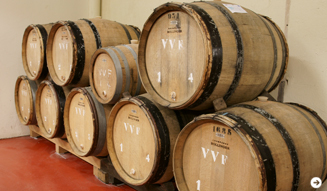
Vieilles Vignes Françaises (VVF) during fermentation in 2009
The secret to the exceptionally high quality doesn't end there. As of November 2009, 60% of the grapes were sourced from their own vineyards (163 ha), 85% of which are Grand Cru. Moreover, the proportion of Grand Cru and Premier Cru grapes used is a minimum of 80% for the Special Cuvée, aged for three years, and 100% for La Grande Année (and R.D.), which is released after a minimum of five years of aging. This high percentage of classified growths reflects the incredibly high quality of the grapes themselves. Without it, Champagne could not withstand such long aging.
The Miraculous Vineyard Known as VVF
If asked, "What else is unique to Bollinger?" and you answer "Vineyards that escaped the phylloxera epidemic," you'd be quite the Champagne connoisseur. Though we couldn't taste it, Bollinger has two plots right next to the house planted with ancient grape varietals using the marcottage method, without grafting. Vieilles Vignes Françaises (VVF), a Champagne considered miraculous, is made from 100% Pinot Noir from vines that survived the phylloxera (a parasitic insect) epidemic that devastated Europe in the 1800s. While the annual production is a scarce approximately 10 barrels (8.5 barrels in 2009), any wine not meeting Bollinger's quality standards during vinification, even from these vines, will not be released as VVF.
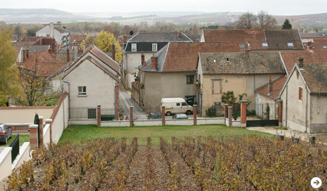
The Vieilles Vignes Françaises vineyard
What's the Verdict on the 2009 Vintage?
In 2009, many in Burgundy predicted "a high probability of a great vintage." Here in Bollinger, it was said, "There's a 90% chance it will be a good year." Of course, they added, "At this stage," a qualification born from scientific analysis of sugar levels at harvest and a cautious awareness of unpredictable factors during winemaking. Regardless, we must wait a little longer to know if this year will indeed be a great vintage.
In today's economic system, which prioritizes annual trends and short-term profits, often driven by global strategies, the quality and style preserved through two centuries of family management hold profound significance. The stringent standards established by Madame Lily, Jacques Bollinger's wife, who took over management in 1941, have safeguarded further "quality and style," allowing us to savor a glamorous feeling at any time. This is because the powerful finish, as light and complex as a romance, is always within reach.
Tasting Notes
Special Cuvée
Grape Varietals | Pinot Noir 60%, Chardonnay 25%, Pinot Meunier 15%
Reference Price | ¥7,875
Special Cuvée accounts for 80% of Bollinger's production. Aged for over three years, it uses grapes from vineyards with a minimum 80% classification. "The 'rosary-like' golden bubbles are beautiful. The toasty aroma spreads in the mouth, revealing flavors of roasted nuts and dried fruits, filling the palate with a pleasant acidity and a sweet, fragrant finish. For its price, the quality is remarkably reasonable," says Saito.
Bollinger Rosé
Grape Varietals | Pinot Noir 62%, Chardonnay 24%, Pinot Meunier 14%
Reference Price | ¥10,500
Based on Special Cuvée, with 5-6% red wine from Grand Cru vineyards in Aÿ and Verzenay Pinot Noir added. It offers a tightly structured, delicate flavor profile with a rich palette of fruit notes.
La Grande Année 2000
Grape Varietals | Pinot Noir 65%, Chardonnay 35%
Reference Price | ¥18,375
Bollinger's prestige cuvée, produced only in exceptional years. After barrel fermentation, it is aged in the bottle under cork for over five years before release. The bottle tasted was aged for eight years, disgorged in January 2009. "It's still young; I'd wait another five to six years. Its potential and fineness are outstanding," says Saito. He notes that warming it and decanting it can reveal notes of café noisette.
With Thanks To:
Bollinger
www.champagne-bollinger.com
Salon de Vinofull
Tel. 03-5795-2553
Japan Inquiries:
Arcan
Tel. 03-3664-6591