Japan Craft Sake Company Presents 'The Master of Craft Sake' VOL. 5 Kokuryu Brewery | INTERVIEW
The Master of Craft Sake VOL.5 "Kokuryu Brewery"
Interview with Naoto Mizuno, 8th Generation Toji
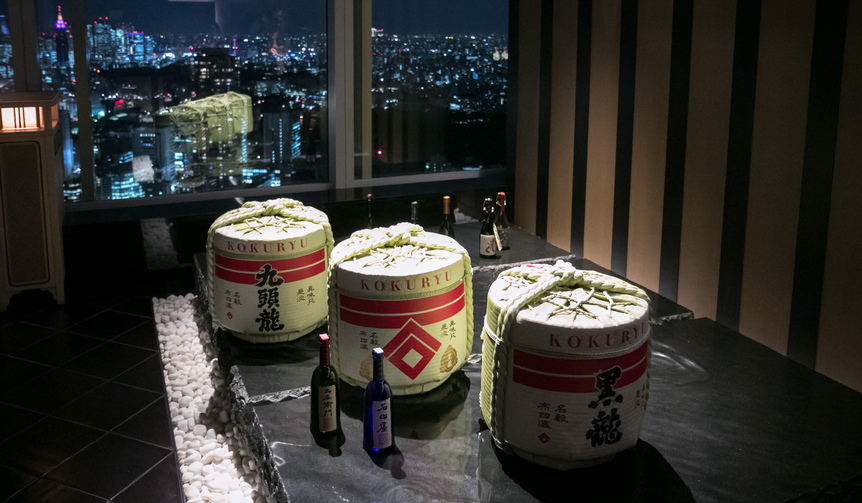
On September 27th, an event titled "The Master of Craft Sake," hosted by JAPAN CRAFT SAKE COMPANY, led by Hideki Nakata, was held at Hinokizaka, the Japanese restaurant at The Ritz-Carlton, Tokyo in Roppongi. Set within the renowned five-star hotel, the event offered a special evening with exquisite cuisine and ambiance, welcoming master brewers from across Japan who meticulously craft their sake with unwavering dedication.
Photographs by Tsutomu TanakaText by June Makiguchi
An Interview with Naoto Mizuno, 8th Generation Toji of Kokuryu Brewery, on the Charms of Kokuryu
This fifth installment features Kokuryu Brewery, founded in 1804, the first year of Bunka. Since the first Toji, Ishidaya Jizaemon, began brewing sake in Fukui Prefecture's Yoshida District, blessed with high-quality water, the brewery has adhered to the simple yet paramount principle of "brewing good sake." They utilize the underground water from the Kuzuryu River, part of the Hakusan water system, which flows deep beneath the brewery. Near its source, rice paddies for sake brewing stretch out richly. The harsh winter slowly encourages fermentation by yeast. We spoke with Naoto Mizuno, the representative and 8th generation Toji of Kokuryu Brewery, which has been brewing local sake for 213 years in Eiheiji, blessed by nature, and is credited with pioneering the premium sake movement, about the allure of Japanese sake and "Kokuryu."
—"Kokuryu" is a representative Japanese sake, isn't it? It's known overseas too.
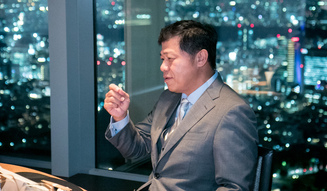
Naoto Mizuno (hereinafter, Mizuno)Actually, shipments overseas account for only 2-3% of our total production. However, we have a long history and have been exporting overseas for nearly 20 years. Initially, I wanted to see how well Japanese sake would be received in France, a major wine-producing country, so we started distributing it there. That led to a partnership with a US importer, and then exports to Asia began. At first, I personally carried bottles to France. I would dine at a three-star restaurant and then approach the sommelier, introducing myself as a sake brewer. As a customer, they listened attentively (laughs). I was curious about how it would be perceived, so I was essentially going to get their evaluation.

—Twenty years ago, "SAKE? What's that?" was still the common reaction overseas.
MizunoIt was a time when Japanese sake was not readily available or appreciated abroad. So, initially, at the Japan Cultural Centre in Paris, I collaborated with Okui Kaiseido, a kelp company from the same prefecture, Fukui, to host an event pairing Japanese sake with kelp. While Japanese cuisine is highly regarded now, back then, much of it was merely "so-so." People didn't know about making proper dashi from kelp. Although "UMAMI" is now a globally understood term, we conducted tastings from a point where neither dashi nor umami were understood at all, and by pairing it with sake, we worked to promote Japanese flavors.
—You were engaged in grassroots efforts.
MizunoYes. However, the evaluations from winery owners and sommeliers were already high. At the time, most sake consumed overseas was warmed sake (kanzake), so the image of Japanese sake was something drunk at the end of a meal, like a pick-me-up. It wasn't necessarily delicious; the stronger image was simply about consuming alcohol. Therefore, the ginjo sakes, like the daiginjo I brought, were truly astonishing to them. They were surprised that such an elegant and delicate Japanese sake existed.
—I must admit, I've also had more opportunities to drink sake recently, and as a Japanese person, I'm surprised by the many facets of Japanese sake.
MizunoThank you. In Japan, the culture of chilled sake only began around the 1960s and became widespread in the 1970s and 80s. Nowadays, people commonly drink chilled sake, and terms like ginjo and junmai are well-understood. It's surprisingly recent that we've reached an era where people can enjoy these specific designations. In the past, such terms didn't even exist. The Japanese Sake Grading System (a classification system under the Liquor Tax Act, where sake was divided into Special, First, and Second Class based on alcohol content and quality) was abolished in 1992. Sake culture changed dramatically after the grading system disappeared. Furthermore, sake was once sold at a uniform national price based on its grade. Amidst this, Kokuryu Brewery pioneered the production and sale of daiginjo. Both in Japan and overseas, our initial sales efforts involved simply suggesting, "Please chill it in the refrigerator."
The Master of Craft Sake VOL.5 "Kokuryu Brewery"
Interview with Naoto Mizuno, 8th Generation Toji (Part 2)
—While the popularity of Japanese sake is growing overseas, do you feel that domestic attention towards sake is also changing?
MizunoAlthough the population is declining and overall alcohol consumption is decreasing, regional breweries, the so-called local sake makers, are producing increasingly excellent sake and working hard, so their reputation is growing. Currently, younger brewers and regional breweries are emphasizing their unique identities and starting to produce a variety of sakes. Rather than modern brewing techniques, they are returning to traditional methods, a kind of "back to basics" approach. With a focus on local production for local consumption, they are actively developing yeasts and sake rice, often using rice grown locally, similar to wine production. There was a period when easily understandable sakes with fragrant aromas were popular, and everyone was making similar types of sake. However, recently, things have diversified, and each brewery's policy has become clearly defined.
—Has Japanese sake culture matured?
MizunoI believe so. I think it has become an interesting era. As for Kokuryu Brewery, the taste of our sake is established to a certain extent. Fukui is famous for Echizen crab and yields abundant white fish, so the local ingredients are often delicate and subtly sweet. We aim to create a sake that complements such ingredients – not one that emphasizes aroma and flavor, but rather one that is elegant, soft, with a subtle umami that spreads, yet finishes with a clean crispness. The concept is to be a companion to the food. We have not wavered from this concept. Our current theme is to cultivate a culture of enjoying Japanese sake together with food. To achieve this, we need elements like changing glasses according to taste and type, similar to wine. This is why we create original glasses and sake cups, as well as tools for warming sake, such as tin tokkuri (sake flasks).
—Having more tools for savoring sake seems to broaden the enjoyment.
MizunoIn the Edo period, there were many diverse tools for enjoying sake. At that time, sake was typically drunk at room temperature, and warmed sake, which involved the extra step of heating, was considered a sake for hospitality. There were even dedicated attendants for warming sake in restaurants. We want to revive such a culture and introduce the enjoyment of taking that extra step, rather than focusing solely on convenience. Recently, the style of slowly enjoying sake in a wine glass has also become popular. We aim to create a "sake path" by proposing various styles that allow people to fully enjoy Japanese sake.
—How do you personally enjoy Japanese sake?
MizunoI often drink it warmed. Warming sake isn't just for winter; true sake enthusiasts enjoy it year-round. Even if it's not specifically made for warming, I warm everything, including daiginjo. I also recommend sipping it slowly as it cools down after being heated. You can enjoy how the taste changes with temperature variations.


—What are the future plans for Kokuryu Brewery?
MizunoWe built a brewery called Seiryuzo, named with a character from my father's (Masato) name, who was the pioneer of daiginjo and my mentor in brewing. This brewery is not for increasing production volume, but for undertaking various challenges to create even better Japanese sake. We believe that to inherit a good culture, we must continue researching for the diversity of Japanese sake. In other words, preserving tradition means incorporating new things to enhance quality. It goes without saying that it pairs well with Japanese cuisine, but we want to continue brewing better sake so that Japanese sake can be considered as one of the choices for any meal. Japanese sake is a wonderful culture that deserves greater recognition. To deliver its excellence more widely, I want to participate in events like today's to gain an objective perspective. I hope that today, by pairing it with various dishes, you can experience how the same sake changes with temperature and how the enjoyment of sake varies depending on the accompanying food.
Concluding the Interview
For this occasion at "Hinokizaka," we paired the Japanese cuisine with seven varieties of Kokuryu: "Kokuryu Shizuku" with its clear taste for the appetizers; the refreshing "Kokuryu Jizaemon" to enhance the delicate flavor of white fish; the smooth "Kokuryu Ishidaya" for shellfish, sea urchin, and roe; the華やか (hanayaka - gorgeous/showy) and rich "Kokuryu 88 Go" to stand up to robust flavors like grilled dishes; and the warmed sakes, Kudoryu "Daiginjo" and "Junmai." We also sampled "Kokuryu Ginjo Hiyoro" with its crisp, muscat-like aroma, served as an aperitif. All were clean, yet possessed a depth of flavor from aging, presenting a subtly impressive range of sakes. It goes without saying that they enhanced the dishes without compromising their taste, amplifying the deliciousness of both. However, what truly surprised me was the marriage of delicate white fish with "Jizaemon." It was the first time I had experienced a pairing that so beautifully brought out the sweetness of white fish. The harmony with sea urchin and roe with "Ishidaya," and the blissful combination of rich flavors like marinated tuna with warmed sake, created a richness that made me feel it would be a waste to enjoy the food without sake.
Japan Craft Sake Company
http://www.craftsake.jp/