An Interview with Benoît Gouez, Cellar Master at Moët & Chandon | MOËT & CHANDON
MOËT & CHANDON
Interview with Cellar Master Benoît Gouez
The Miracle Named Grand Vintage Rosé (1)
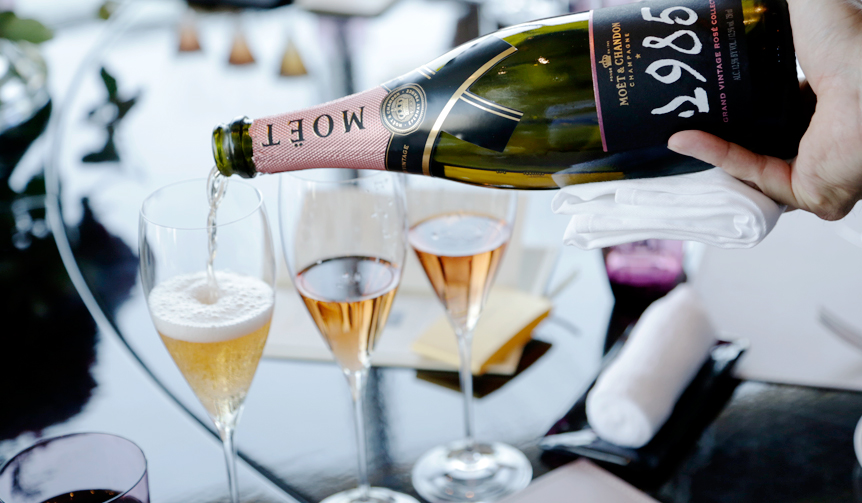
Benoît Gouez, Cellar Master at Moët & Chandon, began our lunch with, "Today's gathering is a bit special." Indeed, the day's selection featured three Grand Vintage Rosés: "1985," "1999," and "2006." Rosé, Grand Vintage, and aged—these qualities make for a rare treat. As the latest release, "2006," was poured into glasses on a summer afternoon, a special moment began.
Text by TANAKA Junko (OPENERS)
What Supports the King of Champagne?
Moët & Chandon was founded in 1743. As Gouez notes, "The third generation likely had foresight." Jean-Rémy Moët, the founder's grandson, achieved the great feat of popularizing Champagne worldwide. Through his efforts, what was once a local drink, enjoyed only by locals, rapidly spread from France to Europe and then across the globe.
Centuries later, Moët & Chandon now reigns as the leading Champagne house. What's remarkable is its overwhelming market share across all categories, from Brut to Rosé, Non-Vintage to Vintage. Gouez analyzes the reasons as follows:
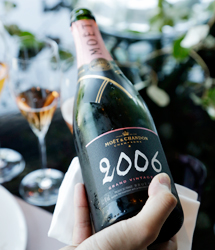
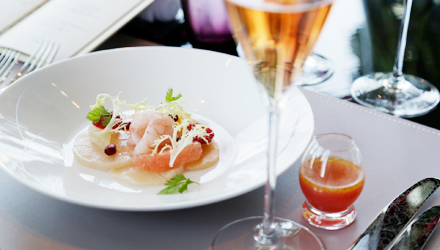
The "2006" boasts a fresh taste reminiscent of just-picked grapes. It was paired with a chilled appetizer of seasonal fruits: "Scallop and Sweet Shrimp Ceviche with Lime, Pomegranate and Raspberry Dressing." Fruitiness exploded in the mouth.
"One factor, I believe, is our abundant resources. This is particularly true for our vineyards. We own around 1,200 hectares of vineyards solely for our own use. A quarter of all the Premier Cru vineyards in the region belong to us, and we also own a considerable area of Grand Cru vineyards. This is essential for maintaining and evolving the quality of Champagne. Why?"
"With such extensive vineyards, there's a wide range of grapes we can harvest. Naturally, the taste of wine depends on the quality of the grapes, so the more options we have, the higher the potential to create superior Champagne. Conversely, if the grape selection lacks diversity, the taste can become inconsistent. This diverse base allows us to reproduce a consistent flavor profile for our Non-Vintage wines and pursue a more refined taste for our Vintage Champagnes."
In the Champagne region, known for its variable climate, the quality of grapes fluctuates annually, making blending the standard practice for creating Champagne. Grapes from different harvest years, villages, and vineyards are blended together. This is the most common method for Non-Vintage Champagne, exemplified by Moët & Chandon's "Moët Impérial."
On the other hand, Vintage Champagne, made from grapes of a single year, is more exceptional. Grand Vintage, produced only in years with exceptionally good grape harvests, expresses the full charm of that year's grapes through a unique blend orchestrated by Cellar Master Gouez. These are special Champagnes aged for over seven years, released only when their taste reaches its peak.
In Moët & Chandon's over 270-year history, only 71 bottles of white Grand Vintage have been released. For Rosé, the number is a mere 40. These figures illustrate just how rare they are. But why such a disparity between the number of white and rosé vintages? We will unravel this mystery on the next page.
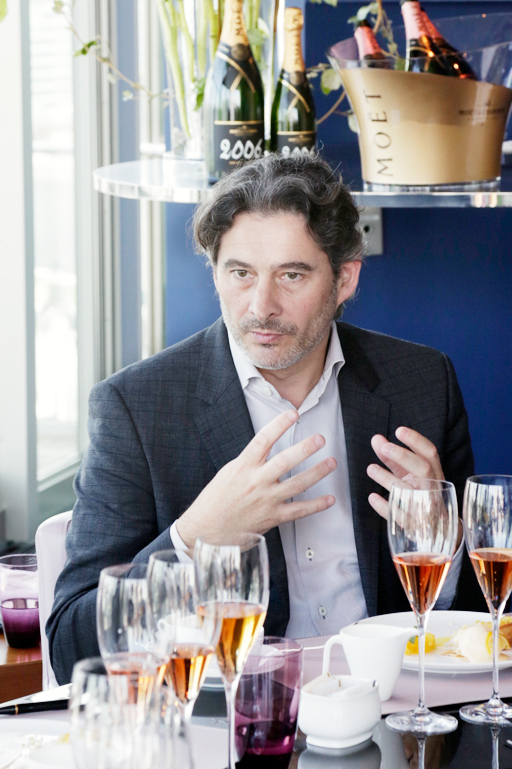
Benoît Gouez, Cellar Master at Moët & Chandon
The Reason for Fewer Rosé Vintages Than White
MOËT & CHANDON
Interview with Cellar Master Benoît Gouez
The Miracle Named Grand Vintage Rosé (2)
Listening to the Voice of the Wine
"Actually, two-thirds of our vineyards are planted with black grapes. Yet, much of the Champagne we produce is white. This might seem contradictory. It's related to the climate; Champagne experiences significant climatic variations and is a cool region, so there are few years where black grapes ripen sufficiently to make red wine. Instead, many of these black grapes are well-suited for making white wine."
"Moët & Chandon creates rosé by blending red wine with white wine. For the red wine component, we use both Pinot Noir and Meunier for Non-Vintage, but only Pinot Noir for Vintage. By focusing on a single varietal, it becomes easier to add complexity and structure. The challenge is that we must patiently wait until the black grapes are sufficiently ripe. In other words, making rosé by blending red wine is akin to a miracle in the Champagne region."
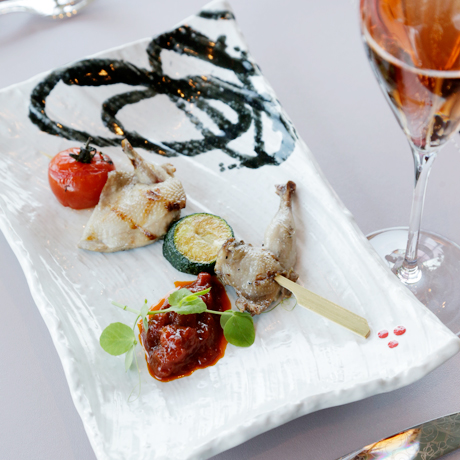
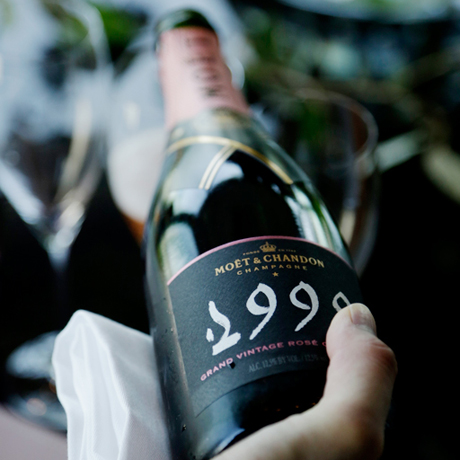
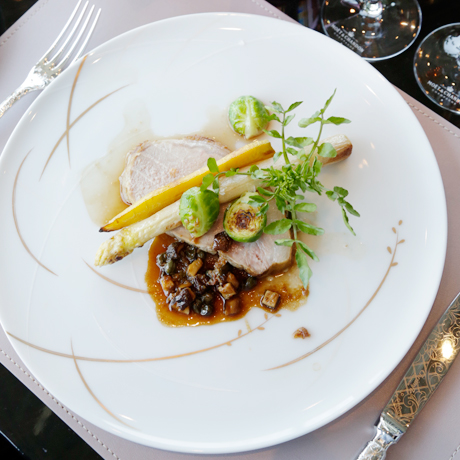
The "1999," with its increased depth compared to the "2006," was paired with a warm appetizer featuring a hint of spice: "Quail and Vegetable Skewers with Iberico Chorizo and Tomato Chutney" (left). The "1985," which had evolved into a smooth, creamy texture, was matched with the main course: "Low-Temperature Cooked Kirishima Pork with White Asparagus and Brussels Sprouts, served with a Shiitake Mushroom Sauce from Oita Prefecture."
The difficulty of making rosé and the challenge of creating a vintage—Grand Vintage Rosé, born from overcoming these two hurdles, holds a unique and special place for the maison.
This is why even the final disgorgement (the process of removing sediment from the bottle) is carried out with great care. A tasting panel of 11 people, including Gouez, repeatedly tastes and discusses to determine the optimal timing. The focus is on the finished product, not the harvest year. As he puts it, "You can tell if you listen to the wine."
Consequently, the release order of vintages can sometimes be reversed. For instance, when the 2003 vintage was released a few years ago, the 2002 vintage was still aging in the cellar. This decision, too, was based on "listening to the wine." While there are standards, the maison's philosophy is to respond flexibly to the situation. "Ultimately, we value the craftsman's intuition, the feeling of craftsmanship," he says.
As mentioned, Grand Vintage Rosé is unique to the maison. Interestingly, grapes grown in similar climatic conditions may follow similar aging paths. The "1985," "1999," and "2006" all possess an unparalleled freshness and depth. These three Grand Vintage Rosés perfectly illustrate this potential.
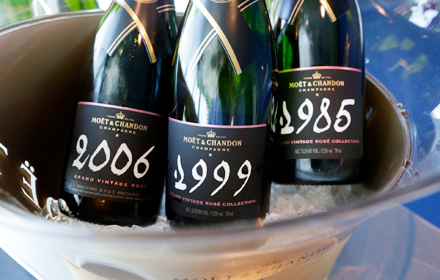
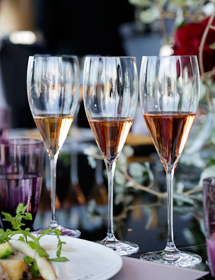
Moving from "2006" to "1999" and then "1985," the color deepens from salmon pink to a richer hue, approaching gold with each passing year. This is due to prolonged contact with the lees. All three possess a youthful vibrancy and fruitiness, belying their age.
"The 1985, 1999, and 2006 were similar in terms of climate. Unusually for Champagne, the word 'maturity' perfectly describes these years. Therefore, we patiently waited beyond the typical harvest period for the grapes to fully ripen and develop tannins. As a result, you should experience the ripe fruitiness blossom the moment it touches your palate. Of course, the color, the effervescence, and the taste differ between the 1999, aged for 14 years, the 2006, aged for 7 years, and the 30-year-old 1985. However, one can anticipate that the appearance of the 1999 and 1985, 15 and 30 years after 2006 respectively, might be quite similar."
Reflecting on such romance while aging alongside the 2006—isn't this another sophisticated way to enjoy Grand Vintage Rosé?

Benoît Gouez
Chef de Caves (Cellar Master) at Moët & Chandon. Appointed Cellar Master of Moët & Chandon in 2005 at the young age of 35. Gouez's style embodies the very essence of Moët & Chandon's Champagne: understanding innovative winemaking from the New World while respecting tradition. With his exceptional senses and knowledge, he is a notable figure in the world of Champagne.
Moët & Chandon Grand Vintage Rosé 2006
Volume | 750mL
Price | ¥10,150
Moët & Chandon
http://moet.jp/