AAF Dispatch | Architecture Student Workshop Shiga 2011: Report
AAF Dispatch: A Two-Month Project Inspired by an Island
Architecture Students Workshop Shiga 2011: Report
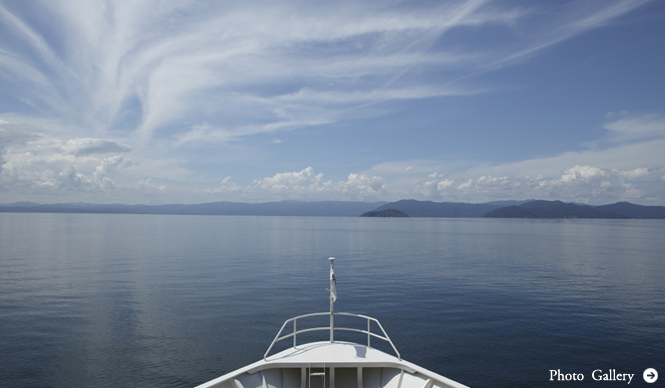
Students from universities nationwide, studying architecture and environmental design, generated ideas to make Lake Biwa's natural environment sustainable and realized them as full-scale spaces.Architecture Students Workshop Shiga 2011was held this summer on Chikubu Island, floating in Lake Biwa. Here, we introduce the proceedings of this workshop series.
Text by Art & Architect FestaPhoto by SHIGETA Satoshi ©Nacasa&Partners.Inc.
Chikubu Island: An Isle of the Gods
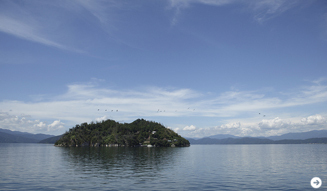
The setting for this workshop was Chikubu Island, an island that has been an object of worship since ancient times, also known as the "Isle of the Gods." Originally a sacred site for both Shinto and Buddhism, it is now divided between Tsukubusuma Shrine, renamed from Benzaiten Shrine, and Hogonji Temple, which is also the 30th temple on the Saigoku 33 Kannon Pilgrimage. The main hall of Tsukubusuma Shrine, with its elegant and ornate decorations representative of the Momoyama period, is a National Treasure. Furthermore, Chikubu Island Benzaiten at Hogonji Temple is counted among the three great Benzaiten of Japan, alongside Enoshima Shrine in Sagami and Miyajima Shrine in Aki.
Information Session & Keynote Lecture
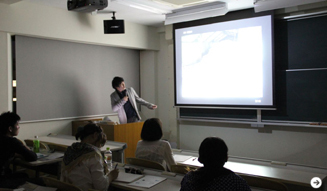
To commence the workshop, an information session was held for prospective students. In Tokyo, architect Yasutaka Yoshimura delivered the keynote lecture, and in Kyoto, architect Hiroshi Sambuichi gave the lecture.
On-Site Briefing & Field Survey
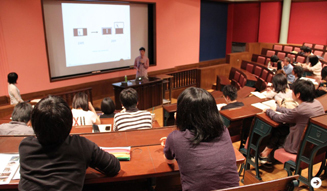
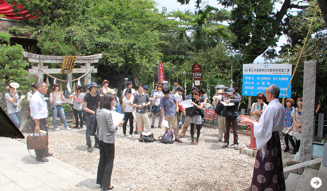
During the on-site briefing held on Saturday, July 2, 2011, the project theme was presented and explained, followed by a field survey. In the morning, the workshop theme was announced and explained, after which participants toured the designated site. In the afternoon, a lecture by Kenji Kato of the Omi Studies Institute, Seian University of Art and Design, was held aboard the megumi ferry, providing insights into the historical and cultural characteristics of the local environment. The session challenged students to consider what is truly necessary for the local residents and for the global environment, and to conceive concrete proposals for achieving it.
Critique Session for Proposed Works
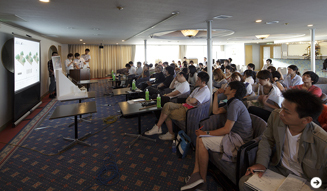
From Saturday, August 6 to Sunday, August 7, 2011, participants stayed overnight on the chartered vessel Bianca for a critique of proposed works and discussions on production plans. On the first day, proposed works were presented, followed by a critique session with the participating instructors. On the second day, based on the previous day's critiques, participants discussed production materials, methods, and approaches in detail. Each group held meetings to arrange production and order materials.
Full-Scale Production During the Camp
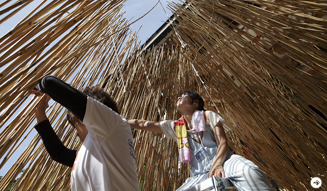
From Tuesday, September 6, 2011, the week-long full-scale production camp finally began. Given the island's location floating on the lake, each team approached production with meticulous preparation. The terrain, rising from 100 meters below the lake surface to an elevation of approximately 200 meters, featured steep slopes, making material transport an unimaginably arduous task. However, creating works in an environment distinct from their daily lives seemed to strengthen the students' resolve to complete their projects.
Onboard Public Presentation
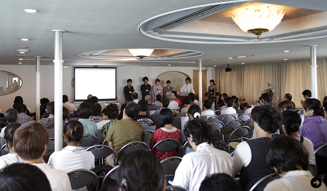
On Sunday, September 11, 2011, a public presentation was held aboard the Bianca (Lake Biwa Ferry), while enjoying a cruise on Lake Biwa. Architects, structural engineers, and environmental scientists served as instructors and judges. Inspired by Chikubu Island's rich natural environment and historical background, the students presented their works, born from fresh creativity. The judges offered critiques from various perspectives. Tears were shed by some students at the awards ceremony following the critiques, marking a finale where the fruits of the workshop, undertaken for over two months, were realized.