Series | Kesennuma Letters | November: "The Symbol of Kesennuma Supporting Fishermen"
Series | Letters from Kesennuma
November: "Kesennuma's Symbol of Support for Fishermen"
In April 2014, travel journalist Naoko Terada headed to Kesennuma City in Miyagi Prefecture. Her goal was to participate in a "boat experience tour" on a new fishing vessel, reportedly built for the first time in 20 years. Three years after the devastating earthquake, this area, which suffered immense damage, was slowly but surely beginning to move towards the future. Terada believes this boat represents a "beacon of hope" not only for Kesennuma but for the entire Tohoku region. Following the fishing boat's lead, what did Terada discover about Kesennuma's present and future? After a heartwarming welcome at Minshuku Tunakan, the group headed to the Tsunami Experience Hall and Osaki Shrine on the Karakuwa Peninsula.
Text & Photographs by TERADA Naoko
The Most Respected Person on a Fishing Boat is the Sen-to (Fishing Master)
The Tsunami Experience Hall is a long-standing facility, established in 1984. I visited it over 20 years ago. Looking back now, I realize I didn't even grasp the significance of having a facility to learn about tsunamis here at that time. It's a stark reminder of how memories fade.
Osaki Shrine is a vital place where fishermen pray for a bountiful catch.
Before venturing out to the open sea, fishermen always navigate past the waters off the cape where the shrine is located. While the men are at sea, their wives pray daily for their safe voyage. In this way, it is an indispensable symbol for Kesennuma, a city that has coexisted with the sea for over a thousand years. A dignified presence emanated from the tranquility. In the late afternoon light, I quietly offered my prayers for Kesennuma's peace.
The highlight of the day was a visit to the historic Kodate family, who have served as fishing masters for generations. Their magnificent Karakuwa Goten, a mansion, was built during the Meiji era. It commanded an overwhelming presence, befitting the esteemed status of this local family.
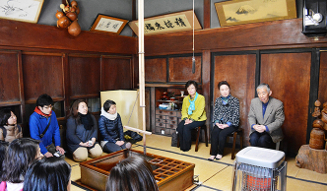
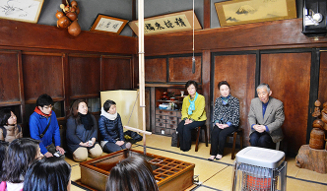
Gathered around the sunken hearth, we listened intently to the stories of the former fishing master and his wife.
"On a fishing boat, the most important person isn't the captain, but the sen-to (fishing master). He chooses the fishing grounds and holds all decision-making power and responsibility – a true man of the sea. He must possess courage and great personal integrity. And the wives of the sen-to are the ones who protect the home and community while the men are at sea. That's why they are incredibly important figures."
Kazue-san, who relayed this, seemed nervous. Apparently, the Kodate family is a household of exceptional status and tradition. Kazue-san herself had never even entered the mansion before.
We were welcomed by the current head of the household, a retired fishing master, and the wives of other fishing masters. As we sat around the sunken hearth, listening to their stories, the men, true to their nature, spoke little. Yet, within their quiet demeanor lay the profound life philosophies forged through their careers as fishing masters. The women shared how they kept household problems to themselves, resolving them internally to spare their husbands, who were at sea, any additional worries beyond the fishing itself. The only thing they felt compelled to share immediately was the birth of a child. In their respective roles, their narratives, imbued with mutual consideration and the pride of being both a fishing master's wife and a pillar of the community, made time fly by.
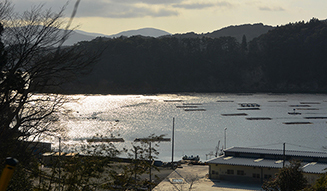
The sea off Karakuwa, reflecting the faint, shimmering afterglow, was endlessly calm and serene.
Leaving the Kodate residence and heading back towards Kesennuma city, the temperature had already dropped, and it was getting cold. The calm sea sparkled in the fading light.
As the sky began to change color, signaling the approach of dusk, the bus arrived at Kesennuma Port. All the participants eagerly put their luggage in their rooms, then began preparing by grabbing jackets and down coats. Yes, another evening's enjoyment awaited.
While the tour offered free time in the evenings, this particular night was the date for the "Kesennuma Bar 2014 Spring" event.
Bundled up against the cold, we headed to "Kesennuma Bar"
"Kesennuma Bar" is an event where participants visit four recovery markets and food stalls in Kesennuma, sampling various local dishes and B-grade gourmet foods, and purchasing souvenirs to support the recovery efforts. The four participating areas are "Minamicho Murasaki Ichiba" (Kesennuma Recovery Market), "Kesennuma Yokochō" (Recovery Food Stall Village), "Kesennuma Shishiori Recovery Marche," and "Minamicho Area Surrounding Shops." By purchasing a set of three tickets, visitors can choose their preferred shops from approximately 40 participating establishments and enjoy special bar menus by presenting one ticket per shop.
Kesennuma in April is still cold. Wearing my down jacket, ticket and list in hand, I decided my first stop should be "Horumon Rihei" in the "Recovery Marche" to warm up. For one ticket, I received a "draft beer, Kesennumaホルモン (hormone) with original spicy miso sauce, and cabbage." Sitting at the table, grilling theホルモン and downing a draft beer – ah, it was bliss. As I savored the moment alone, a woman from Tokyo, also participating solo in the tour, entered the restaurant, so we decided to share the meal. Encounters like these are part of the unique, once-in-a-lifetime experiences of a tour.
After settling in withホルモン and beer, I left the restaurant. Since I was there, I decided to visit "Onodera Shoten" right across the way. There, I browsed various local specialties like seaweed and seafood from Kesennuma, arranging for them to be delivered home. While chatting with the woman tending the shop, asking "Where are you from?", I discovered she was born in Tokyo and had married into the area. Even more surprisingly, our hometowns were close.
"Wow, I can't believe I'm talking about my hometown here!" she exclaimed with a smile.
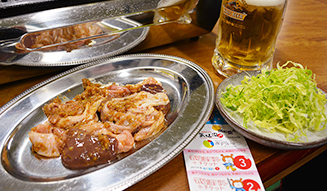
The bar menu at "Horumon Rihei." It's a great deal for just one ticket!
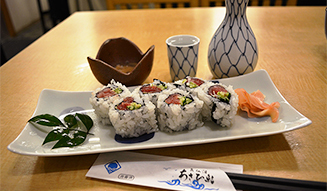
The bar menu at "Asahi Sushi." Fitting for Kesennuma, it was a tuna roll.
Now, for the second stop. I had already decided where to go. I hailed a taxi and headed to "Minamicho Murasaki Ichiba." This is where "Asahi Sushi," a representative establishment of Kesennuma, is located.
"Asahi Sushi" is a long-established sushi restaurant facing Kesennuma Port. It gained widespread popularity for its battleship-maki sushi featuring Kesennuma's specialty, shark fin. However, the main branch suffered extensive damage from the tsunami and closed temporarily. It has now reopened in a temporary location at "Minamicho Murasaki Ichiba."
Here, one ticket included sake, a small side dish, and a roll. The side dish was homemade salted squid. I immediately ordered the shark fin sushi, a must-try when in Kesennuma. As expected from such a popular restaurant, it was crowded, with new customers constantly entering. With the bar menu being offered at a loss, lingering too long is not advisable. I quickly finished my drink and stepped back out into the cooling air.
From "Minamicho Murasaki Ichiba" to "Kesennuma Yokochō" (Recovery Food Stall Village), one can walk through the portside urban area. With my face flushed from the sake, I walked towards the food stall village, the cool sea breeze on my skin, reflecting on Kesennuma from the previous year and the people I had met today.
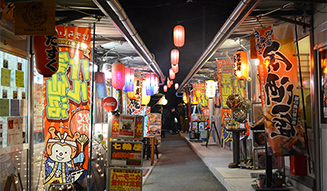
Kesennuma Bar is scheduled to be held again in the spring of 2015. I hope it becomes a regular event that attracts tourists to Kesennuma.
Although it's called an urban area, most of the houses and commercial facilities that once stood there were washed away by the tsunami. The remaining buildings were tilted, bearing little resemblance to their former selves.
A year had passed since my visit to Kesennuma in the spring of the previous year, yet the city's recovery was still very much in progress. Looking up, stars twinkled in the northern night sky. The heavens remained as beautiful as ever. Recalling the smiles of the people I met today, I contemplated the immense weight they carried – a burden I could never truly comprehend.
A few days later, along with the ordered items, a handwritten letter was included in the delivery to my home.
"Thank you very much for your visit today.
We hope you enjoyed your time in Kesennuma.
It was a pleasant surprise to hear the name of a nostalgic station.
Until we meet again,"
Onodera Shoten
Kesennuma is moving forward, thanks to these kind-hearted people.
*"Kesennuma Bar" is scheduled to be held again in the spring of 2015. Please check the official Facebook page for updates.
https://www.facebook.com/kesennumabar
Naoko Terada
Travel journalist. Spends about 150 days a year living in hotels abroad. Has visited around 60 countries, including Australia, Asian resorts, and Europe. Primarily contributes to magazines, weekly publications, and newspapers. Her published works include "Hotel Brand Stories" (Kadokawa Shoten), "London Gourmet Guide" (Nikkei BP, co-authored), "A Journey Through English Gardens" (Nikkei BP Kikaku, co-authored), and she produced "Wagamama Aruki Bali" (Jitsugyo no Nihon Sha).