Serial | Letters from Kesennuma | October: Encountering the Tsurukanto Inn
Series | Letters from Kesennuma
October: Encountering the Seaside Inn Tsunakan
In April 2014, travel journalist Naoko Terada headed to Kesennuma City in Miyagi Prefecture. Her purpose was to participate in a "fishing boat experience tour," a new offering created for the first time in 20 years. Three years after the devastating earthquake, this region, which suffered immense damage, was slowly but surely beginning to move towards the future. Terada believes this boat represents a "beacon of hope" for Kesennuma, and indeed for the entire Tohoku region. What did Terada see of Kesennuma's present and future, guided by this fishing boat? Her journey to the Karakuwa Peninsula began with an encounter at the seaside inn Tsunakan.
Text & Photographs by TERADA Naoko
Farewell Waved with a Grand Fishing Flag
Leaving the viewpoint on Mount Anba, we headed for the Karakuwa Peninsula.
The Karakuwa Peninsula has long been a place that produced skilled fishermen. In the areas overlooking the peninsula's sea stand the homes of these wealthy fishermen, known as "Karakuwa Goten" (Karakuwa Palaces).
These homes embody the bold spirit of men who built grand houses as proof of their earnings, and the head of the household's desire to keep his family safe in a secure location while he was out at sea fishing. Those who remained to protect the home, in turn, built their residences to stand tall and command a view far out to sea, so they could welcome the head of the household back as soon as possible.
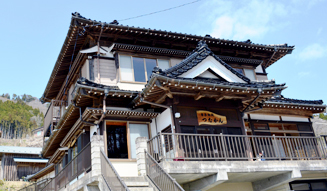
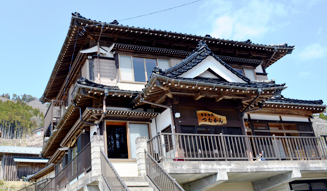
The magnificent Karakuwa Goten, now the "Seaside Inn Tsunakan"
However, the tsunami devastated many homes on the Karakuwa Peninsula. Among them were the Karakuwa Goten. We visited the Shibitachi district. The very name suggests a place that lives in harmony with the sea.
Here stands the seaside inn "Tsunakan." Though it's an inn, it only opened after the earthquake. It's run by Moriya Fisheries, a family that has been cultivating oysters, scallops, and wakame seaweed for three generations, about 100 years. Ichidai-san, who fell in love with the charming owner and married him, is the inn's most popular figure. Some repeat visitors on this tour have come specifically to see her again. Her cheerful personality has won her many fans.
The "Karakuwa Goten," which was the Moriya Fisheries home, was also severely damaged, with the tsunami reaching the third floor. At one point, they considered demolishing it. However, the house, built with the pride of a fisherman, proved resilient. Although everything else was swept away or destroyed by the tsunami, the main pillars remained intact. So, Ichidai-san and her family rebuilt their home. While running the seaside inn Tsunakan, they also turned their focus to rebuilding their oyster cultivation business.
That day, we enjoyed an outdoor barbecue in front of Tsunakan for lunch.
The spread featured seasonal delicacies. There was wakame seaweed shabu-shabu, the local specialty Kesennumaホルモン (hormone), curry, and generously sized grilled oysters. We briefly blanched the vibrant green wakame, dipped it in ponzu sauce, and savored it. The aroma of the sea filled the air. It was a luxury unique to Kesennuma in this season.
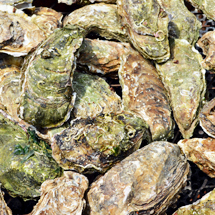
Karakuwa thrives on aquaculture and other fishing industries.
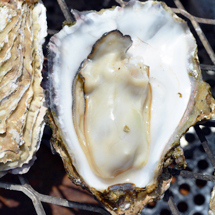
Large Karakuwa oysters
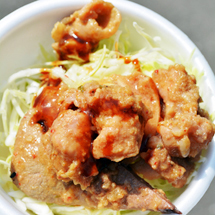
Kesennuma's specialty: "Kesennuma Hormones"
The grilled oysters were sweet and creamy, another exquisite dish. Participants spontaneously called for draft beer and local sake from Miyagi Prefecture.
Midway through, some young fishermen joined us as guests. They were quiet and shy, but they were true men of the sea, ready to face any challenge. Many of them are single, and their next challenge is "finding a bride." "We get up at 2 or 3 in the morning, but our wives can sleep in. Our mothers do too," one of them said.
The hope of those around them was that kind-hearted brides would come, dispelling the image that being a fisherman's wife is difficult. Kazue-san from the "Tsubaki Kai" (Camellia Association) was one of those concerned. "Oh my, we really need to organize a matchmaking tour," she murmured, watching them shyly pose for a commemorative photo with the young women participating in the tour.
With our stomachs full, the group boarded the bus again for their next destination. It's a Kesennuma custom to wave a large fishing flag to see off departing buses. Ichidai-san and the young fishermen waved goodbye.
Actually, plans are underway in Kesennuma for the construction of a seawall as part of the reconstruction efforts. It's planned to be 8 meters high along the coast, a concrete barrier intended to protect against future tsunamis.
However, fishermen have always relied on their own eyes to assess the sea conditions and fish according to the currents. While protecting their families and local community from tsunamis is a primary concern, the prospect of the sea being hidden by a seawall causes great anxiety. Should the seawall be built or not? Kesennuma faces a difficult choice.
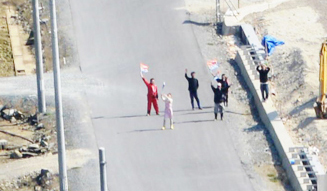
This view from the bus window is something I will never forget.
As the bus slowly climbed the hill and the inlet of Shibitachi and Tsunakan reappeared below, becoming smaller and smaller.
"Ah, they're still waving!"
Someone in the bus exclaimed. Peering out the window, we could see them, like tiny dots, still looking up at us, the young men vigorously waving the large fishing flags. Ichidai-san, too, was jumping with all her might, waving her arms with great energy.
Watching them, a powerful emotion welled up inside me, too profound for words.
The land, cleared after the debris removal, might seem like a gaping void, but warm-hearted people who are determined to move forward still live here. Though we knew they couldn't hear us, we inside the bus waved back with all our might, calling out, "Goodbye!" "Take care!" "Thank you!"
Perhaps because they were so far away, or perhaps because of tears, we couldn't make out their expressions. But we all knew that Ichidai-san and the others were responding with broad smiles.
The next dates for the reconstruction support tour featured in "Letters from Kesennuma" have been decided. Kazue-san's"Grandma's Kitchen"This 2-day, 1-night tour will also visit places featured in the articles, such as "Tsunakan" and the "Fukko Yatai Mura" (Reconstruction Food Stall Village). We encourage you to join us.
Journey to Experience Submerged Aging of Local Sake (Soten-den) and Retrieval of Aged Sake
Dates: Saturday, November 8 - Sunday, November 9 (2 days, 1 night)
Price: ¥39,800
http://www.jtb.co.jp/b2b/tohokufurusatoka/
Naoko Terada
Travel journalist. Spends about 150 days a year living in overseas hotels. Has visited around 60 countries, including Australia, Asian resorts, and Europe. Primarily contributes to magazines, weekly publications, and newspapers. Her books include "Hotel Brand Monogatari" (Kadokawa Shoten), "London Bishi Guide" (Nikkei BP, co-authored), "British Garden Travelogue" (Nikkei BP Kikaku, co-authored), and she produced "Wagamama Aruki Bali" (Jitsugyo no Nihon Sha).