January 28, 2015
New Series | Letters from Kesennuma | September: 'Creating a New Hometown'
New Series | Letters from Kesennuma
September: "Building a New Hometown"
In April 2014, travel journalist Naoko Terada headed to Kesennuma City in Miyagi Prefecture. Her purpose was to participate in a "fishing boat experience tour" aboard a new vessel, the first built in 20 years. Three years after the devastating earthquake, this land, which suffered immense damage, is gradually and surely beginning to move towards the future. Terada says this boat represents a "beacon of hope" for Kesennuma, and by extension, for Tohoku. Guided by the fishing boat, what is the Kesennuma of today, and what lies ahead, as seen by Terada? One month after attending a symposium where she met people working for Kesennuma's recovery, Terada alighted at JR Ichinoseki Station to join the fishing boat experience tour.
Text & Photographs by TERADA Naoko
A Close Look at Kesennuma Today
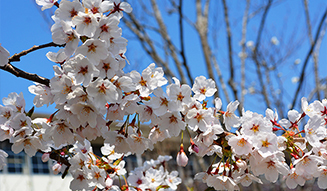
Around Ichinoseki Station, the cherry blossoms were in full bloom, heralding the arrival of spring in Tohoku.
On the morning of Saturday, April 19th, I was at JR Ichinoseki Station.
The 1-night, 2-day "Kesennuma Unmeemon Tour, Part 2: Experience Voyage on a Newly Built Deep-Sea Tuna Longliner" was about to begin, organized by JTB Tohoku Furusato Division. It started with a full house of 30 participants. It had been a while since I joined a regular tour.
The journey from Ichinoseki to Kesennuma by large bus took about an hour. We traveled comfortably by bus along a route I had previously taken by train.
On the bus, after the schedule and important notes were shared, a microphone was passed around for self-introductions. There were people who had volunteered in Kesennuma after the earthquake, those who had enjoyed the previous tour and decided to join again, and individuals involved in the fisheries industry. Everyone had some connection to Kesennuma and felt a sense of sympathy. Although they were a group with a different mindset than typical tourists, like me, they were all eager to experience the fishing boat and savor Kesennuma's delicacies! Indeed, this tour was also an experience designed to enjoy Kesennuma. I had a feeling it would be a delightful journey with these participants who shared the same sentiments.
The first stop on the tour was Mt. Anba.
This mountain, standing at 239 meters, is familiar to locals, rising behind Kesennuma as if embracing it. Its name is said to originate from prayers for safe voyages and abundant catches. From the observation deck, reached by bus, Kesennuma spread out below us.
The air was still sharp with cold, but the sea of Kesennuma was calm and shimmered blue. Late spring had just arrived, andヤマザクラ (Yamazakura cherry blossoms) were blooming in vibrant pink in various spots.
Many parts of the city were only just beginning to be cleared of debris and leveled. The area around the central port also looked different from its former appearance.
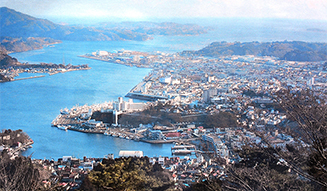
Kesennuma before the earthquake
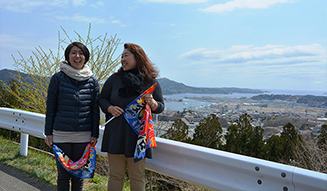
Kazue Saito and Noriko Onodera holding mini-fish flags to welcome us
With the transformed cityscape of Kesennuma behind us, Kazue and Noriko Onodera, Managing Director of Onodera Corporation, who would be taking care of the tour, smiled and told us, "We're thinking of changing Kesennuma from here on."
They laughed heartily. Behind their cheerfulness lay immense sorrow and strong determination. They watched over Kesennuma, which had lost its former appearance, and sought to build a new hometown from its present state. I felt ashamed of my own inability to do anything in return.
They understood well that this was likely how we felt. That is precisely why they spoke with bright, gentle smiles, like the soft spring sunlight, without dwelling on sadness.
The sky was high and blue, the spring sea breeze was pleasant, and the sparkling sea was beautiful. Precisely because it was such a peaceful time, I vowed to be grateful for being there and to observe the "now" of Kesennuma closely before returning. That was the most I could do.
Naoko Terada
Travel journalist. Spends about 150 days a year living in hotels abroad. Has visited around 60 countries, including Australia, Asian resorts, and Europe. Primarily contributes to magazines, weekly publications, and newspapers. Her books include "Hotel Brand Stories" (Kadokawa Shoten), "London Gourmet Guide" (Nikkei BP, co-authored), "A Journey Through English Gardens" (Nikkei BP Kikaku, co-authored), and she produced "Wagamama Aruki Bali" (Jitsugyo no Nihon Sha).