Yasuhiro Mihara | Part 2: Filmmaker Hitomi Kamanaka x Yasuhiro Mihara (4) Dialogue
Part 2: Filmmaker Hitomi Kamanaka x Yasuhiko Mihara (4)
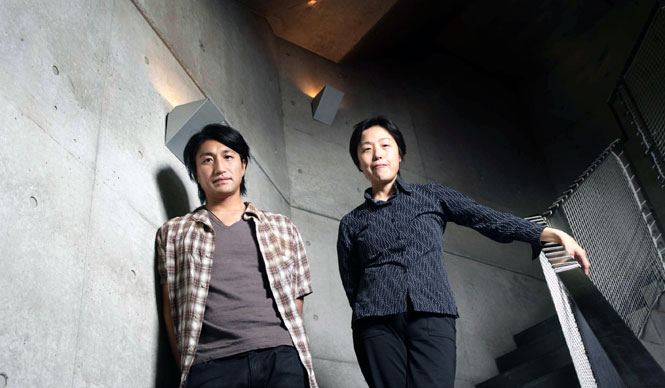
A conversation with Hitomi Kamanaka, a filmmaker known for documentaries focusing on social issues such as "HIBAKUSHA: The End of the World" and "Rokkasho Rhapsody." In this final installment, we delve into how we can achieve a lifestyle independent of nuclear power, and what beliefs are necessary for a sustainable future on Earth.
Photo: Kaoru KitaharaSummary: Yasuhiro Takeishi (City Lights)
Each Person Doing What They Can
MiharaBy the way, Kamanaka-san, your films sometimes capture truth with brutal honesty. What does documentary mean to you?
KamanakaAs a media professional, I act as a mediator. In "Rokkasho Rhapsody," I made an effort to convey the way of life and thoughts of the people living there as faithfully as possible. Documentary is a medium that can show facts, like 'I met this person during my explorations,' which is my starting point. However, when I saw the children dying in Iraq, I felt a profound sense of injustice. Why must these children die? And I couldn't change that reality. But you want to change it, don't you? To do that, I believe people must know that such injustices are occurring, and that we are creating them. When I filmed Rokkasho, there was injustice there too. The villagers didn't truly want to accept the reprocessing plant. It was forced upon them as national policy, and even though they were told it wasn't harmful, the villagers were the first to suffer the consequences. By presenting that situation itself, I want viewers to think for themselves.
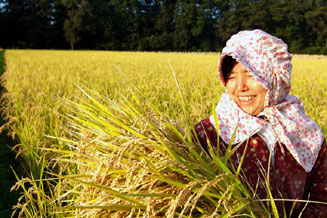
Yasuko Tomabechi, who grows completely organic rice in Towada City, a town adjacent to Rokkasho Village. Since the release of "Rokkasho Rhapsody," many people have visited her, but her worries about whether she can continue growing rice in this area persist. From "Rokkasho Village Newsletter No. 4."
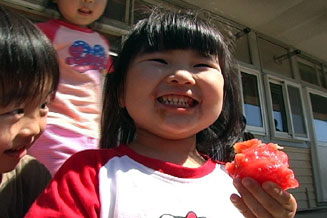
Children enjoying ripe, pesticide-free tomatoes at the Araki farm in Tohoku Town, next to Rokkasho Village. The Araki couple, who run the farm, want children to taste the real flavor, but they worry about the reprocessing plant's environmental impact, stating, "Life is far more important than money or work."
MiharaFor example, regarding food safety and other issues, various things are happening now, and values are changing. When we become aware of such problems and injustices, what should we do? There are methods like protests and petition drives, but I suspect that government agencies and power companies are reluctant to engage in dialogue.
KamanakaI believe it's a mistake to assume that things can only be changed from the top down, such as by politicians. Take electricity, for instance. We are consumers, and in other words, customers. We buy electricity and pay for it. And that money includes the cost of reprocessing nuclear fuel. Therefore, we should be able to say, 'Please don't generate electricity in a way that produces such waste.' The other day, I interviewed a man in Sweden who drives an electric car. When I asked, 'Where does that electricity come from?' he said, 'It's from wind power.' He buys electricity from a wind power company for his home as well. When I asked if it was expensive, he replied, 'What are you talking about? It's cheaper than nuclear power.' Japan doesn't even have such an option. However, to increase our options, I think it's important for us to continue sending messages to power companies. Speaking of which, I recently visited someone who generates electricity from bamboo.
MiharaHow do you generate electricity from bamboo?
KamanakaBamboo can be considered a plant that stores solar energy. Bamboo, with its highest growth rate among plants, produces gas when chipped and fed into a generator. That gas turns a turbine to generate electricity. Furthermore, in this process, the bamboo is steamed and becomes charcoal, which can be spread on fields to improve the soil. Currently, bamboo is growing excessively throughout Japan, causing problems by encroaching on forests, but it can be utilized as a resource. Due to the effects of global warming, about 10% of Japan's forests have become bamboo groves, yet the Forestry Agency is spraying herbicides there. It's a tremendous waste, especially when we could be eating Japanese-grown bamboo shoots instead of imported ones. Japan is often said to lack resources, but if we are going to rely on petroleum and electricity for heating, which will surely be depleted in the future, there are various methods such as using bamboo chip boilers or solar energy. Therefore, a shift in thinking is necessary.
MiharaSo, even ordinary citizens like us can do something.
KamanakaIt's important to choose and support companies with new methods and ideas like that. When I investigated, I found that Yamaguchi Prefecture, which granted the landfill permit for the planned Kaminoseki nuclear power plant to Chugoku Electric Power, was actually a major shareholder in Chugoku Electric Power. Thinking this was strange, I investigated further and discovered that there were 800 power companies in Japan before World War II. This means that Japan once had choices in electricity. During the war, to control electricity, the government bought and nationalized the shares of power companies nationwide, consolidating them.

MiharaI didn't know that. Knowing such facts, perhaps Japan is, in a sense, a difficult country to live in.
KamanakaYes. Perhaps the Earth itself has already become a difficult planet to live on. There's this way of thinking: imagine the Earth's capacity to regenerate resources for us to consume and sustain our society over a year. Then, humanity has already consumed all the resources available up to 2008 by September 24th. In other words, we are currently living by consuming future resources. And this is a calculation based on the global average. But if you calculate it for Japan alone, when do you think it is?
MiharaPerhaps around June?
KamanakaNo, it's February. Japan is a country that imports and consumes resources voraciously, including petroleum and food. Although it appears to be a very prosperous country, I believe this is wrong. Energy is used when importing food and other goods, so we must be aware that we are consuming diverse forms of energy, not just electricity. Mihara-san, when you create clothing, do you consider environmental considerations?

MiharaI do ponder it. There's organic cotton, but I feel if I'm going to do it, I have to do it thoroughly.
KamanakaThat may be true, but just as we cannot magically eliminate 55 nuclear power plants, it's probably difficult to change everything about clothing production at once. For example, I think creating a separate line that considers the environment would be good. Responsibility lies not only with the producers but also with each consumer. To use Sweden as an example again, Sweden is a country that has developed methodologies for how to become an environmentally advanced nation.
One of these is the approach that each individual, whether a designer or a filmmaker, should consider the environment within their own field. This idea was conceived by a pediatric oncologist and is based on four principles he conceived while researching cancer. It gained traction in the late 1980s with the support of ABBA, a popular Swedish pop group at the time, and even the King expressed his support. The idea is that not everyone has to do everything; if you have a specialty, do it there. Volvo, the car manufacturer that endorsed this, announced its development of cars that run on fuels other than petroleum. They reflected on their core mission and realized they were a company that provides 'mobility,' not just cars. This led to ideas like building railway lines. By re-examining their identity, new ideas emerged. Designers, too, could consider directions beyond just making and selling clothes, such as proposing the comfort of wearing clothes that improve the environment the more you wear them.
The Belief That "People Can Connect With Anyone"
MiharaIn other words, clothes that are comfortable for both myself and the environment. It won't be easy, but I want to try my best. By the way, what is your belief, Kamanaka-san?
KamanakaWell, I suppose it's that people can connect with each other, no matter who they are. Even with those who promote nuclear power, I'd like to communicate with them. I believe they are probably doing it with the intention of doing what's best for everyone. I think the worst thing is when people with different ways of thinking don't talk to each other. I want to appeal for more conversation and for people to share their feelings, and to create such spaces.
MiharaI don't want to despair about that. If both the opposition and the proponents could discuss at the same table, I believe the situation would be different.
KamanakaExactly. After all, we all want a comfortable life and energy, don't we? Only a handful of people are solely interested in making money from nuclear power. Even those who say they have to do it because the company tells them to, or those who remain silent at government offices, must be thinking in their hearts, 'Is this wrong?' We need people who can acknowledge those feelings. Our livelihoods are at stake, so we are all desperate, and we need to untangle these knots. I hope to be able to do that kind of work. Many people think that whatever they do is futile, but I want to tell them, 'It has become this way because you think that.'
Simply by shifting that mindset, things can change dramatically. There are certainly limits to environmental issues. We are not yet at a point of despair, but I want to strive to ensure we don't lose hope in 20 years. This is because, having traveled around the world, I've learned that Japan is a country where one can speak so freely. If I were to do my current activities in Russia, I would have been shot dead in an elevator by now. In China, I'd be put in a bag and beaten up from behind.
MiharaYou are very cheerful, Kamanaka-san. Even though you make serious films, your cheerfulness feels like a salvation.
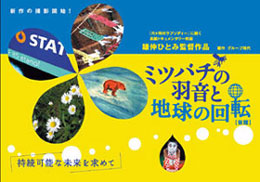
Hitomi Kamanaka's currently in-production feature documentary, "The Buzzing of Bees and the Rotation of the Earth" (tentative title).
Finding inspiration in Sweden's decision to phase out nuclear power, the film advocates for the importance of not going against the laws of nature for a sustainable future where the buzzing of bees can be heard. Scheduled for completion around autumn 2009.
KamanakaBecause I believe things can be changed. The people who have seen my films have changed significantly, and the network has expanded. It may be small, but it's spreading even without me saying anything directly. I feel a resonance and a connection there.
MiharaThat's a wonderful thing. By the way, what kind of work is your new film planned to be?
KamanakaIt has a dynamic title, "The Buzzing of Bees and the Rotation of the Earth" (laughs), but in a nutshell, it's about how beings like bees symbolize the sustainability of the Earth. If bees can live, humans can live too. Humans don't even understand why the Earth rotates; nature is full of mysteries. Yet, we are sustained by it. That's the major theme of the work.
MiharaThat's a theme I like. I'm very much looking forward to it. So, finally, could you give a message to OPENERS readers?
KamanakaWell, I'd like people to think carefully about how they spend their money. Even when buying essential items like toothbrushes and detergents, nowadays there's a stark contrast between environmentally friendly products and highly destructive ones. Instead of unconsciously buying something just because it's cheap, I hope people will pay a little attention to these things. For example, even when buying an onigiri at a convenience store, I hope they'll look at the label and choose something that's even slightly better for their bodies. This is an era where we can choose, and we are in a place where we can choose, so we should make use of that. If we practice these things in our daily lives, we will develop a sense of agency, realizing that we are making a difference. I want people to understand that each of us has the power to change the world through such actions.
MiharaUnderstood. Thank you very much.
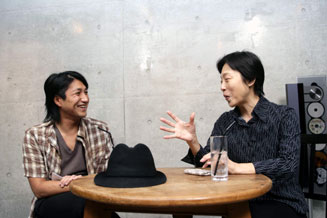
Profile
Hitomi Kamanaka
Born in Himi City, Toyama Prefecture, in 1958. After graduating from Waseda University, she signed an assistant director contract in 1984 with Group Gendai, a video production company specializing in documentaries. In 1987, she signed an assistant director contract with Iwanami Productions, among others. From 1990, she spent three years training at the National Film Board of Canada with a grant for overseas artistic dispatch from the Agency for Cultural Affairs. She then moved to New York and worked as a media activist. Returning to Japan in 1995, she became a freelance filmmaker and has produced numerous works, including television programs, video works, and films. Her representative works include "HIBAKUSHA: The End of the World" (2003) and "Rokkasho Rhapsody" (2006). Her new feature documentary, "The Buzzing of Bees and the Rotation of the Earth" (tentative title), is scheduled for completion in autumn 2009.
"The Buzzing of Bees and the Rotation of the Earth"
http://888earth.net/