May 11, 2015
Yasuhiro Mihara | Part 4: A Conversation with Hair Stylist Miho Matsuura (2)
Establishing Authentic Japanese Hair Quality and Individuality
Part 4: In Conversation with Hairstylist Miho Matsuura (1)
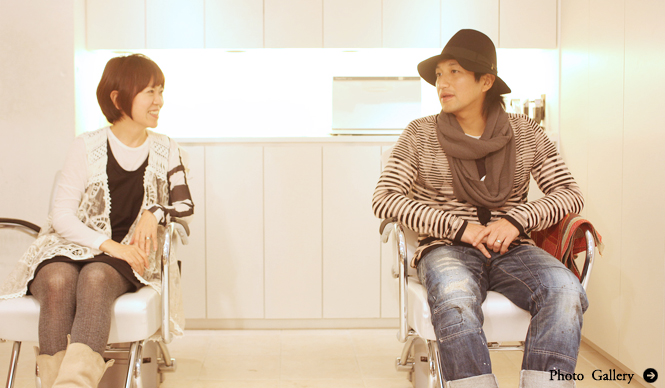
This is the second installment of a conversation with Miho Matsuura, owner and hairstylist at the salon "Twiggy," who is currently developing organic products.
Mihara learns that the shampoos we use so casually can actually impact our health. She is moved by Matsuura's conviction as she strives to change these surprising realities.
Photo: JamandfixSummary: Yasuhiro Takeishi (City Lights)
Yasuhiro MiharaHave there not been any health-conscious products in the beauty industry until now?
Miho MatsuuraBefore encountering organic shampoos in New York, I believe the only option was shampoo using traditional Japanese camellia oil. Even then, it contained chemical ingredients.
MiharaSo, organic products are a very recent development, and they are limited in quantity?
MatsuuraI've heard that even now, they account for only about one percent of the total market.
MiharaWas the industry forced to rely on chemical ingredients due to its rapid growth?
MatsuuraYou could say that. Ultimately, all ingredients in conventional shampoos are chemical; they cannot be made without relying on chemical processes.
MiharaIn Italy, I've seen soaps made solely from natural ingredients like olive oil, but can't shampoos be made that way?
Miho Matsuura
MatsuuraUnlike soap, shampoo must prevent hair from tangling or becoming dry. For that, surfactants specifically for shampoo are absolutely necessary.
However, surfactants derived from natural ingredients are extremely difficult to obtain.
MiharaIs that so? By the way, were there any regulations regarding the health impact of ingredients used in shampoos?
MatsuuraThere were no strict regulations, so it was effectively a free-for-all. When I was young, shampoos were only sold in hair salons. Before commercial products became widely available, everyone washed their hair with natural soap.
However, because hair would become dry and soap residue would form, shampoos were developed. But all the ingredients were chemically synthesized.
MiharaWhat are the main ingredients in shampoo?
MatsuuraShampoo needs to produce lather, and the ingredient responsible for that is surfactant. These are almost entirely chemically synthesized, and are said to be not good for hair and scalp at all.
People are careful to choose healthy options for food and cosmetics, but when it comes to hair, it's often an afterthought. Substances can penetrate through the pores, but I feel shampoo is overlooked in this regard.


The Impact of Chemically Synthesized Ingredients on the Human Body
MiharaSo, shampoos are absorbed through the pores and scalp. Does this have any impact on the human body?
MatsuuraI believe it does, to some extent. Substances absorbed through the scalp enter the capillaries and reach the liver and kidneys. Organs that absorb toxic substances are put under strain. The kidneys, in particular, are vital organs responsible for detoxification, and if their function weakens, the body's overall detoxification process is compromised.
MiharaIs that so? It seems there are no positive aspects at all, so why are such chemicals used?
MatsuuraThere's a history where hair was considered "dead cells," and once cut, it was thought to be the end of it, so health aspects weren't given much consideration. However, hair has cuticles, and within them is the medulla. The medulla receives blood from the hair root. This means that substances absorbed through the cuticle could potentially enter the bloodstream via the medulla.
MiharaHearing you explain this, I now understand the importance of shampoo ingredients.
MatsuuraI want more people to know these facts. Nowadays, many healthy lifestyle choices are incorporated into our lives, but attention hasn't really extended to shampoos and conditioners.
I believe Japan has become one of the most fashionable countries globally, but to maintain that, this is an essential element. It's a question of, "Is it okay if my hair is damaged, as long as it has a good style?"
The unique charm of Japanese people is indeed their black hair, and its luster allows them to pull off straight long hair beautifully. This is important, and while it's an indispensable element for both fashion and daily life, it has been neglected based on the old notion that "hair is dead."
While I think bleaching hair completely white and then shaving it off is a valid fashion statement, you can't achieve that with damaged, fine hair. If we lose the ability to maintain our natural Japanese hair quality, we won't be able to create edgy hairstyles either.
MiharaI see. By the way, what kind of effects do these chemical substances have on the body once they enter through the hair and pores?
MatsuuraOne of them is said to be allergies and atopic dermatitis. These are very common recently, and it's believed to be a result of chemical substances used not only in shampoos but also in cosmetics and food affecting the body and disrupting immune function.
Yasuhiro Mihara
MiharaDespite these issues, products using natural ingredients still only make up one percent of the market, is that correct?
MatsuuraYes. From a commercial perspective, chemical ingredients have the advantage of being inexpensive to produce.
Consumers prefer cheaper products, which ultimately leads to chemical-based ones. Organic products naturally become more expensive.
MiharaWhy do organic products end up being more expensive?
MatsuuraUnlike chemical processes that are simple and inexpensive, organic production requires improving the soil itself. It also takes more effort. Just like organic rice is more expensive but tastier, it's the same with shampoo.
It can take several years to improve the soil and cultivate organic crops, during which time no profit can be expected. However, I don't think it's right for them to become excessively expensive either. I find it strange when 'eco' becomes too much of a business. It requires effort and patience to reduce costs as much as possible.
MiharaI can clearly see that you are engaged in this not just as a business, but with a strong conviction.
Part 4: In Conversation with Hairstylist Miho Matsuura (3)To be continued
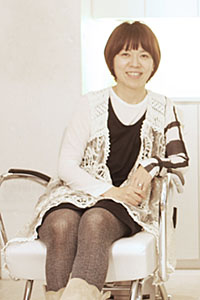
Miho Matsuura
After serving as manager at "Roppongi Hair Salon" in the early 1980s, she moved to the UK in 1988. Upon returning to Japan, she opened the hair salon "Twiggy." In addition to salon work, she has worked as a hairstylist, expanding her activities to include backstage at New York and London Collections and hair show events.
In 2003, with the launch of the American natural beauty brand "Aveda" in Japan, she was appointed Artistic Director. For five years, she contributed to the brand's penetration by providing advice on product development and proposing hairstyles.
In 2007, "Twiggy" relocated to Jingu-mae. Through collaborations with "Secret Closet" (fashion boutique) and "Ange" (nail team), it offers a total beauty salon experience encompassing hairstyles & coloring, hair spa, nails, and fashion. She is currently developing her long-desired original products.
Twiggy
http://www.twiggy.co.jp

