Yasuhiro Mihara, Part 1: Welcoming Safia Minney, Founder of People Tree (3/3)
Part 1: Safia Minney, People Tree Representative (3rd and Final Part)
Why Handmade Products Are Effective for the Environment and Poverty
Fashion designer Yasuhiro Mihara explores what concrete actions are needed to change the world for the better and what the future "criterion" will be, through conversations with people who are influencing public opinion through social activities. This is the new series, "Criterion MIHARAYASUHIRO."
In this first installment, we feature Safia Minney, representative of People Tree, a fair trade company that was an early seller of fair trade products in Japan since 1993 and will be collaborating with Mihara for the Spring/Summer 2009 collection. She speaks over three parts about fair trade, and social issues such as poverty, the environment, and child labor.
Photo: Kaoru KitaharaSummary: Yasuhiro Takeishi (City Lights)
The Irreplaceable Resource of Human Hands
MiharaNow, let's change the subject slightly. What is People Tree's corporate philosophy?
SafiaIt's "people and the environment."
MiharaSo, what do you consider to be a resource, Safia?
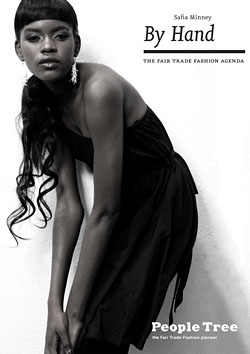
Safia's book, "By Hand," published in the UK this year. It illustrates with photos and text how fair trade and handmade production are beneficial to the planet and to us humans. ©People Tree
SafiaOf course, there are things the Earth gives us, like water, air, and oil, but I believe human hands are also a resource. The world population is said to exceed 9 billion in 20 years. At that point, human hands will become a very important resource. I think utilizing human skills to create things will become even more crucial.
I recently published a book in the UK called "By Hand" that encapsulates this idea. It discusses why handmade products are effective for the environment and poverty.
MiharaThat sounds like a wonderful book. I'd like to read it carefully. In any case, I believe the current situation is also partly due to a lack of morality in developed countries. Despite having education and industry, they push all these problems onto developing countries, forcing them to produce things cheaply. I think this is the result.
Also, I've always wondered, but isn't the very expression "developed countries" and "developing countries" problematic in the first place?
Morality for True Happiness
SafiaSpeaking of which, I recently saw data on the "Gross National Happiness Index," and the country with the highest score was Vanuatu, a developing nation. I found that to be very interesting. Japan and the UK scored very low, though (laughs).
MiharaUltimately, it's about what constitutes developed and developing, isn't it? I think those criteria will change in the future. It won't just be about economics, but also about how we approach morality. Japan is a country of mass consumption, but if consumption isn't accompanied by morality, it will lose social credibility in the future.
I can't claim to "save Japanese industry" or anything so grand, but I always think about making efforts to improve things, even slightly. In reality, both developed and developing countries have problems, but the world we desire is the same: everyone wants to live happily and with a smile, right? However, if the morality that we shouldn't impose burdens on other countries for our own happiness becomes widespread, the world will change much more. It would be great if planners, producers, and consumers could all work with the same motivation. Though I know it's not that simple.
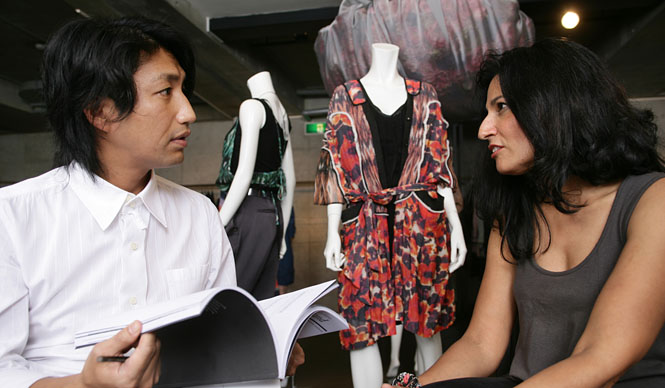
Safia: I agree. You were one of the first to use organic cotton in your collections, Mihara. What was the inspiration behind that?
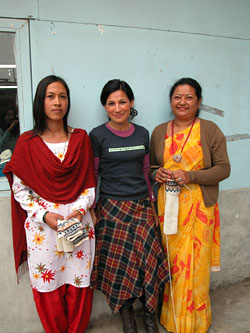
Women knitting People Tree's knitwear in Nepal. Through this hand-knitting production, this cooperative provides work for over 2,000 women. ©People Tree
MiharaTo be honest, I was quite ignorant about those matters (laughs). A knowledgeable staff member in my company suggested we try it. I'm the type of person who doesn't get moved by anything outside my own philosophy, but issues like the environment and poverty have gradually become part of my philosophy.
Frankly, Safia, you might be angry, but I used to find the word "eco" a bit dubious. Now, it has taken root within me as a conviction. That's why I want you to teach me more, perhaps by taking me to visit your sites.
SafiaUnderstood. I look forward to your continued support.
MiharaFinally, could you give us a message for OPENERS readers?
SafiaYes. Fair trade is a system where you can get good products, protect the environment, and support local people. You can easily participate just by choosing fair trade products, so I truly hope more people will join us.
MiharaThank you very much.
Profile
Safia Minney
Born in the UK in 1964. While working in the publishing industry, she participated in NGO activities for human rights and environmental protection from a young age. She came to Japan in 1990 and founded the NGO Global Village the following year. She began fair trade in 1993 and established the specialized fair trade brand "People Tree" in Japan and London. She is globally recognized as a social entrepreneur and leads a busy life, traveling between Tokyo, London, and various countries where fair trade is practiced. She is married to James and has two children, Jerome and Natalie.
People Tree
www.peopletree.co.jp