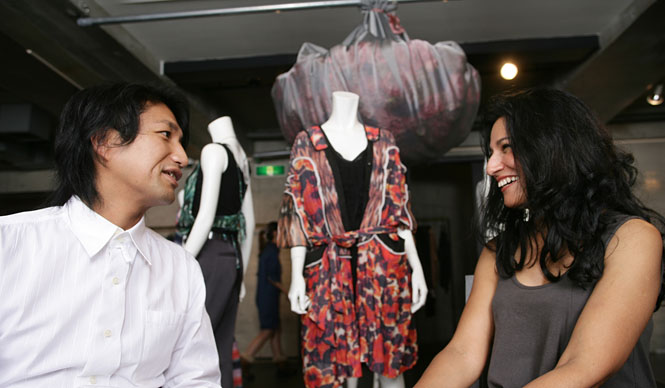
Yasuhiro Mihara, Part 1: Welcoming Safia Minney, Founder of People Tree (2/3)
Part 1: Safia Minney, People Tree Representative (2)
Fair Trade is Slow Fashion
In this new series, "Criterion MIHARAYASUHIRO," fashion designer Yasuhiro Mihara explores what concrete actions we must take to change the world for the better and what the future "criteria" will be, through conversations with people who are moving public opinion through social activism.
For this first installment, we feature Safia Minney, representative of People Tree, a fair trade company that was an early adopter of selling fair trade products in Japan starting in 1993 and will be collaborating with Mihara for the Spring/Summer 2009 collection. She speaks with us over three installments about fair trade, as well as social issues such as poverty, the environment, and child labor.
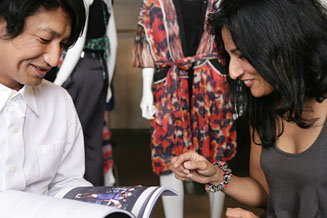
Photo: Kaoru KitaharaSummary: Yasuhiro Takeishi (City Lights)
Not Pity, But Respect for People
MiharaI feel a strong respect for people in Safia's work. The desire to pay fairly for the labor of those working for low wages is not pity, but an expression of respect. I feel that this is an era where people with such sentiments are the ones who will change the world.
SafiaThat's right. When I visit the sites and meet people with wonderful skills, I always feel that helping them isn't that difficult. Their skills are truly amazing.
What becomes the bottleneck are information about the global market, capital for sourcing raw materials, and partners in developed countries who can develop products using traditional techniques. If these barriers could be overcome, they could work properly and earn sufficient income. However, it's simply difficult within the current economic system.
Especially in the fashion industry, where I and Mihara are involved, production periods are becoming shorter and shorter, making it impossible to create handmade items like hand embroidery or hand weaving.
MiharaThat might be difficult. When I previously worked on a fair trade project, I was told the delivery would be nine months later. For us, that timeframe is just too long to even contemplate (laughs).
I understand that items made carefully and meticulously by hand are satisfying when you hold them. However, I realized there are indeed difficulties within the current distribution system.
SafiaFair trade is slow fashion (laughs). By the way, when did you start planning the collection that is currently on display?
MiharaTwo months ago (laughs).
SafiaIs that so? (laughs).
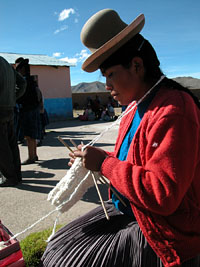
Quechua women from the Andes Mountains in Peru. The simple knitwear, hand-spun from natural alpaca wool and hand-knitted, is very light and warm. ©People Tree
MiharaIndeed, the current fashion cycle is too fast. However, I believe that things made with such care and time are, conversely, a great luxury. They are difficult to produce within the current system. By the way, what is the situation in developing countries from your perspective, Safia?
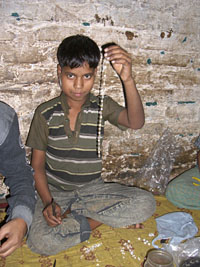
Children making accessories in a slum in Delhi, India. Such child labor is a serious problem, and the items made by these children are sold on the streets of developed countries. ©People Tree
SafiaCurrently, about 20% of the world's population lives on $1 (about 100 yen) a day, and about 50% live on less than $2. In countries like Bangladesh and India, where such people form the majority, fair trade can double the average income.
When I visit places like the slums of Delhi, I see children under ten years old making accessories. What's more, some of these children have been sold by their parents from afar. It's like slavery, with many children living together in small rooms. Accessories made by such children are sold in the UK and Japan. Furthermore, the checks on such child labor are hardly functioning.
MiharaDon't those countries have labor laws?
SafiaThey do have laws, but the police are completely inactive. I believe that buyers also bear responsibility for this situation. Through one-sided conditions like "deliver by this date" and "we can only pay this much," even children who can be exploited are drawn into labor. The root cause of poverty that gives rise to such children is likely the change in the lives of local people, who once lived with abundant natural resources, due to the entry of multinational corporations through globalization.
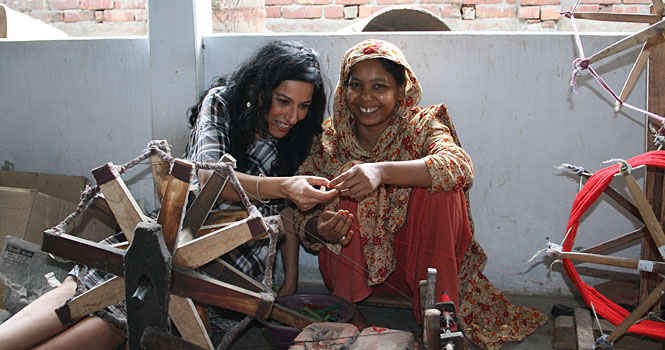
A woman working at a fair trade organization in Bangladesh, winding thread. Wearing traditional attire, she slowly winds the thread using a traditional wooden thread winder. ©People Tree
Rooting Fair Trade in Japan
MiharaThe situation is very serious.
SafiaPrecisely. I believe we need to create systems that bring consumers and producers closer together.
MiharaThe issue might lie with the companies that act as intermediaries between consumers and producers. Of course, consumers ideally want good products at low prices, but I believe they would adopt a stance of understanding the reasons behind the pricing if they were properly informed about the current situation. However, I don't think the products from People Tree, which you run, are particularly expensive. So, could you tell us about your future goals, Safia?
SafiaI would love to spread fair trade further in Japan. To that end, I have a request for you, Mihara. We are planning to hold an event called "World Fair Trade Day" on May 9th next year. We want to create T-shirts with messages on the theme of "Fair Trade + Ecology" from various opinion leaders, and we would be delighted if you would participate.
MiharaThat would be an honor. I would be happy to participate.
SafiaThank you! Also, if you have the opportunity, I would like to take you to Bangladesh and introduce you to the local producers. I have a village there that I love more than anywhere else in the world.
MiharaI would definitely like to go. Actually, I'm a "site fetishist" (laughs). I just love seeing the places where things are made and meeting the craftspeople. That's why I started making shoes.
SafiaIs that so? It's no wonder, given that you make shoes yourself.
MiharaWhen I watch people making things, something inexpressible is born. Of course, there is respect, and I am also encouraged. I believe that the reason I can move forward each season is largely because I draw courage from such people. I often get inspiration on the spot.
SafiaI see. I would love for you to meet the artisans from our fair trade partners and create something together.
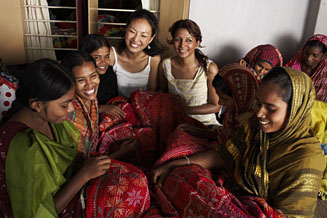
At a fair trade organization in Bangladesh. Over 200 women have jobs in hand weaving, sewing, and embroidery, supporting their families. This is the organization Safia mentioned wanting to take Mihara to during our conversation. ©People Tree
Profile
Safia Minney
Born in the UK in 1964. While working in the publishing industry, she participated in NGO activities for human rights and environmental protection from a young age. She moved to Japan in 1990 and founded the NGO Global Village the following year. She began fair trade in 1993 and established the specialized fair trade brand "People Tree" in Japan and London. She has received global recognition as a social entrepreneur and leads a busy life, constantly traveling between Tokyo, London, and various countries where fair trade is practiced. She is married to James and has two children, Jerome and Natalie.
People Tree
www.peopletree.co.jp