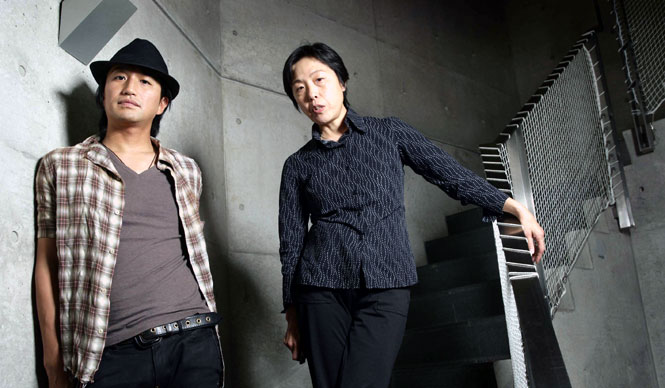
Yasuhiro Mihara | Part 2: Filmmaker Hitomi Kamanaka x Yasuhiro Mihara (2) Dialogue
Part 2: Film Director Hitomi Kamanaka x Yasuhiko Mihara (2) Dialogue
A conversation with Hitomi Kamanaka, a film director who continues to focus on social issues with documentaries such as "HIBAKUSHA: The End of the World" and "Rokasho Village Rhapsody." Mihara, also a surfer, discusses the unavoidable presence of radioactivity, which he feels close to, and the outdated arguments and opaque responses from administrative bodies.
Photo: Kaoru KitaharaEdited by: Takeishi Yasuhiro (City Lights)
The Tangible Reality of Personal Radiation Exposure
MiharaI’ve been surfing for a long time, and I often go to the beaches in Ibaraki and Chiba. There are rumors that radioactivity from Rokasho Village flows there too, but is radioactivity diluted in the ocean as the government claims?
KamanakaI believe it is true that it dilutes to some extent. The radioactivity in the oceans of Ibaraki and Chiba is likely lower than off the coast of Rokasho Village.
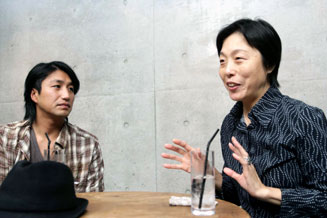
MiharaIs that so? I feel a little relieved (laughs).
But the possibility of internal exposure from radioactive substances dissolved in seawater is not zero, is it?
KamanakaThat's true, but radioactivity doesn't have an immediate, visible effect, so it's difficult to assess. Furthermore, even if 100 people are exposed to the same conditions, the effects vary from person to person; some may develop illnesses while others do not. This has been proven in Hiroshima. The Hiroshima atomic bombing data allows for quite accurate calculations, with data on the distance and the amount of radiation received. According to this, even at the same distance, there were people who died and people who survived, and people who developed illnesses and people who remained healthy. In other words, some people get sick from even a small amount of radiation, while others can absorb a lot and remain healthy. This variability is what makes radioactivity so difficult to understand. However, I have heard that plutonium does not dissolve in water and floats in the air as bubbles, so surfers may be at risk of inhaling it.
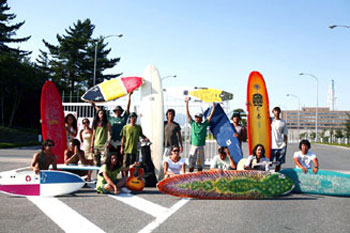
Surfers who learned about the Rokasho Reprocessing Plant embarked on a tour called "WAVEMENT" from Shonan, heading north along the Pacific coast to inform surfers in other regions about its existence. The photo was taken in front of the main gate of the Rokasho Reprocessing Plant, the tour's final destination. From "Rokasho Village Newsletter No. 4."
MiharaIs that true?
KamanakaIn Sellafield, a coastal town in the UK with nuclear facilities nearby, plutonium has been detected in dust collected from rooms and tested with a vacuum cleaner. I believe the levels in Ibaraki and Chiba are lower than there, though.
MiharaI've heard that the radiation emission standards were quite low during the Sellafield era. Compared to that, how much radiation does the Rokasho facility emit?
KamanakaI believe the amount released into the sea is quite small. However, when combined with the radioactivity released into the air, a total of 1,880 trillion becquerels have been emitted in real terms over the past two years, making it certainly one of the facilities emitting the most radioactivity in the world.
MiharaIs it not possible to reduce these emission amounts?
KamanakaIt seems that installing a certain device could reduce emissions, but they apparently do not want to install it because it would result in a deficit.
MiharaIs it a budget issue? Is the Rokasho facility operated by the government in the first place?
KamanakaNo. All nuclear power plants in France are operated by the government, but in Japan, it's private companies. In Japan, the government says 'nuclear power is good,' and private power companies say 'we're doing it on our own.' Nuclear power is a national policy; they provide support but do not take responsibility. Therefore, the Rokasho facility is operated by Japan Nuclear Fuel Limited.
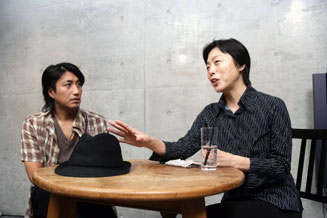
MiharaSo, Japan Nuclear Fuel is not a state-owned enterprise.
KamanakaThere are no state-owned power companies in Japan to begin with. That's why the government can evade responsibility by saying 'it's what the operators are doing,' and the operators say 'we're doing it because it's a national policy.' In other words, this is a system where no one takes responsibility.
MiharaIn "Rokasho Village Rhapsody," the village was divided into three factions: pro, con, and neutral. From your perspective having visited Rokasho, what was your impression of the village? For the local people to make a living, is the reprocessing plant also necessary in some aspects?
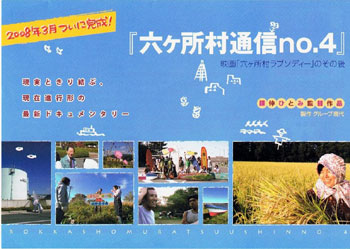
"Rokasho Village Newsletter No. 4," a documentary that follows how the people of Rokasho Village began to act after watching "Rokasho Village Rhapsody," released in March 2006.
The "Rokasho Village Newsletter" series, "No. 1-3," produced as video letters before the film's release, are packed with interview scenes that didn't make it into the film and are each sold on DVD.
KamanakaIn reality, there are places with even more severe situations than Rokasho Village. However, Rokasho happened to have a large amount of water, which is essential for reprocessing nuclear fuel. Moreover, while opposition movements always arise when plans for nuisance facilities like nuclear power plants are proposed, here they were able to purchase the land in advance by asking landowners to sell, without needing to persuade them. In such a situation, farmers without land rights could not resist, and it was the fishermen with fishing rights who fought.
Currently, the average annual income in Aomori Prefecture is 2 million yen, which is quite low nationwide. Even within that, Rokasho Village was a region with even lower annual incomes. The villagers of Rokasho, most of whom had lost the assets they had built while pioneering Manchuria and Sakhalin, had nowhere else to go upon their return. For them, being offered a price 100 times higher for their land, they likely had no choice but to sell. I don't think they understood much about what kind of facility would be built there.
Opaque Administrative Responses That Evoke Outrage
MiharaThe very term 'nuclear fuel reprocessing plant' is confusing, isn't it? The name alone could sound ecological.
KamanakaThat's certainly true. If they say 'it's recycling,' then that's that.
MiharaWhen I first heard about the 'Rokasho Reprocessing Plant,' I also had an ecological and economic image. But I learned that it wasn't the case. However, I don't think this facility is an issue solely for the people of Rokasho Village or Aomori Prefecture. I believe it is a problem that all Japanese citizens should confront, but why doesn't the government and administration engage more with the public and dialogue?
KamanakaThat's a big issue, but fundamentally, it's something the government decided on its own.
MiharaThat's something that inevitably evokes great indignation.
KamanakaThe government should make information transparent and explain to the entire nation what they are doing. This is called public communication in English, but the Japanese government does not do it. There is a severe lack of transparency in information. Especially concerning nuclear power and nuclear issues, transparency has been decreasing due to the risk of use by terrorists. This trend has become markedly evident since 9/11.
For example, when transporting nuclear fuel, the routes used to be announced, but now it is done secretly. All the waste generated to produce electricity for Japan is brought to Rokasho. This is waste generated by all 120 million Japanese people. It is all being imposed on Rokasho, and reprocessing will contaminate Rokasho first and foremost.
I have visited nuclear fuel reprocessing plants all over the world, and there is no area that is not contaminated. In some cases, the contamination has spread to regions outside their own country. Radioactivity from Sellafield in the UK has flowed into the North Sea, causing mass deaths of seals three times. The government explains that the cause of death was a decline in immunity due to a disease similar to seal AIDS, and that the cause is unknown.
MiharaIs that so? Earlier, you mentioned the high incidence of breast cancer in Japan; are there regional statistics available?
KamanakaIn Japan, it has been increasing since around 1996, and data shows a higher incidence on the Sea of Japan side, from Hokkaido to Tohoku. This is said to be due to the Chernobyl nuclear accident in the former Soviet Union in 1986. At that time, the Japan Meteorological Agency had installed devices to measure incoming radioactivity in various locations, and in 1986, readings 100 times higher than normal were detected. These devices measure radioactive cesium, which may have entered women's breast tissue, caused mutations, and led to the development of breast cancer over 10 years.
However, since it was 10 years ago, it is difficult to definitively conclude that it was the cause. Even recognizing radiation sickness from the Hiroshima bombing is difficult. But I am not trying to eccentrically emphasize the dangers of such trace radioactive substances alone.
In my work "Rokasho Village Newsletter No. 4," there is a scene where surfers and fishermen from Iwate Prefecture go to deliver signatures to the administration. A young bureaucrat from the Agency for Natural Resources and Energy appears and says, 'Everyone, the world operates on dilution and diffusion, where poisons become weaker. Exhaust fumes are dangerous, but cars can run because the gas is diluted. So Rokasho is also safe.' A government official says this so confidently.
As a result of continuing such actions, carbon dioxide has increased to this extent, leading to global warming in the current era. In other words, although it has disappeared from our immediate sight due to dilution, the entire global environment has become polluted. This is a very outdated way of thinking and can be considered global environmental pollution.
MiharaIt's such a foolish way of thinking that it's astonishing. If this continues, won't humanity be eliminated from the Earth by the pollution it has caused? I hear there is a plan to build a nuclear power plant in Yamaguchi Prefecture even now; in what kind of location is it being built?
KamanakaGeographically, it's a bay on a long, narrow island on the mainland side, but it's an area where freshwater springs from the seabed and special seaweed thrives. Such areas are called 'seaweed beds' (moba) and are essential for the ecosystem where fish gather to spawn and juvenile fish grow. The Ecological Society of Japan has also raised objections to Chugoku Electric Power. It is the last remaining environment in the Seto Inland Sea, and they warn that the entire ecosystem of the Seto Inland Sea could be destroyed by the nuclear power plant. However, Chugoku Electric Power denies this.
MiharaThe governor of Yamaguchi Prefecture also approved the landfill, didn't he? Was there no discussion between the local residents and the administration?
KamanakaThe town of Kaminoseki, the planned construction site, held a town council meeting, and I went to film it. That day, 250 townspeople, especially from Iwaijima, which is strongly opposed, gathered to observe. However, only 20 seats were available in the observation area. The remaining 230 people pressed to be allowed to listen, even from the hallway, but they were ultimately shut out. Furthermore, other media, such as NHK, were also present for coverage, but I alone was forced to leave.
MiharaIt seems the administration has no intention of discussing the matter at all. It feels like they are merely going through the motions of appearing to have discussions.
KamanakaThe people of Iwaijima are also suffering from frustration because their feelings about why they don't want a nuclear power plant built are not being conveyed. Meanwhile, the plan progresses steadily. The planned construction site is very close to Iwaijima, directly in front of their residential area. This means they would have to live with the nuclear power plant in view, and in a location with no escape route in case of an accident.
MiharaWhy was construction decided for such a location?
KamanakaKaminoseki Town does not have an information disclosure ordinance. There are only nine such towns in Japan without such an ordinance, and they were targeted. Rather than geological conditions, they seem to target towns where administrative influence is strong or where depopulation leads to a lack of income. Even the Kashiwazaki Kariwa Nuclear Power Plant has a fragile geological foundation.
Profile
Hitomi Kamanaka
Born in Himi City, Toyama Prefecture, in 1958. After graduating from Waseda University, she signed an assistant director contract with Group Gendai, a video production company specializing in documentaries, in 1984. In 1987, she signed an assistant director contract with Iwanami Productions, among others. From 1990, she trained for three years at the National Film Board of Canada with a grant for overseas training of artists from the Agency for Cultural Affairs. She then moved to New York and worked as a media activist. Returning to Japan in 1995, she became a freelance filmmaker and has produced numerous works, including television programs, video works, and films. Her representative works include "HIBAKUSHA: The End of the World" (2003) and "Rokasho Village Rhapsody" (2006). Her new feature documentary film "The Buzzing of the Bees and the Rotation of the Earth" (tentative title) is scheduled for completion in the fall of 2009.
"The Buzzing of the Bees and the Rotation of the Earth"
http://888earth.net/