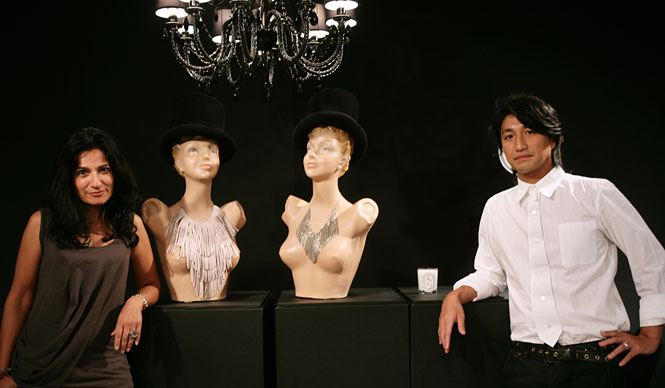
Yasuhiro Mihara, Part 1: Welcoming Safia Minney, Founder of People Tree (1/3)
Part 1: Safia Minney, People Tree Representative (1)
A New Trading System: "Fair Trade"
Fashion designer Yasuhiro Mihara explores what concrete actions are needed to change the world for the better and what the future "criteria" will be, through conversations with influential figures driving public opinion through social activism. This is the new series, "Criterion MIHARAYASUHIRO."
For this first installment, we feature Safia Minney, representative of People Tree, a fair trade company that was an early adopter of fair trade products in Japan starting in 1993. People Tree also decided on a collaboration with Mihara for their Spring/Summer 2009 collection. Minney discusses fair trade, as well as social issues like poverty, the environment, and child labor, over three parts.
Photo: Kaoru KitaharaSummary: Yasuhiro Takeishi (City Lights)
Fair Trade Centers on People and the Environment
Yasuhiro MiharaIt's a pleasure to meet you. Thank you for having me.
Safia MinneyThe pleasure is all mine. Thank you.
MiharaTo start, I'd like to ask about the basics. What exactly is the "fair trade" system?
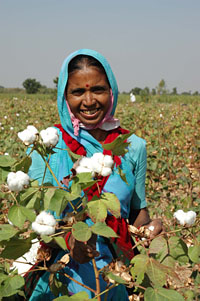
Small-scale farmers cultivating organic cotton in India. Grown naturally, without reliance on pesticides or chemical fertilizers. People Tree uses this cotton for the majority of its clothing.
SafiaSimply put, fair trade is a new system of trade. It's trade where people and the environment are at the center of the system, not just profit.
While issues of poverty, human rights, and the environment have seen some improvement over the past 50 years due to the efforts and donations of aid organizations, the gap between rich and poor continues to widen. Fair trade aims to create a system that secures income sources by leveraging the skills of economically vulnerable people, rather than relying on donations.
For example, farmers in developing countries possess excellent organic cotton cultivation techniques, but currently, these skills are not utilized because buyers pressure them to use pesticides to lower costs. I think this is a tremendous waste.
MiharaSafia, you've actually seen these situations on the ground. What do you believe needs to change first?
SafiaI think it's people's awareness that needs to change first. In Japan, awareness of North-South issues and environmental problems is growing, but when it comes to fair trade, there's still a long way to go. For instance, in the UK, it's said that over 70% of the population understands the fair trade system, but in Japan, it's likely less than 10%.
A Global Perspective Beyond Self-Interest
MiharaI believe Japanese consumers have only recently started paying attention to the country of origin and production process of goods. This was largely driven by health consciousness and ecological concerns stemming from food mislabeling scandals, and I don't think fair trade has entered their consciousness yet. Perhaps it's because whether producers in the country of origin are paid fairly isn't a direct personal issue for them.
In contrast, issues like food damage and global warming are easier to perceive as direct personal problems. Even when fair trade is covered in the media, it's often treated superficially, as a slogan, and few people understand the system itself. Is this awareness beginning to change in Japan?
SafiaAs you say, Mihara, health foods perceived through a "LOHAS" lens are, in a way, for one's own benefit. And that's not necessarily a bad thing. However, even if something is trustworthy, if its production process harms the environment, involves systemic exploitation, or utilizes child labor, then it is indeed a problem. While it's fine to start with a LOHAS-like perspective, Japan should take it a step further and adopt a more global viewpoint.
Japan has a high level of education and a well-established social infrastructure among developed nations, so I believe it should take a leadership role in the field of fair trade. I hope to see a greater awareness of international cooperation and a push for more transparent, person-to-person trade.
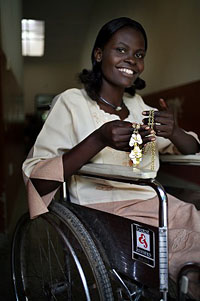
An organization in Kenya that provides employment opportunities for people with disabilities. They create brass and silver accessories, which are also popular at People Tree. ©Miki Alcalde / People Tree
MiharaWhat was the initial motivation for you to start a fair trade organization in Japan?
SafiaI lived in London until 1989, where I used to buy organic foods and second-hand clothing that were good for the environment. Fair trade products, mainly food items, were also available in London back then. However, in Japan, there was very little available that I wanted to buy. So, with friends in Japan, I started gathering information, even with my limited Japanese (laughs), and began going to purchase items directly or have them made. We started selling through flyers and mail-order catalogs.
The Concept of "Social Business" as a Necessity
MiharaSo, initially, you were acting more as an individual than as an organization. What fueled your passion to that extent?
SafiaI worked in publishing and advertising in London from the age of 17. It was a world that epitomized consumerism and materialism, and I always questioned why vast sums of money were spent on things that felt meaningless. Then, at 22, I backpacked around the world, read books, and learned about the human rights and environmental issues generated by massive corporations that lacked transparency. I became very angry. That's why, even now, I want my money to be used for good, and I don't want to buy products from untrustworthy companies.
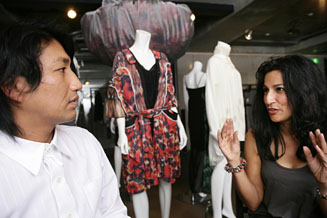
MiharaI sometimes wonder how much people truly trust economies and corporations. For example, in the past, consumers would blindly buy products simply because they were sold in a famous department store. But that trust has eroded, hasn't it?
I believe we are currently in an era where people harbor distrust towards "products" across various fields.
As creators of products ourselves, we feel it's a time to reflect on what the role of a company should be. And while I am currently involved in fashion as a designer, I want to do everything within my power.
I had heard the term "social enterprise" before, but at the time, it just sounded like a slogan. I thought it was something companies did as a social contribution once they had achieved business success and had the luxury to do so. However, after hearing your story, Safia, I realize that's not the case anymore. It's not a trend or a status symbol; it has become a necessity for businesses. What are your thoughts on the concept of "social enterprise"?
SafiaI believe it's not yet a fully ingrained concept as a necessity in Japan, but it is becoming a significant trend. In Europe, more universities are teaching social enterprise and social business, and the idea of giving back to society only after achieving financial success is actually decreasing. There are many young people who want to contribute to society from the outset. This trend is also visible in Japan, and I hope that young people with this mindset will change companies from within in the future.
Profile
Safia Minney
Born in the UK in 1964. While working in the publishing industry, she participated in NGO activities for human rights and environmental protection from a young age. She came to Japan in 1990 and founded the NGO Global Village the following year. She began fair trade in 1993 and established the fair trade specialty brand "People Tree" in Japan and London. She has gained global recognition as a social entrepreneur and continues to lead a busy life, traveling between Tokyo, London, and various countries where fair trade is practiced. She is married to James and has two children, Jerome and Natalie.
People Tree
http://www.peopletree.co.jp