
Creatures of the Wind x Sanyei Corp: Bridging Tradition and Mode at Daimaru Seisakusho 2
Creatures of the Wind x Sanyo Shokai
A Bridge Between Tradition and Mode: Daimaru Production Studio 2
New York-Based Collaboration Between Made in Japan and High-End Fashion (1)
Among the things Japan should be proud of to the world is its craftsmanship, born from unique sensibilities and meticulous handiwork. While domestic Japanese craftsmanship is, of course, significant, it's worth noting that in recent years, skilled Japanese artisans have earned deep trust from international collection brands, leading to high acclaim abroad. Here, we feature the work of Sanyo Shokai, a venerable name in the Japanese fashion industry celebrating its 70th anniversary this year, and New York's "Daimaru Production Studio 2," as representatives of Japan's globally active craftsmanship. We aim to shed light once again on the power of "Made in Japan" that bridges tradition and mode.
Text by SAKUMA YumikoPhotography by KAWASAKI Shiori (NEW YORK), SANYO SHOKAI (IWATE)
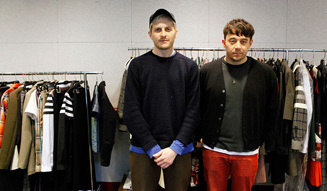
On February 7, 2013, "Creatures of the Wind" presented their Fall/Winter 2013 collection at New York Fashion Week. The designers are Chris Peters and Shane Gabie, a duo from Chicago who were finalists for the CFDA Award in 2011. Despite presenting in a highly competitive slot where many designers were showing elsewhere, the brand is undoubtedly one to watch, with Vogue Editor-in-Chief Anna Wintour visiting their backstage area.
Creatures of the Wind and Sanyo Shokai's Capsule Collection
One of the themes for the collection presented this time was "Teddy Girl." These were women with a mannish style who were around the "Teddy Boys," a subculture and style that emerged in Britain from the 1950s to the 1960s.
"The Teddy culture arose from a tough, aggressive stance against the bleak historical backdrop of Britain. Teddy Girls were gender-fluid, wearing menswear like armor to distance themselves from reality. We were inspired by their style (Chris Peters)."
Another theme was the "Memphis Movement." This was a design movement that emerged in Italy in the 1980s, characterized by colorful and kitsch designs.
These two inspirations were sublimated into a collection comprising masculine looks that utilized menswear details, and feminine silhouettes that incorporated pop jacquard weaves.
Within this collection was a capsule collection of seven coats, a collaboration between "Creatures of the Wind," Sanyo Shokai, and New York's "Daimaru Production Studio 2." Designers Chris and Shane reviewed approximately 500 sketches from Sanyo Shokai's archives from the late 1960s, and created new coat designs inspired by those they selected.

"It made sense to use Sanyo Shokai's archives, which excel in coats, to envision the 'Teddy Girl' wearing men's outerwear like armor. From there, we developed patterns and decided on materials, gradually evolving into modern pieces (Shane)."
"The late '60s is an era we really love. Finding sketches to inspire us was enjoyable and easy. I was surprised that Sanyo Shokai's sketch archive resembled our own sketches (Chris)."
They also conducted their own research and discovered advertisements made by Sanyo Shokai in the 1960s, which they used as inspiration. Mr. Shiraishi Yutaka from Sanyo Shokai's Business Strategy Office Marketing Team elaborates.
"The two from 'Creatures of the Wind' are wonderful people with a passion for fashion. From the project's inception, they meticulously studied the details of Sanyo coats sold in New York, and their highly proactive attitude was truly impressive."
Creatures of the Wind x Sanyo Shokai
A Bridge Between Tradition and Mode: Daimaru Production Studio 2
New York-Based Collaboration Between Made in Japan and High-End Fashion (2)
Daimaru Production Studio 2 Facilitated the Partnership
"Creatures of the Wind" has focused on quality control since its debut.
"When we launched the brand, we thought that in a world overflowing with clothes, launching a new brand would be meaningless unless it possessed a quality we could be proud of (Shane)."
They wanted to produce within their line of sight, so all garments were manufactured in their New York factory (sunglasses and shoes were produced in Italy). However, from Fall/Winter 2012, they began entrusting part of their mass production to "Iwate Sanyo Sewing," a Sanyo Shokai factory in Iwate, and in Spring/Summer 2013, they commissioned the same factory for sample and part of their mass production.
"We recognize Sanyo Shokai as a Japanese heritage brand. We don't have to worry about the ethics of their manufacturing. Furthermore, we became even more interested upon hearing that their factory is located in an area heavily impacted by the Great East Japan Earthquake (Chris)."
It was "Daimaru Production Studio 2" that brokered the connection between "Creatures of the Wind" and Sanyo Shokai.
The relationship between "Creatures of the Wind" and "Daimaru Production Studio 2" dates back to Spring/Summer 2012. "Creatures of the Wind," who were looking for a pattern maker, learned of Mr. Ryuhei Daimaru, president of "Daimaru Production Studio 2," through a mutual friend and commissioned him for part of their pattern creation. From there, their relationship deepened, and "Daimaru Production Studio 2" now provides consulting services, broadly handling everything from pattern making to material sourcing.
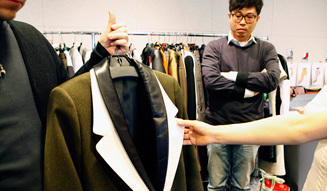
"(Daimaru) Ryuhei can bring my sketched ideas to life in three dimensions. His high level of comprehension and shared visual sense create a trust that we see things the same way (Shane)."
"Even when I see shows from other brands, I can immediately tell when Ryuhei was in charge of the patterns (Chris)."
Chris shared an interesting anecdote about Mr. Daimaru: "Ryuhei once went to the trouble of making shoulder pads himself. Normally, no one goes that far. I thought his dedication was almost crazy."
Ms. Sayuri Nagasawa of Daimaru Production Studio 2 added, "In Japan, there are many types of shoulder pads. In America, there are only about two types. That's why he made them by hand."
Creatures of the Wind x Sanyo Shokai
A Bridge Between Tradition and Mode: Daimaru Production Studio 2
New York-Based Collaboration Between Made in Japan and High-End Fashion (3)
Daimaru Production Studio 2 Undertakes More Than Just Pattern Making
"Daimaru Production Studio 2" was founded in New York in December 2008. President Ryuhei Daimaru, after working as a pattern maker for Comme des Garçons, moved to the United States, gained experience at Donna Karan New York, and then went independent. He has numerous clients in and outside New York, including "Jason Wu," "Suno," and "Creatures of the Wind," primarily handling pattern making and sample sewing. However, he undertakes more than just pattern making and sample sewing.
"I believe craftsmanship is the fundamental basis of everything. I started this business with the desire to create new business based on that foundation. I wanted to build a company that could handle everything from pattern making to sewing (Mr. Daimaru)."
Many who study fashion and build a career as a pattern maker eventually aspire to become independent designers.
"I deliberately chose not to pursue the path of a designer because I wanted to work in a more neutral capacity. The current business model offers broader possibilities, as the outcome can vary entirely depending on the collaborator. "
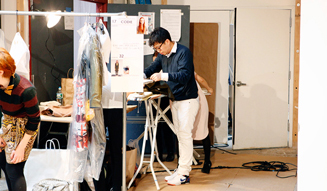
While his background is in pattern making, his ability to engage with designers so deeply now stems from his comprehensive understanding of the entire process.
"In the past, tailors handled everything from design to production. The current fashion industry has become too specialized and fragmented. My employees understand both sewing and fashion. They conduct market research and are rigorous about production. They need to understand clothing at the same level as designers (Mr. Daimaru)."
After leaving Comme des Garçons, Mr. Daimaru moved to the US with very limited English skills and found employment. In the American fashion scene, he truly recognized the strength of Japanese manufacturing.
"While I had a comfortable life at Donna Karan, I gradually began to think about Japan. I felt it would be more meaningful to contribute to society and send a message from Japan as a Japanese person."
Mr. Daimaru states that the meticulous approach he learned in Japan, even in how patterns are drafted, differs significantly from Western methods. For example, the jacket with men's details created for this capsule collection.
"We meticulously incorporated men's techniques, such as the way the sleeves are set, and used materials from Nippon Keori that were previously used for uniforms. Westerners create things intuitively, which is fine. But as a Japanese person, I want to think thoroughly about the theory and process. This is unique to Japanese people. If I'm making a boyfriend jacket, I want to use the mindset of a men's tailor and make it with genuine dedication."
Given Mr. Daimaru's dedication, his encounter with Sanyo Shokai was a perfect match for his aspirations.
"Nowadays, there are hardly any apparel companies that own their factories. To stubbornly protect their factories in this era is remarkable. I am proud to be able to work with such a company."
Creatures of the Wind x Sanyo Shokai
A Bridge Between Tradition and Mode: Daimaru Production Studio 2
New York-Based Collaboration Between Made in Japan and High-End Fashion (4)
What Makes "Made in Japan" So Remarkable?
Products made in Japanese factories are often described as "high quality," but it can be difficult for consumers to discern the difference. What exactly is the difference?
"There is no country that can match Japan in its ability to produce highly precise mass-produced items. America and Italy have a tailor's culture. Their products are fundamentally based on what a tailor sews themselves. When adapting this to mass production, weaknesses inevitably emerge."
We also asked "Creatures of the Wind," who commissioned Sanyo Sewing for their production.
"When the samples return, we can tell how carefully they were handled and how much effort was put into them. It would be foolish to put effort into design and pattern making only to have the product's quality diminished by entrusting it to a factory lacking the necessary skills (Shane)."
Mr. Daimaru, from his experience as a pattern maker, acutely understands the importance of choosing the right factory.
"No matter how excellent the pattern, if the sewing capabilities are not on the same level, the final product will not be good. Even with a perfect pattern, if the sewing is subpar, the resulting garment will only be mediocre. Only when design, pattern making, fabric selection, and sewing all come together can a superior product be created."
We also asked Sanyo Shokai, which has long been committed to owning its factories.
"The high technical skill of each individual operating a sewing machine is a significant strength, but through meticulous management of each component and environmental improvements, we can produce large quantities of high-quality products with minimal waste. We have five domestic factories. Our staff of approximately 100 people operates like a single organism, with everyone fulfilling their role. This allows us to feel a warmth, a human touch. This cannot be cultivated in just a few years of operation (Mr. Shiraishi)."

It goes without saying that production in Japanese factories is not a cheap option. In an era where many mass-production brands targeting the mass market collaborate with high-end brands to create stylish items affordably, perhaps it is precisely because of this era that such movements become interesting.
"What's interesting is being able to bridge Japan, capable of producing excellent goods, with high-end brands, directing the process, and creating a situation where established and emerging players stimulate each other to produce something new (Mr. Daimaru)."
Sanyo Shokai celebrates its 70th anniversary this year. In this milestone year, "Made in Japan" coats produced in a factory in Iwate, an area heavily affected by the earthquake, were showcased on the New York runway.
"Seeing the coats, imbued with Sanyo Shokai's philosophy, on the runway filled me with gratitude towards 'Creatures of the Wind' and Mr. Daimaru. While sales figures are currently challenging due to market conditions, our commitment to providing high-quality products remains unchanged. To become a key player in 'Made in Japan,' Sanyo Shokai needs to regain its confidence. In that sense, this project has been an invaluable experience (Mr. Shiraishi)."
Mr. Daimaru intends to continue supporting Japanese manufacturing from New York.
"Japan is a country that has built things diligently. Its people have a history of carefully planning, sowing seeds, and cultivating the land to grow rice. I believe we must compete on that foundation."
SANYO SHOKAI LTD.
0120-340-460 (C.R. Dept.)
http://www.facebook.com/CreaturesofthewindSanyo