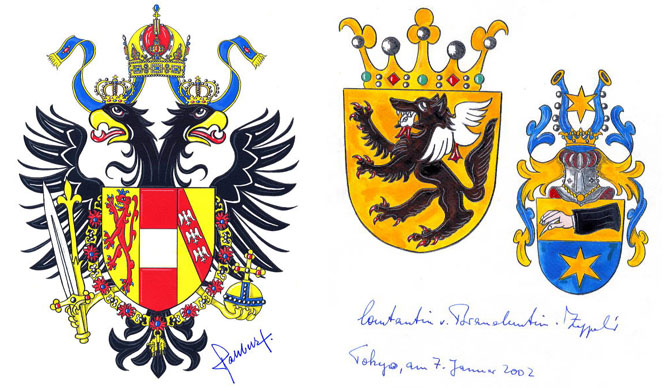
The Work of Western Heraldic Artist Kazune Yamashita (Part 1)
IKKON YAMASHITA THE HERALDIST
The Work of Ikkon Yamashita, Heraldic Artist (Part 1)
Ikkon Yamashita has designed coats of arms for numerous cardinals and bishops of the Roman Curia (Vatican City), as well as for distinguished Western noble families and prominent houses. He also participated in the creation of the coat of arms for the Pope. Through Mr. Yamashita, the only Asian who has studied heraldry, a tradition that has continued unbroken since the Middle Ages, and carries its history into the modern era, we explore the world of Western heraldry, which is still unfamiliar in Japan. (Total 2 parts)
Composition and text by Yasuhiro Takeishi (City Lights)Photography by Mitsuhiro Okuyama (Okuyama Photo Office)With the cooperation of the Shiomi Catholic Church (formerly 'Ant Town', Archdiocese of Tokyo)Reverend Eichi Shimosako (Catholic Bishops' Conference of Japan, Secretariat for Public Relations)
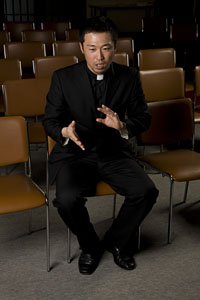
Ikkon Yamashita
The World of Heraldry: Western History Encoded
It is often the case that when an outsider enters a traditional culture that has been passed down through generations in a specific country or region, various barriers arise. To gain recognition within such a culture would be even more challenging. Ikkon Yamashita is one such individual who has overcome these barriers to work as a Western heraldic artist.
Mr. Yamashita, a fellow of the Swiss Heraldry Society, Europe's most prestigious, and the Cambridge University Heraldry and Genealogy Society, has also published heraldic art collections in Italy and received an award from the College of Arms in Spain. He is the only Asian among the heraldic artists who belong to such societies and create official coats of arms registered with heraldic authorities in various European countries.
Even as Japanese people, we have likely encountered Western heraldry on numerous occasions. It is used in the logos of established Western brands, car emblems, labels on wine bottles, and in the form of Royal Warrants (appointed by the British Royal Family). However, it is probable that the meaning and history behind them are not widely known in Japan.
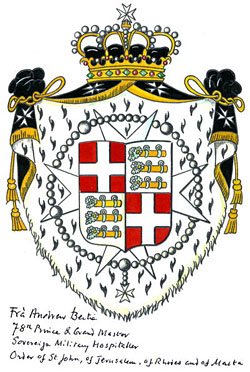
The coat of arms of H.E. Andrew Bertie, 78th Grand Master of the Sovereign Military Order of Malta. The Order, officially known as the Sovereign Military Hospitaller Order of Saint John of Jerusalem, of Rhodes and of Malta, is a monastic order dating back to the First Crusade. The insignia of its members features the famous eight-pointed cross.
The origins of such heraldry trace back to medieval Europe. In an era of conflict, it is believed that the marks drawn on the shields of knights, who fought clad in armor with swords and shields, served to distinguish friend from foe. This served the same purpose as the decorative helmets of Japanese samurai during the Sengoku period. This is why heraldry is expressed in English as "Coat of Arms" or "Herald" (a messenger of the army, or one who displays their shield to show allegiance). Eventually, these marks came to function as family crests for royalty and nobility, becoming formalized around the 12th century as symbols of lineage passed down through generations.
While similar to Japanese family crests (kamon), a significant difference is that heraldry also serves to identify the individual who possesses it, along with their lineage. Therefore, unlike family crests which remain unchanged through generations, coats of arms can change their design depending on the individual who inherits them. Even today, there are heraldic artists in Europe who continue to create new coats of arms.
An Encounter with My Esteemed Mentor, Archbishop Bruno Bernard Heim
“The first time I encountered heraldry was in junior high school in Oita, when I saw a book in the library. I remember thinking how colorful and beautiful it was. Later, when I went to university in Tokyo, I found a book on heraldry in the university library. It was a work by my mentor, Archbishop Bruno Bernard Heim. Deeply impressed by the book, I wrote a letter to the Archbishop in Switzerland, and he replied immediately. I then took advantage of my summer vacation to visit him and learn the teachings of heraldry.”
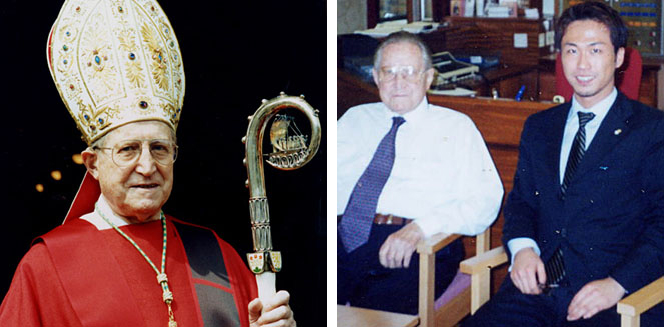
Archbishop Bruno Bernard Heim, who designed the coats of arms for successive Popes, including John Paul II, and for many prominent European families. When Mr. Yamashita once asked why he had taken him as a disciple, his mentor replied, "Only God knows." The photo on the right shows Mr. Yamashita during his apprenticeship with the Archbishop in Switzerland.
Mr. Yamashita recounts his encounter with heraldry as follows. His late mentor, Archbishop Bruno Bernard Heim, was a master of heraldry who designed numerous coats of arms for successive Popes and for European royalty and nobility. Historically, churches managed heraldry along with civil registries, and most heraldic artists were clergy. Mr. Yamashita himself is involved with the Catholic Central Council of Japan, the headquarters of the Catholic Church in Japan, located in Shiomi, Koto-ku, Tokyo.
While serving as Apostolic Nuncio to Great Britain, Archbishop Heim created many coats of arms and contributed to the development of heraldry as President of the Cambridge University Heraldry and Genealogy Society. Although Archbishop Heim had not taken any disciples until he was 89 years old, he invited Mr. Yamashita to his home in Switzerland in 1997, after Mr. Yamashita graduated from university, making him his first and only disciple. Thus, Mr. Yamashita studied Western heraldry under Archbishop Heim for approximately two years.

“I had never studied art or design before, but Archbishop Heim taught me everything about heraldry, from specific drawing techniques and the meanings of traditional motifs to the rules of design. Furthermore, he took me to visit aristocratic houses and prominent families throughout Europe by car, introducing me to them.”
The Work of Ikkon Yamashita, Western Heraldic Artist (Part 2)To be continued
The dignified coat of arms of H.R.H. Prince Don Carlos, Duke of Calabria, a cousin of the current King Juan Carlos I of Spain. Motifs such as crowns can only be used in the coats of arms of families with royal bloodlines, but there are also designs of crowns that can be used more generally.

Coat of arms production by Ikkon Yamashita is accepted by Dual Cruise Inc. For details, please contact us at the information below.
Dual Cruise
Inquiries: 03-6382-7785
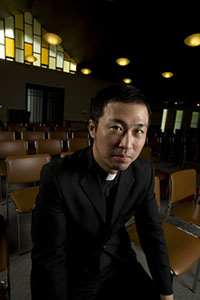

Ikkon Yamashita
Born in Oita Prefecture in 1974. After graduating from Sophia University, he moved to Switzerland to study heraldry. He is fluent in German, which he learned from his mentor, as well as Italian, French, English, and Latin, which is essential for heraldry. He currently designs coats of arms from around the world in Japan. Last year, he held a solo exhibition at the Heartland Gallery in Roppongi Hills.