Factelier by TERUTA | A Cardigan Concentrating the Techniques of a Long-Established Knit Factory
Factelier by TERUTA
A Cardigan Condensing the Expertise of a Long-Established Knit Factory
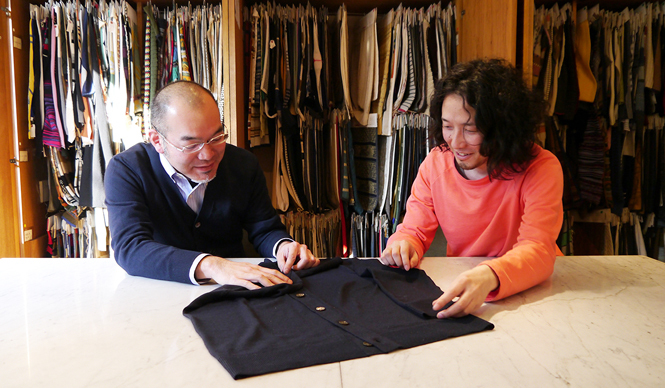
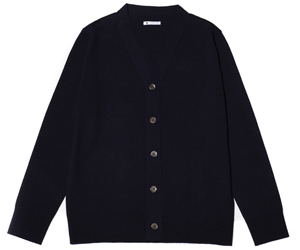
Factelier, a website that partners directly with Japanese apparel factories to offer high-quality original products under the concept of “Reviving Made in Japan,” has launched its latest project following shirts and ties. This time, they've teamed up with Teruta, a long-established knit factory in Sumida Ward, Tokyo. The result is the “Factelier by Teruta” cardigan, jointly developed by designer Yota Kakuta and Teruta.
Text by Morito IWANAGA (OPENERS)

Aiming to Revive a Factory Reduced from 70 to 20 Employees
Teruta Co., Ltd. is a long-established knit factory founded in 1923 (Taisho 12), now in its 80th year. They have produced numerous knit products for global brands, and their signature Milano rib jackets and cashmere jackets became so popular they were known simply as “Teruta jackets.” However, due to factors such as the rise of fast fashion and the shift to low-cost overseas production, the workforce has dwindled from 70 to just 20 employees, placing the company in a precarious situation.
To break through this situation, Factelier has partnered with Teruta, driven by the spirit of “preserving the craftsmanship and techniques of Japanese artisans while benefiting both consumers and the factory.”
Pouring in Traditional Techniques
The finished cardigan showcases Teruta's full technical prowess. Their linking technique, a sewing method unique to whole-garment knitting, is globally acclaimed and creates a sharp V-neckline. The ribbed hem and cuffs are constructed using a full-gauge, needle-out method to maintain optimal tension, resulting in a clean, straight silhouette.

The beautiful V-zone created by meticulous linking
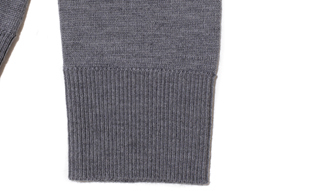
The ribbed section, normally trapezoidal, forms a clean rectangle
Furthermore, the 19.5-micron extra-fine wool used in the fabric is treated with a shrink-resistant finish, making it washable at home. It is, in essence, an ideal item: a luxurious material that can be washed.
According to the Ministry of Economy, Trade and Industry's "Monthly Statistics of Textiles and Living Goods 2010," the domestic production ratio of apparel in Japan decreased from 50.1% in 1990 to 4.5% in 2009. However, there is a growing movement to protect Japanese manufacturing, spurred by the recognition of this dire situation.
It is no exaggeration to say that the technical capabilities of Japanese apparel factories are world-class. The "Factelier by Teruta" cardigan will undoubtedly serve as proof.
We invite you to experience firsthand the skill and passion cultivated over 80 years by this knit factory, by wearing it yourself.
Factelier
http://factelier.com