
Taishi Nobukuni x Kaori Nakano: Meiji University's Passionate Fashion Lecture
Taishi Nobukuni x Kaori Nakano
Meiji University: A Fiery Fashion Lecture
“It’s not about what to wear but who wears it.”
What is fashion? It’s a profound question, bordering on the philosophical. We invited Taishi Nobukuni, who recently opened his atelier “THE CRAFTIVISM” in Ginza and has fully embarked on his journey as a tailor, to Meiji University. Through his valuable anecdotes drawn from extensive experience, we explored the essence of fashion, what it means to be “cool,” the secrets to creativity, and what is needed in the future design field. Here, we present the highlights. This lecture is filled with useful insights for contemplating the various issues surrounding fashion.
Text by NAKANO KaoriPhotographs by JAMANDFIX
I. Education at Central Saint Martins: “Fashion is All About Humanity”
Kaori Nakano (hereinafter Nakano):You completed your Master’s degree at Central Saint Martins in London. Its full name is The London Institute Central Saint Martin’s College of Art and Design, a school famous for producing renowned designers. Graduates include Alexander McQueen, John Galliano, Stella McCartney, Riccardo Tisci, Katharine Hamnett, Neil Barrett… the list is endless. (To Nobukuni) You studied at a school that produces top-tier talent in the fashion world. What made you decide to go there?


Taishi Nobukuni (hereinafter Nobukuni):I actually dropped out of high school voluntarily. While working in streetwear in America, I felt a growing desire to study properly. Seeing the names of Central Saint Martins graduates, I went there with the hope of acquiring diverse knowledge, academic learning, and skills.
Nakano:Specifically, what kind of fashion education do they provide there?
Nobukuni:There aren't specific classes for the Master's program. You're given two or three assignments per year. For example, something like, “Design a 40-piece collection within three months.” In between, renowned alumni like Alexander McQueen, John Galliano, and Malcolm McLaren would come for lectures. What they talked about was how to live life. Essentially, life lectures.
Nakano:So, no classes on design methods or pattern making?
Nobukuni:No. I’ll never forget the first day of the Master’s program. The director, Louise Wilson, who is famous then and now, had a physique like Matsuko Deluxe and always wore Yohji Yamamoto. She entered the classroom, lit a cigarette in the non-smoking building, handed out a single sheet of paper, and began to speak.
Nakano:What was written on it?
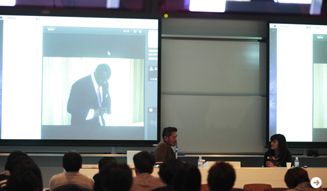
Nobukuni:It was written in about two sentences: What is fashion? First, fashion is a mix of opposites, such as soft and hard. Second, fashion is a statement of who you are, of what you are. Keep these two points in mind as you tackle the assignments here.
Nakano:That’s quite abstract.
Nobukuni:There was a third point. It stated that fashion is entirely subjective. “This school is run by a few directors. Anyone deemed unsuitable in the subjective challenge of fashion will be expelled, regardless of the reason or time, and the student waives their legal right to appeal.” Below that was a blank space, which we were made to sign.
Nakano:Expulsion… that’s strict. Did anyone actually drop out?
Nobukuni:About half of the students quit during the transition from the first to the second year. Some quit voluntarily, and others were made to leave.

Nakano:Who were the ones who were expelled?
Nobukuni:There was a very intellectual Korean student. He was never late and attended every session; he was a model student. He studied Le Corbusier's architecture and drew inspiration for his tie designs from it. Even such a model student was expelled. The reason? He was “uncool.” The feedback was, “Who would wear a tie with a Le Corbusier print?”
Nakano:Harsh…
Nobukuni:I was actually almost failed once. However, even those who were initially failed were given a chance to make a comeback. If you could create a piece and present it by the deadline, in any form, you could be reinstated. Alexander McQueen, who was a year above me, was also nearly failed. According to Louise, Lee (McQueen's nickname) was a hopeless student but made a comeback. She suggested I might too.
Nakano:How did you make a comeback?
Nobukuni:I wasn't good at drawing to begin with. I was better with three-dimensional forms, so I presented my collection not as drawings, but in a somewhat three-dimensionally cut form. That was actually praised, and I was able to make a comeback.
Nakano:So, the designers who survived are on that graduate list. But why the need for expulsion? Did they not want uncool people to represent the school?
Taishi Nobukuni x Kaori Nakano
Meiji University: A Fiery Fashion Lecture
II. What is Creativity? The Power to “Notice” is Empathy
Nobukuni:In the UK, the only postgraduate fashion programs are at the Royal College of Art and Central Saint Martins, so there might be a competitive dynamic between the two. Regardless, the school's reputation is paramount, and the students exist to serve that. That’s how it felt.
Nakano:Did you feel any discrimination or differential treatment based on race?
Nobukuni:No, not at all. However, I was the only one who wasn't gay, so perhaps there was reverse discrimination (laughs). They didn't exclude me from activities because I wasn't gay, and everyone was kind.
Nakano:The fashion industry overseas really is full of gay people. The scarcity of gay people in the Japanese industry feels rather unusual.
Nobukuni:I might have made it sound like a terrible school, but that wasn't the case. Louise was an exceptionally talented person, and I learned what is truly important in fashion. So, what is cool? This relates to today's theme: I learned that it all boils down to the phrase, “Fashion is who you are.” At Central Saint Martins, even if you showed them a design sketch, they never commented on the collar, the stitching, or the fabric.
Nakano:So, it’s about more fundamental expression rather than the details?
Nobukuni:Fashion is the person, the individual. How much the designer loves themselves. How they perceive themselves. By dressing a model who embodies the work, they express themselves, and people who feel sympathy for that buy the clothes. Therefore, fashion is ultimately about humanity.
Nakano:I understand that fashion ultimately comes down to the “person.” But in reality, designers must create something. What is the method or process for that?
Nobukuni:In the UK, where libraries are a cultural staple, people research everything. Research is the method of creation across all genres. At Central Saint Martins, you're asked about your research before you even start designing. How much have you investigated? How much material have you gathered? What have you seen? It could be anything found on the street. What inspired you? You had to present that first, then we would have discussions and design. If you brought nothing, they’d ask, “Are you a genius?”
Nakano:Creativity is often misunderstood as conjuring something out of nothing, but that’s not the case. The real challenge is having a wealth of references and discovering originality within them. In academia, too, the bibliography is questioned first. How much did you refer to in order to write this? I used to think it was different for designers, but it seems the same in the design world. It all comes down to how much of an ability you have to “notice.”
Nobukuni:To “notice” something means to find something in others, but it’s something that already exists within oneself. The power to notice is empathy. It’s the ability to feel for others as you would for yourself, the ability to perceive someone as beautiful; that is the power to notice.
Nakano:Even when looking at the same thing, some people “don’t see” it, while others “see it clearly.” Those with the power to notice can find something in what already exists.
Nobukuni:One of the stylists I admire is Alistair Mackie. His graduation collection was inspired by a girl who lived next door and loved heavy metal. She used to graffiti the names of her favorite bands on her leather jacket, and Alistair drew inspiration from that for his collection.
Nakano:So, references don't have to be books or photos; they can be people or things around us.
Nobukuni:I thought Alistair Mackie was amazing even as a student; I knew he would become someone significant, and he did. He also directed the first Japanese edition of Vogue Hommes. This is one of his works (shows a photo). There’s also a photo of a boy not wearing clothes. Even without clothes, it’s fashion. It’s his empathy for this boy. I believe that’s what it’s all about. (Shows another photo).
Nakano:Hearing about Central Saint Martins like this, it sounds like it’s important to notice what you can empathize with, but that studying fashion rigorously is meaningless?
Nobukuni:What you learn from the outside is ultimately just an add-on. Fashion and Buddhism have similarities; you can't really learn fashion in the way you try to learn something. It’s a matter of whether you can arrive at who you yourself are.
Nakano:You were also a Buddhist, weren't you? That analogy is interesting.
Nobukuni:Through the harsh, almost harassing guidance at Central Saint Martins, I felt like my layers were being stripped away. The reason they had to be stripped away was that, although I thought of myself as a hip, dropout type, what I felt in London was how much I had been shaped by the Japanese education system. How earnest I truly was.
Nakano:What do you mean by being shaped by the education system?
Nobukuni:In terms of art education, in the UK, there’s a foundation course. Through activities like working with clay, origami, and drawing, students slowly and naturally find their direction – whether it’s towards two-dimensional or three-dimensional work, and within three-dimensional work, whether it’s fashion, architecture, or ceramics. People who arrive at fashion through that process are the ones who end up in the fashion industry. I felt that people like me, who came in with a “structured education” and saturated with media information, couldn't compete.
Nakano:So, you wanted to strip away that information?
Nobukuni:I have serious doubts about whether attending a Japanese fashion school and majoring in styling will actually lead to becoming a stylist.
Nakano:It seems that people who come from completely different industries tend to be more successful.
Nobukuni:Speaking of people from different fields, there’s a famous stylist named Koichiro Yamamoto. We hung out when I was a student, and he became a stylist because he knew every shop in Tokyo inside out. When he gives feedback, he says things like, “That’s too stylist-like, it’s no good.” Like, “It looks like a stylist is styling it.” It’s like a Zen koan (laughs). A stylist should make it look as if they aren't working at all. That’s what makes a top stylist.
Nakano:That’s a very high level.
Nobukuni:It’s less about technical skill and more about empathy for the person. It shouldn’t look like the person is being “dressed up.”
Nakano:Stylists can have as much influence as designers, or even more. Are there any other stylists who have influenced you, Nobukuni?
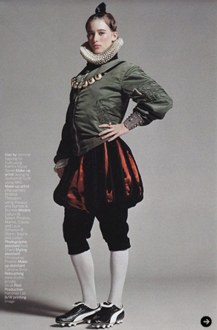
Nobukuni:There’s Ray Petri. He led the stylist collective Buffalo and influenced the British cultural scene in the 80s. It was like people from outside the fashion industry banded together to make an impact. Drawing inspiration from Velázquez’s paintings, he made nameless but beautiful people on the street look beautiful. He had strong empathy for outsiders. Before shoots, he would even spray them with perfume. That’s how strong his affection was. He was set to direct an Armani campaign, but he passed away from AIDS. In his later years, Gaultier created a special seat for him and showed him his collection. He was that respected. Please look at this photo.
Nakano:A 16th-century noble style with doublet and hose, but with sneakers on the feet… Looking closely, the jacket isn't a doublet but a bomber jacket.
Nobukuni:This is a shoot styled by his close friend Barry Kamen as a tribute to Ray Petri. There’s Barry Kamen’s empathy here. There’s gratitude and empathy for the subject. I feel like I can hear Barry whispering to the subject: “You were born with heavy shackles and wander this street with sorrow, but I will dress you in royal attire so that the radiance of your heart shines beyond your sadness. Yes, you are a king, a king of the streets. With your bomber jacket like a medieval noble, your large collar held proudly, you kick off the iron horse with your Pumas and ride away. You are a king. The king of the street. Your large collar is held proudly, so wipe your tears and hold your head high. Proud, like in a Velázquez painting.”
Nakano:That’s poetry… To “immerse” oneself so deeply in the subject, that is “empathy,” isn’t it?
Taishi Nobukuni x Kaori Nakano
Meiji University: A Fiery Fashion Lecture
III. A Designer Writes a Letter to the Masses; a Tailor Writes to One
Nakano:Nobukuni, after your extensive experience as a designer, you are now transitioning to become a tailor. What is the difference between the two?
Nobukuni:The work of a ready-to-wear designer is like writing a letter to an unspecified number of people. In contrast, a tailor’s work is like writing a letter to one specific person.
Nakano:That’s a very clear analogy. Why did you decide to become a tailor?
Nobukuni:There was an Englishman who influenced me, an older gentleman named John Pearse. He ran an avant-garde shop called Granny Takes a Trip, but he also trained as a craftsman on Savile Row. One day, I visited his boutique, and he was incredibly friendly. It was completely different from the image I had of “British suits.” His clients included Charlie Watts of the Rolling Stones. There was no stuffiness at all, and it made me realize, “Ah, there can be suits for rebels too,” and that tailors could create such suits. That experience was formative.
Nakano:Suits for rebels! Indeed, in Japan, the world of bespoke tailoring often carries the image of “bespoke vouchers” for politicians and businessmen. I wonder if there have been many tailors who have explicitly advertised making suits for rebels before.
Nobukuni:Perhaps not. Anyway, when I felt the desire to study again, I met Mr. Yasuo Sasaki. At first, he turned me away, but I left my phone number. About a month later, he called, and we went for a meal. He told me that a tailor’s clients are typically about ten years older or younger than them. Since he was around 70, his older clients were dwindling, and he wanted to do something interesting. When he asked me what I was looking for, I said, “I want to see all the techniques again.”
Nakano:I’ve heard he’s considered the best in Japan for his skill, and his client list is also impressive.
Nobukuni:It’s very Showa-era, but clients included Shigeo Nagashima, Akira Fuse, Hiroshi Itsuki… Even if you search their names online, Yasuo Sasaki’s name doesn’t appear much, but the “top people in their fields” get their suits made by him. He said the most neurotic and stylish person was Chosuke Ikariya. There were also people from untouchable circles. Ken Takakura was also a client.
Nakano:Why do you think Sasaki is favored by such distinguished individuals?
Nobukuni:He asked me, “Do you have many friends?” He said, “A tailor is about human connection.” He was an interesting old man who would say things like, “You’re tall, so that’s good. A short tailor is no good.”
Nakano:The world of bespoke tailoring is precisely about creating while “talking” with the client, so if the tailor has personal charm, they will attract suitable customers, won't they?
Nobukuni:Nowadays, we live in an era where we don’t know where things are made. But at Sasaki’s place, I felt an unspoken warmth from the place where things are made. I wanted to preserve that and pass it on to the next generation.
Nakano:About 30 years ago, there was still an apprenticeship system, a system of service. But that’s not permitted anymore. In a few more years, there will be no craftsmen left in the tailoring world. I hear this is the case not only in Japan but also in Europe. In such a critical situation, your decision to focus on and pass down proper tailoring skills is incredibly significant.
Nobukuni:Unless we consciously work to establish schools or take other initiatives, tailoring skills will not survive. It’s a world of craftsmanship, distinct from the core fashion world.
Nakano:Nobukuni, you have experienced both extremes: the cutting-edge creative world and the diligent world of craftsmanship. Today, we’ve heard about both. What is essential for each world?
Nobukuni:Learning creativity in school is not useful. If you want to work in the creative field, you’re better off quitting school and getting close to the people who are actually working. However, it’s strange that the creative world, more than others, has an apprenticeship system (laughs). It’s close to craftsmanship. For stylists, there are assistants who work while observing their mentor.
Nakano:Rakugo and manga too.
Nobukuni:If you want to make a living through craftsmanship, I think becoming a darn repairer is a good idea. Restoring a sweater with a hole. The demand is constant, and it’s a skill that provides a solid foundation for life. I think it’s good to look for such grounded work. Work that is fundamentally necessary for people.
Question from a student 1You mentioned that the ability to “notice” from a vast amount of references and everyday matters is important. In order to cultivate this “noticing ability” that can lead to creativity, what kind of awareness should we maintain in our daily lives?
Nobukuni:It’s about feeling things genuinely. I once underwent a ceremony with Native Americans in Arizona. What the elder said was this: “Westerners see a buffalo and say it’s a buffalo, but they aren’t truly seeing it. They grasp it conceptually, not with their whole heart.” It’s important to see things as they are, with the eyes of the heart, not through concepts. Fashion is empathy. Let’s train ourselves to see with our heart’s eye, unclouded by preconceived notions.
Question from a student 2What is design to you, Nobukuni?
Nobukuni:Regarding fashion, it’s the consciousness of “self.” The other projected by that consciousness. Expressing one’s identity after imagining that other… In general, not just fashion, but for all design, it starts with the original source. Do you add to it, subtract from it, or multiply it? Without an original source, nothing can be expressed. When I was in London, I shared an apartment with Vivienne Westwood’s son. I had many opportunities to talk with Vivienne. She often said, “I am a copier (someone who copies various things).” Quotation and transformation. That’s what design is, in essence.
Question from a student 3You said creativity arises from what we see and hear, not from zero to one. If creativity is about generating ten from one, what is needed to turn that ten into a hundred, or even a thousand?
Nobukuni:Unexpected encounters, and creating things that people don’t easily imagine through contrast. Combining “scary” and “cute” to create “scary-cute” is an example.
Question from a student 4I’m interested in street culture. What are the differences between Japanese street culture and the British street culture you experienced during your studies abroad?
Nobukuni:In the UK, many people ran shops as a form of “expression” in various ways… Current street culture, wherever it may be, is pretty much over. Especially Americanized street culture lacks substance. It’s sustained by atmosphere, mood, and branding. There’s nothing to feel. I believe only mature, affectionate, and good things will remain from now on. It’s best not to be swayed by street culture.
Nakano:I could listen to you talk for much longer, but our time is running short. Lastly, could you offer some advice to the students who are thinking about their future careers?
Nobukuni:Youth is a time of many possibilities, which is enviable, but the sheer number of choices can also be overwhelming. I want you to pursue whatever interests you with all your heart. Regarding careers, I believe you should choose paths that are more grounded, things that are fundamentally necessary for human beings. Like carpenters, jobs that create essential things for people with solid skills. Something that provides a tangible sense of accomplishment. Please polish your inner eye daily to “notice” such “fundamentally necessary jobs” for humanity.
Nakano:Today, we’ve heard profound insights, from the essence of fashion and the secrets of creativity to how we should approach the world. I am deeply moved. Thank you very much.
Taishi NOBUKUNI
Born in Kumamoto Prefecture in 1970. In 1996, he completed the Master’s program (Menswear) at the prestigious Central Saint Martins College of Art and Design. In 1998, he launched “TAISHI NOBUKUNI.” In 2005, he received the Mainichi Fashion Grand Prix Newcomer Award. In 2007, he started the new line “BOTANIKA.” In 2011, he launched the tailor salon “THE CRAFTIVISM taishi nobukuni,” actively pursuing his work as a tailor.
Kaori NAKANO
Specially Appointed Professor at Meiji University's School of Global Japanese Studies. She teaches courses on “History of Fashion Culture” and “Mythology of Mode.”
As an essayist and fashion historian, she researches, writes, and lectures from a broad perspective, covering fashion history from the past 2000 years to the latest mode trends.
Her books include “Mode to Eros to Shimon” (Shueisha Shinsho), “The Genealogy of Dandyism: Men Who Men Adored” (Shincho Sensho), and “Beloved Mode” (Chuo Koron Shinsha), among many others.