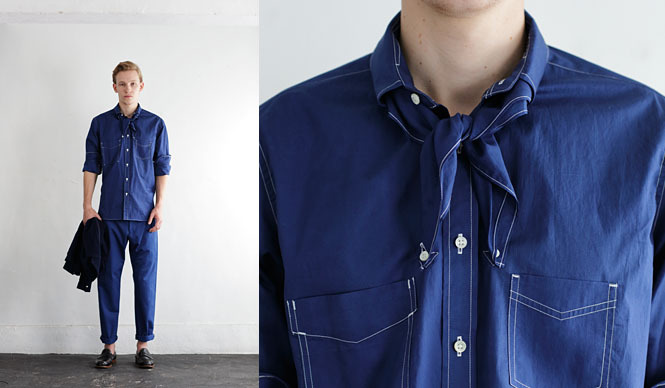
salvy; | Spring/Summer 2014 Collection
salvy;
The Brand's First Spring/Summer Collection
Shirt Styles Woven with Texture, Color, and Detail
salvy; embodies contemporary, three-dimensional wear through masterful pattern-making, designed by Yuichi Go, who honed his skills at numerous maison brands. All items are produced in their own factory, and since Spring/Summer 2014, nearly all fabrics have been custom-made. This season marks the brand's debut in Tokyo stores such as International Gallery BEAMS, URBAN RESEARCH, and CIBONE, and it's garnering significant attention with offers from renowned international boutiques.
Text by Makoto KAJII (OPENERS)
Each Season Begins with Fabric
――What is the theme/concept for the Spring/Summer 2014 collection?
While we haven't set a specific theme for the season, our collections are developed under the brand concept of 'pursuing what can only be expressed by Japanese people, rooted in traditional techniques and culture. We aim to explore and create not only the pursuit of detail but also the prevailing mood of the times.'
――What were the key points and aspects you wanted to highlight in this season's lookbook shoot?
We start by developing fabrics each season. This season, we created a high-density twill and a 200/2 twill, woven to their absolute limits. To express the unique luster and allure of these fabrics, we focused on shooting in natural light.
――What are the differences in styling, silhouette, and color compared to last year's Spring/Summer collection?
This is our first Spring/Summer collection presentation. In terms of styling, we are proposing new shirt styles. Regarding silhouettes, we express a wide silhouette, created through salvy;'s unique pattern construction, in both trousers and shirts.
――What are the key looks (outfits) for this season?
We have a double-breasted jacket set-up that can be worn reversibly, and a look layering a pajama shirt over a button-down shirt.
The double-breasted jacket offers different designs on each side. It's made from typewriter cloth*, so despite being reversible, it's as light as a shirt, combining duality with functionality.
For the pajama shirt look, we propose a light and fresh layered style, different from the jacket coordination, by wearing a pajama shirt made of cut-and-sew material over a standard button-down shirt.
*Typewriter cloth: A lightweight, plain-woven cotton fabric made from fine, long-staple cotton yarn. Its name originates from its use as ribbon for typewriters.
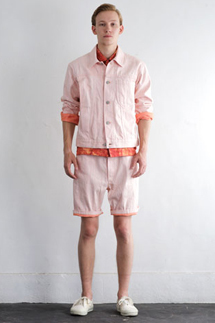
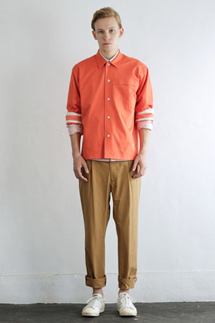
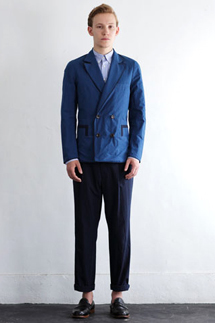
Key Colors: "Navy" and "Orange"
――What are the key items and key colors?
Our key items are shirts and trousers, offered in various iterations. For shirts, we focus on fabric and finishing, while for trousers, we emphasize pattern work and silhouette.
We also hope you'll pay attention to our button-down shirts, which are developed each season with subtle variations in pattern depending on the material. Though they appear simple, they are crafted with meticulous techniques and pattern work, making them emblematic of the brand.
Our brand's core principle is always 'how to express modernity using traditional Japanese colors.' This season, we focused on navy and orange. Using these two colors as key hues, we've expressed them by interweaving traditional dyeing methods and innovative techniques across various fabrics.
――What "materials" did you focus on this season?
We focused on a high-density twill and a 200/2 twill, woven to their limits. The high-density twill is woven on old shuttle looms to the maximum possible density. However, to prevent it from becoming too stiff, we finish it with a light brushing to soften the texture. This fabric remains durable even after about a year of wear, and its qualities improve over two to three years, making it a material designed to evolve with the wearer.
The 200/2 twill uses 200-count ultra-fine yarn, spun into a double thread, similar to what's used in high-end dress shirts. This results in a fabric that is both supple and lustrous, offering exceptional comfort. The blue and navy colors are treated with a special dyeing process called "Hydrangea Processing," using sulfur dyes that mimic indigo. While the color resembles indigo, it fades more slowly and develops its character over time, offering a different kind of aging process compared to true indigo.
――What are you currently noticing in the fashion scene?
High-tech materials, couture techniques, and the national team uniforms for the Sochi Olympics.
――Please share your personal goals for 2014, both professionally and privately.
The patterns are already done, so my goal is to complete the coat for this winter.
Key Retailers
BEAMS, URBAN RESEARCH, TODAYS SPECIAL, HYPEBEAST STORE, etc.
For details, please visit the website below
http://salvy.jp/stockist/index.html
salvy;
http://salvy.jp
info@salvy.jp