
Levi's® Vintage Clothing | The Eternal Classic
Levi's®Vintage Clothing | Levi's®Vintage Clothing
Mastering the Legendary Lot Numbers!
The Eternal Standard "501®" Fitting Guide (1)
Shining brilliantly in the history of denim, the Levi's 501® continues to command an overwhelming presence.®Here, we look back at the details that have transformed over time and explore its appeal. All featured models can be purchased directly from rumors.rumors
Text by Takashi Tsuchida

Levi's®Vintage Clothing Faithfully Recreates Each Era's "501®"
The history of jeans begins with Levi's. Among them, the "501®", whose first model was born in 1890 and has remained at the center of style to this day, can be said to be a true representative of its era.®
Levi Strauss ran a wholesale dry goods business in San Francisco, California, during the Gold Rush. Jacob W. Davis, a tailor in Reno, Nevada, serving low-income laborers. The meeting of these two men brought a new item to the world: jeans. In 1890, they first assigned lot numbers to the jeans they produced. Of course, that number was the 501®.®Conceived as durable, rugged workwear, the 501® underwent repeated specification changes driven by the pursuit of functionality, eventually evolving into a fashion item that asserts individuality.®As footwear shifted from boots to shoes, the silhouette also changed significantly, from flared to tapered, and from relaxed fit to slim fit.
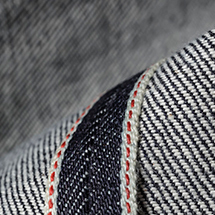
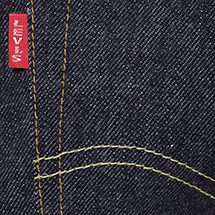
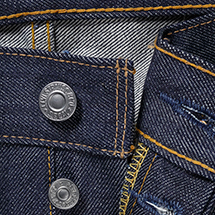
Levi's® Vintage Clothing (Levi's® Vintage Clothing) recreates the charm of the 501® of each era using modern technology.®®®Based on archives from the past 140 years stored in Levi's San Francisco warehouse, each detail is interpreted with precision. The collection, which conveys the philosophy of the 501®, reigns as Levi's premium line today.®Here, we would like to introduce five highlight models.
1937 501®Jeans
First Appearance of Levi's Denim Icon "Red Tab"
The Red Tab, attached to the right back pocket, is marked with "LEVI'S®" in capital letters.®This logo style continued until it was changed to the current head cap in 1971 and is affectionately known as the "Big E." By this time, wearing jeans with a belt through the belt loops had become common, so the suspender buttons were eliminated, leaving only the cinch back to adjust the waist. Additionally, to avoid scratching riding saddles or chairs when seated, they first adopted the idea of hiding the rivets on the back pockets within the fabric. The silhouette is a relaxed fit with ample room throughout. The lower leg is straight.
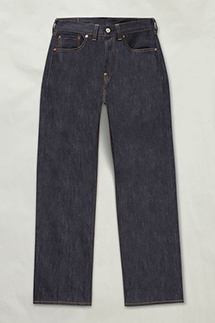

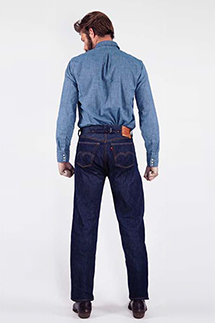
"1937 501®Jeans"Click here for product details
1947 501®Jeans
A Monumental Design Comprehensively Incorporating Modern Details
The rivets, omitted during wartime due to U.S. government material restrictions, were reinstated, and the arcuates on the back pockets returned to stitching from paint. The arcuates, originally conceived as reinforcement stitching for the pockets, were retained even after reinforcement became unnecessary to distinguish them from imitations. Furthermore, the introduction of two-needle stitching machines during this era led to the diamond shape formed by crossed stitching on the center of the pockets starting with the 1947 model. The silhouette, which had become slimmer, was later described as classic slim fit, and its refined appeal remains undiminished today.
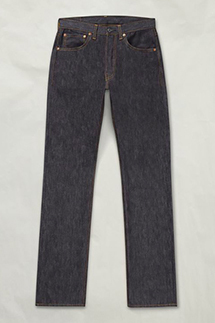
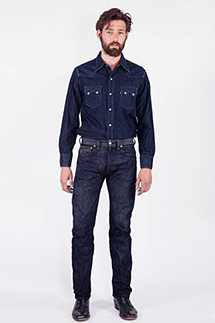
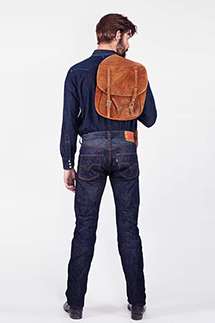
"1947 501®Jeans"Click here for product details

Levi's®Vintage Clothing | Levi's®Vintage Clothing
Mastering the Legendary Lot Numbers!
The Eternal Standard "501®" Fitting Guide (2)
We continue to bring you the evolving charm of the 501® through the ages.®The movie above is an animation produced by Levi's that concisely summarizes how to achieve your preferred fit. We hope you will also refer to it.
1954 501®Jeans
Later to become 502®" Zip Fly Model
To expand the sales of jeans, which had gained citizenship in the American West, to the East Coast, a new detail was introduced: the zip fly. Thus, the 501Z® was born, featuring a zipper closure at the front.®This model was given the new lot number 502® in 1967, and as processing technology advanced, it evolved into pre-shrunk (shrink-resistant processing).®The reason for this was quite practical: to avoid the phenomenon where the shrinkage of the fabric, characteristic of "shrink-to-fit," would cause the zipper to warp. The silhouette featured a tapered leg from the knee down, giving it an even slimmer impression compared to the 1947 model.
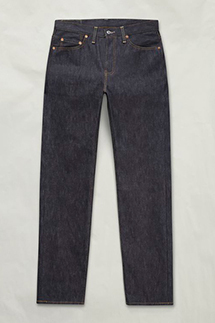


"1954 501®Jeans"Click here for product details
1955 501®Jeans
The Anti-Fit, Where Needs Shifted Towards Style
As wearing styles shifted from workwear to daily use, the jeans, which had been functionally slimmed down, showed a completely new direction with this model: the anti-fit silhouette. Its distinctive form, with ample room around the hips, was intentionally baggy, similar to modern loose fashion. This undoubtedly reflects the era when jeans began to represent identity. The lower leg returned to a straight cut, strongly reflecting the trends of the 1950s. Furthermore, it was from this model that the logo began to be printed on both sides of the Red Tab. The silhouette returned to a straight cut, with a tapered leg below the knee.
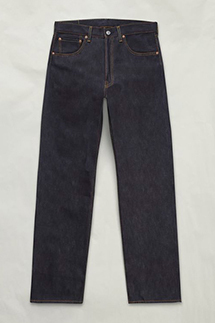
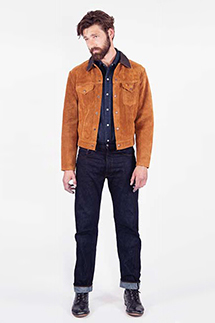
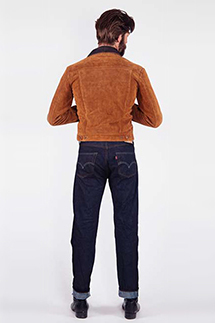
"1955 501®Jeans"Click here for product details
1966 501®Jeans
With Advancements in Sewing Technology, Back Pocket Rivets Are Finally Abolished
Hidden rivets had been used on the back pockets since the 1937 model, but over several years of wear, the rivets would eventually pierce the denim fabric, causing the problem of scratching riding saddles and furniture again. To address this, a new method was devised: abolishing the rivets and reinforcing with bar tacks. With advancements in sewing technology, rivets completely disappeared from the back pockets with this model. Furthermore, since the current logo began to be used on the Red Tab in 1971, this model is also treasured as the last "Big E." The silhouette returned to a straight cut, with a tapered leg below the knee.
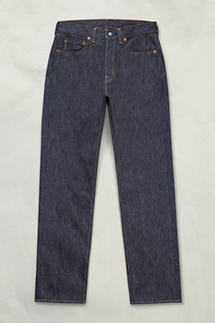

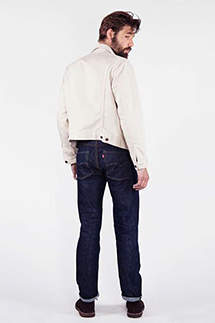
"1966 501®Jeans"Click here for product details
Levi's® XX
Tel. 03-6418-5501