
LOOPWHEELER | "Border Pattern" Cut-and-Sewn Made with "Tsuri-ami"
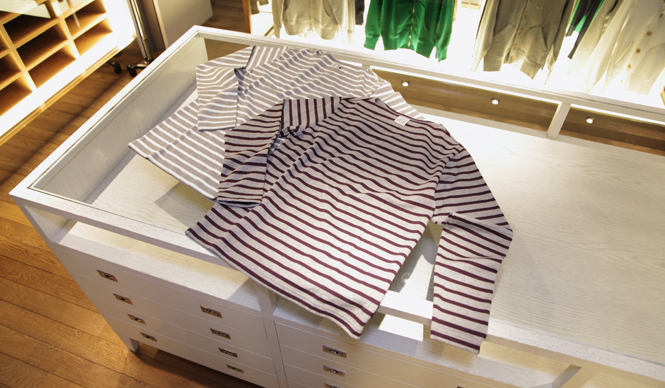
Rumors Exclusive: Classic Border Cotton Boat Neck
The Secret to "Border Patterns on a Loopwheel" (1)
Garments produced on these time-honored machines possess a unique, supreme texture that modern machinery cannot replicate.—Loopwheeler has succeeded in creating border-patterned cut-and-sew garments using a loopwheel machine. The secret to its brilliance lies in the fact that a "legendary technique has been passed down to the next generation." We delve into the appeal of this epoch-making product, along with its development story.
Photographs by MIKAMI MakotoText by IWANAGA Morito (OPENERS)

Can't Loopwheel Machines Make Border Patterns?
The "LW Classic Border Loopwheel Cotton Jersey" was achieved by combining a loopwheel machine with a special yarn-switching device. This item, with its exceptionally soft feel, makes you want to fully experience its comfort. To commemorate the release of this limited-edition colorway—gray mélange x purple—ordered exclusively for Rumors, Hiroyuki Matsumoto, director of Rumors, interviewed Satoshi Suzuki, president of Loopwheeler, about the secrets behind this cut-and-sew garment.

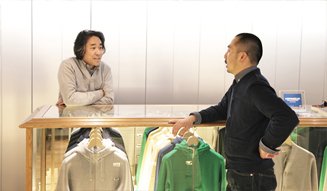
Satoshi Suzuki, President of Loopwheeler

Hiroyuki Matsumoto, Director of Rumors
MatsumotoFundamentally, knitting borders on a loopwheel machine is impossible, isn't it?
SuzukiKnitting machines can be broadly categorized into single jersey and double jersey. They have one or multiple yarn feeding ports, where the yarn enters. Loopwheel machines are single jersey with only one port, so they cannot switch yarns. Normally, to knit borders, you use a knitting machine with two yarn feeding ports. The machine automatically and instantaneously switches to a different color for the next course, quite skillfully. However, Loopwheeler does not produce items made on machines other than loopwheel machines.
MatsumotoSo, to do that on a loopwheel machine with only one yarn feeding port...
SuzukiTheoretically, you would have to stop the machine, tie the yarn, and repeat that process for every color change.
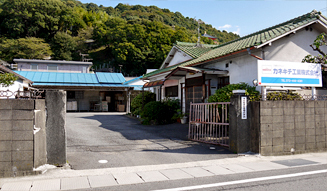
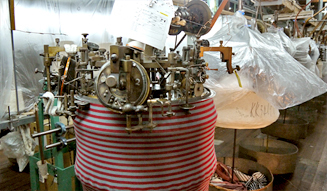
A young person at Kanekichi Kogyo was cleaning out everything in the factory warehouse when they discovered a mysterious machine, not a knitting machine, tucked away in the back. However, everyone, including the president, seemed to have lost their memory of it. They had apparently forgotten its very existence. After some investigation, it was determined that the machine was likely made in the 1970s. This was the encounter with the switching device that might enable border patterns to be knitted on a loopwheel machine.
Rumors Exclusive: Classic Border Cotton Boat Neck
The Secret to "Border Patterns on a Loopwheel" (2)
A Revived Legendary Technique
MatsumotoWithout that encounter with the switching device, this product wouldn't exist.
SuzukiThat's right. The mechanism is like a bicycle's rear derailleur, with a chain and cogs that mechanically change the courses. Those chains and cogs are no longer available, and there are no manuals or anything. While tinkering with it, we thought, perhaps by combining it with a loopwheel machine, we could knit border patterns, and we experimented extensively. Since they kept me updated on the progress, my first task was to ask them to proceed.
And thus, the "LW Classic Border Loopwheel Cotton Jersey" was born. When I showed the product to Mr. Matsumoto, he said he definitely wanted to carry it at Rumors, so we discussed changing the color.
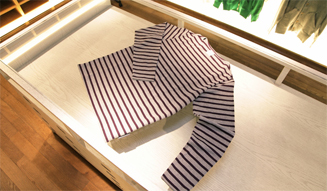
MatsumotoWe requested a gray mélange base with purple stripes. The border color is a reddish-purple, close to a slightly reddish grape color. Overall, it's a subdued color that isn't too flashy, resulting in an elegant impression.
SuzukiMany jersey knit cut-and-sew garments like this tend to be thick and dry, like Saint James. Soft-textured items are rare for what are known as "bask shirts." Generally, thicker yarns make fabric stiffer, but using a loopwheel machine resulted in a soft finish.
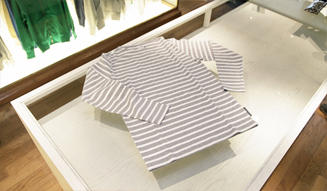
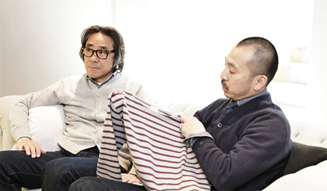
MatsumotoEven with just the fabric, a great deal of effort went into determining its feasibility.
SuzukiLoopwheel machines are very low-tech, so there are inconveniences. Even for knitting border patterns, without creating a separate switching device, mass production would have been impossible. To improve this, newer, faster knitting machines with multiple yarn feeding ports were developed. That's only natural. However, even setting that aside, old-style loopwheel machines have many advantages. They produce fundamentally high-quality items, with excellent comfort, texture, and durability. They were abandoned due to human convenience factors like being troublesome to set up or difficult to manage.
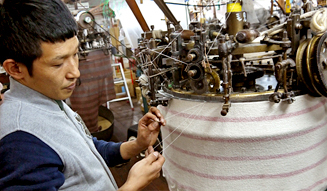
In essence, seeking cost reduction or mass production from loopwheel machines makes them completely unusable. Ignoring efficiency means it requires a lot of labor and time, making it not worthwhile for the workers.
However, looking back, work that involves such effort and time often yields excellent results, doesn't it? Approaching it with that mindset, loopwheel machines are worth the effort and time invested.—In other words, they are machines that accept the will of the maker.
Loopwheeler
http://www.loopwheeler.co.jp/
SUZUKI Satoshi
Born in Shizuoka Prefecture in 1959. After graduating from Hosei University, he entered the textile industry. Pursuing garment making through self-study, he launched the sweatshirt brand "LOOPWHEELER," which exclusively handles loopwheel-knitted items, in 1999. Having been involved in the planning and production of cut-and-sew garments for many years, he aims to pass down not only the high quality of Made in Japan but also its philosophical aspects to the next generation, backed by his extensive network, trust, solid technical skills, and production facilities. He is a sweatshirt specialist who continues to research vintage sweatshirts, as well as technical aspects including old loopwheel machines and knitting methods.
MATSUMOTO Hiroyuki
Born in 1969. After gaining experience in editing and sales for a car magazine during his student years, he joined World Photo Press Co., Ltd., and was assigned to the advertising sales department. He was involved in numerous magazines, including "World Watch" and "Mono Magazine." After leaving the company in 2005, he worked as a production producer for "SHIBUYA-FM" and consulted on product development for apparel brands. In 2006, he co-founded Shichiyo Co., Ltd., launching "Openers" and "Rumors." He possesses a wide network not only in the fashion industry but also in various other fields. He is currently the Managing Director of the company and also serves as the MD for Rumors.
