
Part 3: Appearing at the "ECO x FASHION" Talk Show
3rd "ECO×FASHION" Talk Show Appearance
The Message on Our T-Shirts: Her Thoughts and Mine
As a special event for Japan Fashion Week in TOKYO 2008, I had the honor of participating in a talk show titled "ECO×FASHION" held at Tokyo Midtown.
The panelists included moderator Sei-kō Itō, myself, and model Ai Tominaga, with Catherine Hamnett as our special guest. Catherine is a pioneer in discussing ecology within fashion. Meeting her was a deeply moving experience for me.
Text by Taishi NobukuniPhoto by Jamandfix
Weighing Designer Creativity Against Timeless Standards
At the venue, staff members were wearing what could be considered Catherine's signature message T-shirts.
The moment I saw them, a flood of memories and images came to mind.
It was 1985, and I was in my third year of junior high school. Even looking back, I was a peculiar kid. The DC brand boom was in full swing, and my after-school routine involved studying fashion magazines that were like catalogs and meticulously examining every brand in department stores.
Being that kind of kid, I'd compare Levi's 501s with denim from other brands, agonizing over how to spend my limited allowance. One day, I went to a store, tried on a pair, and asked the salesperson about the silhouette difference compared to the 501s. For some reason, I touched a nerve, and they kicked me out of the store, telling me, "This isn't a place for junior high students like you." The next day, when I told my friends, one of them was so angry he seriously suggested we go back with firecrackers, and it took a lot to calm him down.
Why did I even ask that question? As a child with little money, I was seriously contemplating the value of clothing. The creativity of designers versus the universal value of standard items. At the time, designer names carried more prestige, but I felt the 501s, which were also cheaper, held more value. I think I was looking for words from the DC shop salesperson to overturn that perception and make a decision. Of course, brands like JUNYA WATANABE didn't exist back then (laughs).
The Message I Chose: "CHOOSE LIFE"
After that experience, I drifted away from the DC shops in department stores and discovered a small boutique that quickly stocked imported designer clothing. Brands like Paul Smith, Courrèges, Culture Shock, and Margaret Howell—which are now widely available (though some no longer exist)—were then niche, insider brands.
Looking at those clothes alongside other standard imported items, I felt a different atmosphere from the designer pieces compared to Japanese clothing. They were creative, yet carried a sense of history. Among them was Catherine's clothing; her khaki cotton tailored jacket was strikingly beautiful, and the Helvetica font on the tag looked modern and cool.

From then on, I visited that shop every day (unlike the DC stores, the staff were kind). They let me look at magazines like 'ID' and 'FACE,' which were still new at the time, and I even borrowed videos of Catherine's shows. I was surprised by the shows where the music would cut out and repeat the same phrase. I only learned the next year, around the time RUNDMC became popular, that it was a DJ mixing two records.
Even though I couldn't afford a suit, I found T-shirts with large lettering that I could buy. I'd get excited, thinking, "I can afford this!" But then I'd agonize again over which of the several messages to choose. An indecisive, penniless kid who lingered in the store, asking bizarre questions—if I were the shopkeeper, I would have kicked me out immediately. But because there were people who kindly taught me many things, I am who I am today.
After much deliberation, I chose the message "CHOOSE LIFE." At my academically rigorous school, I was contemplating what kind of adult I would become. I interpreted the message as "making choices in life" and resolved to wear that T-shirt and make the right choices, so as not to become a foolish adult.
23 Years Later, I Learned the "Choice of the Value of Life"
Twenty-three years later. Seeing the T-shirts worn by the staff at the venue, all these memories flashed through my mind like a reel. Then, while reading the materials about Catherine that were provided beforehand, I discovered that the original meaning was "the choice of the value of life," and I laughed at my misunderstanding. Before my turn, as we lined up backstage like models before a show, I nudged Catherine in front of me and abruptly told her the story. She said my interpretation also held meaning. When I replied, "But I made the wrong choice to pursue the difficult profession of a designer," she laughed and said, "But design is a wonderful job."
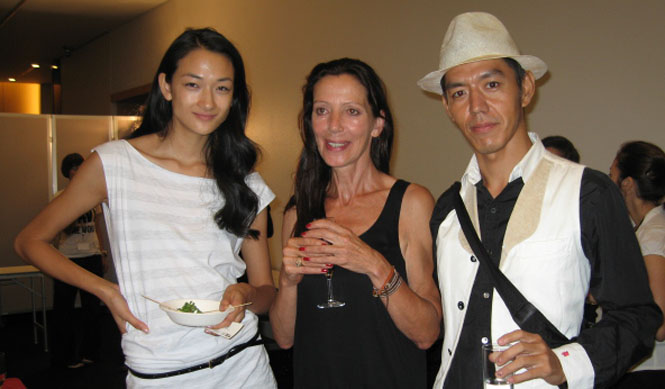
With Ai Tominaga and Catherine Hamnett
Choosing a Beautiful Yet Challenging Path
It is quite ironic that I, driven by such a misunderstanding, chose the path of a designer, and now my work centers on the original meaning of that phrase: the respect for life.
I also learned for the first time that Catherine's initial inspiration for addressing ecological issues came from Buddhism. Years ago, I had the opportunity to meet Prime Minister Junichiro Koizumi at his official residence, and I wore a T-shirt that read "Please do not revise Article 9 of the Constitution." This action was greatly influenced by Catherine wearing a T-shirt to protest nuclear disarmament when she met Prime Minister Thatcher. I tried to hand him another one, but the security detail stopped me. However, Mr. Koizumi read the message on my chest during our meeting, though I naturally have no idea what he was thinking at the time.
Given that we share the same alma mater (though I dropped out of Japanese high school, which was my "CHOOSE LIFE" moment, so getting into graduate school was a miracle), it seems I cannot escape Catherine's influence.

However, even when working with social concepts, I must admit there are times I feel isolated. Fashion journalists, after all, seem only interested in things like collar shapes or the sheen of fabrics.
It's evident that she too has gone through various complex emotions. I sense she has faced difficult struggles, at times questioning herself through stoicism. She found Buddhism and learned to "live rightly," which she aspired to. It is a beautiful yet arduous path, as one must discern what is right for oneself.
Watching her speak on stage, I felt the weight of her complex history, and at the same time, I was happy to have found a reliable senior. Our hug at parting was powerful, a telepathic exchange of unspoken understanding. Leaving the venue, devoid of natural light, the blue sky outside seemed exceptionally beautiful, much like the sky on the day I left my high school after dropping out. It made me feel that my "CHOOSE LIFE" wasn't entirely misguided.