
A Message from Taishi Nobukuni: "On the Launch of This Series"
A Message on the Launch of Our Series
A Message from Taishi Nobukuni
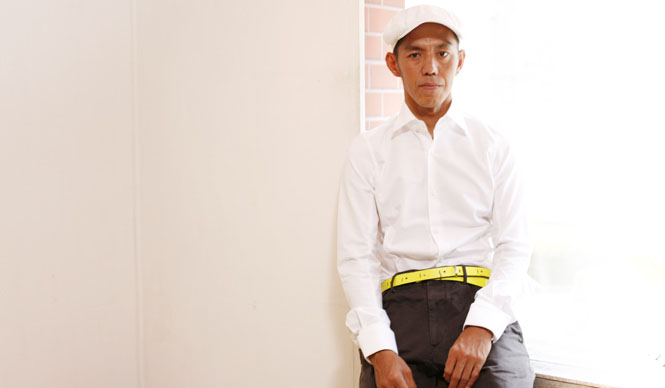
We met with designer Taishi Nobukuni at his Tokyo office, just as he was finishing his exhibition for the Spring/Summer 2009 collection in Paris.
The theme for his OPENERS series is, quite simply, "SPIRITUAL FASHION." The subtitle, "fashion is not just for wrapping the body but the spirit – tales of slightly unusual fashion from a slightly unusual designer –" is particularly intriguing.
Our conversation began with the topic of ecology, which has likely increased with the launch of his new brand, "BOTANIKA/taishi nobukuni."
Photo by JamandfixSummary by Makoto Kajii (This magazine)
True Spirituality Transcends Good and Evil
—Since launching "BOTANIKA/taishi nobukuni" this spring, we've seen you frequently in interviews about ecology.
I do feel there's been more interest in ecological themes. On the other hand, I often feel a sense of dissonance because the era is shouting about ecology a bit too loudly.
—A dissonance?
The reason I started "BOTANIKA/taishi nobukuni" wasn't primarily ecology, but rather issues of comfort, consciousness in dressing, and a more intuitive approach. While I'm happy to be covered from an ecological perspective, I feel it's different from the general public's understanding of ecology.
For example, I question whether CO2 is truly the cause of global warming. When I investigate, there are theories suggesting increased solar activity, and that the interaction between solar energy and the Earth's internal energy causes major earthquakes. This resonates with human vibrations, leading to actions beyond comprehension like indiscriminate murder, or conversely, a sense of resignation. Emotional polarization occurs.
—I see.
As a result, more people become interested in spiritual matters, but then I feel that dissonance again. It's the tendency to fall into a dualistic view, where the visible world is considered false and the invisible world is true, overvaluing the unseen.
I believe true spirituality is about transcending notions of good and evil.
In some cases, chemical fibers may have less environmental impact than conventional cotton.
—How has "BOTANIKA/taishi nobukuni" been received?
Again, much of the reception has been based on a superficial understanding of ecology, and I often feel a sense of dissonance so far. I hope it can be accepted more naturally, as a matter of course.
I've experienced this myself elsewhere: brands touting "20% or 30% organic cotton" but when you touch the fabric, you can't feel it. If customers can't discern the difference, even if it becomes a trend, everything will revert. What's important is the ability to feel the difference, not just the hype or sales pitch. As creators, we betray ourselves if we can't express that.
That's why when I consider fashion, I'm careful not to think, "Since I'm using organic cotton, I can relax, and the design doesn't really matter."
—For instance, how do you view the potential of materials?
I think it might be better not to use cotton at all. If using conventional cotton, chemical fibers might actually have less environmental impact in some cases. I also see potential in materials like linen.
When I visited a folk museum in Yamagata and saw old kimonos, cotton was a luxury item. The widespread use of cotton today is inherently unbalanced. It's obvious that if everyone started using organic cotton, the supply would be insufficient.
Thinking about it this way, perhaps silk is actually the most ecological. It allows for integrated production from mulberry cultivation. Hemp is another option.
—What about dyes?
With dyes, the more you try to bring out the organic feel, the more you have to be meticulous. Sometimes, dyeing can subtly diminish the tactile sensation you get from touching the raw organic cotton before it's dyed.
There's a dyer named Mr. Yamagishi who cultivates the plants for his dyes himself. He works in an ideal environment with a river flowing beside his home. He says, "Natural dyes are fluorescent" – that natural colors glow in the dark. Hearing that changed my preconceived notions.
Mr. Yamagishi never wears gloves when dyeing. When I asked why, he said he feels the colors with his hands. For example, red clothing warms the body.
—What are the characteristics of this autumn/winter collection?
I haven't set a specific theme, but inspirationally, I've been drawn to the work of the architect Thom Mayne of Morphosis, and I'm focusing on the cutting techniques.
Underlying this is the idea that while using organic materials, I want the designs to be modern.
—You are one of the supporters of More Trees, and we look forward to your collaboration on product planning and more.
The pleasure is all mine. I look forward to it as well.