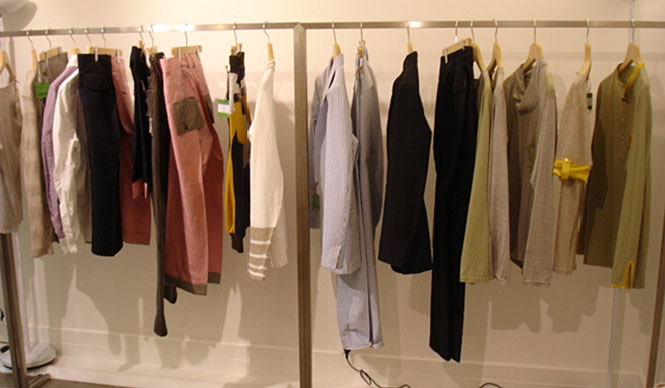
Part 2: From a Paris Showroom
BOTANIKA 09 SPRING & SUMMER COLLECTION
From the Paris Showroom: Part 2
Our First Visitors at the Exhibition
At MC2, a showroom in Paris that resonated with BOTANIKA's ethos and expressed a desire to sell our clothes, we held an exhibition during the men's collection season.
But honestly, I'm not fond of this city. I have no particular reason, but I've felt this way since I worked like a slave at Galliano's atelier in Bastille.
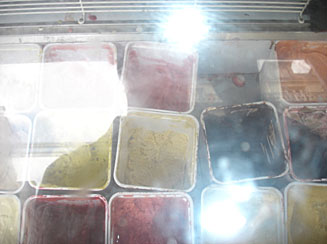
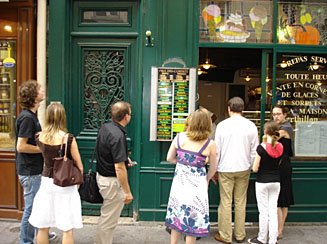
My only small pleasure in this city is going to Île de la Cité for ice cream. Like in Japan, there's a line, but the fruit flavors are so intense and delicious. Île de la Cité retains its atmosphere with many old shops, which I love.
And so, our first visitors at the exhibition were none other than Mr. Takeo Kikuchi, whom I affectionately call 'Take-sensei'.
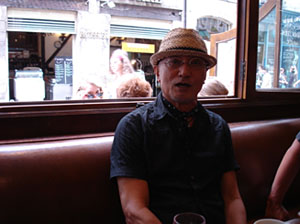
Sensei always rushes to be the first to support me when anything comes up. Although I'm no longer involved with the brand, we actually have more opportunities to chat freely these days. After visiting the showroom, we bumped into each other in the Marais district. Later, when we went to a restaurant I was curious about, he was there, and we ended up having a long lunch together. It's strange how often our instincts and tastes seem to align, though I hesitate to say it.
When I dine with Sensei, my vegetarianism often comes up. Each time, I explain that it's a natural inclination rather than a strict ideology, so he needn't worry. Being vegetarian can be inconvenient for those around me.
What is Ecological?
My shift to vegetarianism wasn't for religious reasons; I simply started to feel a certain way, as if I didn't need to eat meat, and it became natural. I also stopped drinking alcohol for similar reasons, though I used to drink about 750ml of shochu a day and was a self-proclaimed 'meat-tarian.' The most surprising person to witness this change is myself.
Looking back, I can cite reasons like the fact that if meat consumption ceased, the world could feed an additional 100 million people with the grain that would otherwise be used for feed. I'm also angered by the 'food majors'—giant American agricultural companies—who manipulate biofuel policies behind the scenes. It's also something I recently learned: they strategically promoted meat consumption in Japan and are pursuing similar strategies in China to increase grain consumption, both of which contribute to global food shortages.
While American farmers, who hoard grain waiting for price increases and drive sports cars, laugh all the way to the bank, there are people in Africa eating salt mixed with dirt. Such inequality is a modern problem. To me, being ecological means being aware of the interconnectedness of all living things, like how a storm benefits a bucket maker. Carrying an eco-bag, however, is not ecology.
The Story of Atisha, an Indian Monk
I mentioned Buddhism last time, but surprisingly, monks in places like Tibet commonly eat meat. My teacher jokes that he's a failure as a Buddhist. In Buddhism, intention is everything, so eating meat from a market isn't considered killing. Well, I don't eat it, though.
Most of my yoga friends and yogis worldwide are vegetarian, often for the purification of their bodies and energy. Many practice occasional light fasting for detoxification.
However, the idea of purifying myself doesn't resonate with me. Humans are a collection of thousands of bacteria and microbes; there's no inherent purity or impurity. Yoga class advertisements often claim things like 'find your true self' or that polishing your current self will reveal your true self. These are words that fuel a snobbery of 'pure me.' The explosive popularity of yoga in America, for instance, stems from igniting such self-importance, perhaps as a counterpoint to the reality that one in four Americans is obese. Phrases like 'the true me within me' sound like fragmented ramblings, devoid of meaning.
So, if there were truly a pure person, an anecdote about an Indian monk named Atisha, who lived about 1000 years ago, comes to mind.
Atisha once made a firm resolution and secluded himself in a cave for 12 years to dedicate himself to his practice. After 12 years of unwavering devotion, what do you think happened?
He found no change, no results. Despondent, he felt he lacked the aptitude and decided, 'I'll give up everything,' and descended the mountain.
On his way down, he encountered an old dog. The dog suffered from a skin disease, its flesh festering, emitting a foul odor, its wounds oozing pus and maggots—a truly pitiful sight. At that moment, a feeling of 'how pitiable' began to well up within Atisha.
Tears welled up as he wished to alleviate the old dog's suffering. He reached out to tend to the maggots, but the dog cried out in pain as its wound was touched. Feeling even more compassion, Atisha, with tears streaming down his face, brought his face close to the foul-smelling, rotting wound. He then used his mouth to suck out the maggots and gently cleaned the wound with his tongue.
It was then. Suddenly, the old dog transformed, and standing in its place was Maitreya Bodhisattva. At that moment, Atisha, having attained a form of enlightenment, was told by Maitreya Bodhisattva, 'You lacked compassion.'
I believe that someone like Atisha, who cultivated such a heart, is what one could truly call pure.
Italians, Parisians, and North Europeans
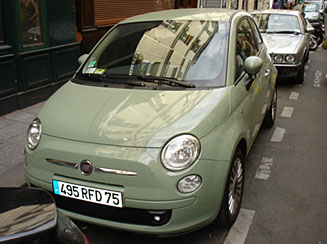
Changing the subject, I saw many Fiat Cinquecentos on the streets, more than I expected. Many of you might know them from "Lupin the Third"; this almond green color is quite charming.
However, I was surprised by the number of new French cars, given the current times. I'm often asked about the difference in reactions to my organic clothing between Europe and Japan. It's not that they have a deeper understanding of the environment or anything like that.
Italians, as expected, love leather goods (though it has nothing to do with the environment; for me, the Earth and animals are living beings. The interconnectedness of them is the true meaning of ecological). Parisians, amidst their exhaust-filled city, love steak. My daily Ashtanga Vinyasa yoga practice has studios worldwide, but Paris is one of the few major cities where the Mysore style, a self-practice style, is only available in the evening. (This is a bit of a tangent, but...)
Beautiful Parisian women, lost in their indulgent culinary culture, are stiff (though yoga isn't solely about flexibility) and strain themselves with every 'un, deux, trois.'
While we tend to lump 'Westerners' together like comedians, Northern Europe stands out as different. Finland and Denmark lead in energy policy and have the highest number of yoga practitioners. Northern Europe seems to hold many clues for the direction we should be heading in all aspects.