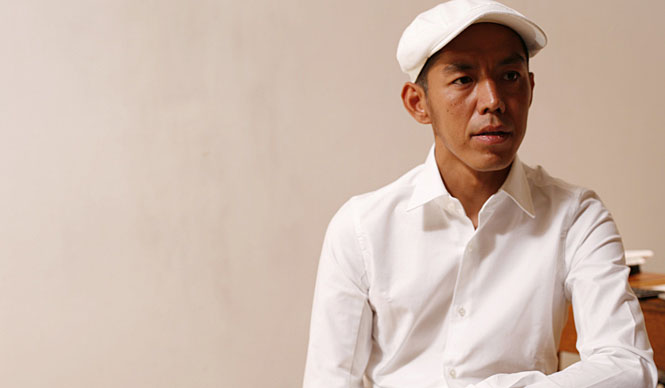
Part 1: I Am Training in Tibetan Buddhism
Part 1: I Am Practicing Tibetan Buddhism
I deliberately chose the title "spiritual," a term I least want to be used right now, to invite misunderstanding.
This isn't due to masochism, but rather because my perspective on fashion has shifted away from conventional materialism, becoming largely a mental pursuit.
Furthermore, I wanted to challenge the popular spiritual boom by conveying my own understanding of true spirituality, which differs from what is commonly labeled as "spiritual" today.
However, my aim isn't to critique, but rather with a touch of youthful ambition, to foster a greater awareness of what is genuine.
To put it more concisely,For me, clothing is not for the body, but to envelop the soul.My perspective has shifted to this: clothing envelops the soul. And what is true spirituality, in relation to the soul? It is not about spirits, auras, or tales of gods that flood the popular consciousness, but rather the fundamental consciousness, neither one nor many, that resides deep within your heart and mine.
It is an essence beyond language, which cannot be described by any words, nor can it be said to exist or not exist, to both exist and not exist, or even to neither exist nor not exist.
It is not a god like a white-haired old man in the sky, but something inherently present within you, all living beings, and everyone.
It is what sprouts or is remembered in your heart when you feel the beauty of trees while being caressed by a gentle breeze.What I want people to feel through my clothing is that kind of simple happiness.Indeed.
Text by Tasuku ShinokuniPhoto by Jamandfix
Compassion. A Heart That Cares for All Beings
I'll make a confession right from the start.
Iam practicing Tibetan Buddhism.
My teacher is a practitioner of the Gelug school, the same as His Holiness the Dalai Lama, and he spends ten months of the year in solitary retreat in a cave on the sacred mountain called Kailash.
The other is a Nyingma practitioner named Patrul Rinpoche, who is considered a reincarnation of a figure from the early 19th century who wandered Tibet as a mendicant, spreading teachings across various regions. (Rinpoche is a title for such a reincarnate master, and he is recognized by His Holiness the Dalai Lama.)
Reference│http://www.patrulrinpoche.org/
This individual, from past lives (a term that may be confusing to some), left behind many significant teachings. His Holiness the Dalai Lama himself has appointed this master, transcending sectarian boundaries, to meticulously study the texts left by this reincarnate.
Why would I, a designer, speak of such things that might lead to misunderstanding? Because I want to convey that Buddhism is not a religion that worships Buddha as you might imagine, but rather a methodology and a practical science for transforming one's mind towards goodness and benefiting others.
And what am I learning from such a wonderful teacher? It is the mind of compassion. A mind that cares for all living beings.
Inspired by Jet Li's Words and Actions
By the way, the reason I decided to speak about this publicly is that I heard something from my friend, the stylist Jai-an (Tetsuro Nagase), which sparked this.
It was during a filming job Jai-an had with action actor Jet Li. During breaks, Jet would spend his time alone, not attending wrap parties, and kept to himself, avoiding social interaction. Upon closer observation, it seemed he was constantly chanting something that sounded like Buddhist scriptures.
When Jai-an finally mustered the courage to ask what he was doing, Jet replied that he was practicing Buddhism and explained it to him with great care, saying:
"I came from a poor background and struggled a lot. Only after achieving my current status and wealth did I find inner balance. But then I realized I had wasted so much time. It was then that I first encountered Tibetan Buddhism and decided to dedicate the rest of my life to it."
Hearing this from Jai-an, and initially having no particular interest in Jet Li, I began researching him. I discovered that he honestly and carefully explained Buddhism to his fans. I also learned that as a result of this practice of inner transformation, he established a disaster relief fund, raised substantial donations for the Sichuan earthquake, and contributed significantly himself without disclosing the amount. Witnessing what a single individual's mind can achieve, I truly felt the power of the Buddha's teachings.
Compared to him, I am like an ant before a giant. However, especially in this country where Buddhism has been distorted into seeking truth and authority outside oneself, I felt compelled to speak what is right without hesitation.
Changing the subject, today I read a book titled "Singing with Color" by Fukumi Shimura, a renowned intangible cultural asset holder and dyer.
At the beginning of the book, a passage from the "Oral Traditions of Dyeing," passed down among ancient dyers, is quoted: "Plants, like humans, are living beings created by nature. The plants that become dyes offer their lives for humanity, becoming colors that protect people from evil spirits. Therefore, they must be handled with compassion, and the craft of dyeing must be pursued with gratitude and prayers to the forest spirits."
What my Buddhist teachers have taught me is this same compassionate spirit. The clothing I wish to create is made from materials imbued with the power of such living beings.
While I cannot yet say that I have fully achieved this, I work every day with such influences and goals in mind.