March 10, 2015
Brand GRIFFIN Designer JEFF GRIFFIN Interview (Part 1)
GRIFFIN Designer
JEFF GRIFFIN Interview
GRIFFIN is a fashion brand that continues to propose its significance not merely as clothing, but as a creative design force.
Its garments, a mix of militarism, combat, and sportswear elements, possess an authentic value born from practical intent.
This is the first installment of a two-part interview series with designer JEFF GRIFFIN, delving into everything about GRIFFIN, from his journey as a designer to the brand's direction.
Text by Hitoshi Kaneko (This magazine)Photo by Jamandfix
— Please tell us what inspired you to become a fashion designer.
I decided to pursue a path in fashion culture when I was 16.
It was to change my life, which was spent evading skinheads and rockers. That was the catalyst for me to enter this field. After graduating from Central Saint Martins, I went to Italy to hone my skills in garment making, then returned to the UK and launched the brand 'GRIFFIN' in '94.
The reason I started my own brand was partly a reaction against the flashy fashion scene of the 80s. I wanted to create clothes that were different from the collections presented on the catwalk. I wanted to create something more edgy, with a touch of sportswear. That's why I started it myself.
GRIFFIN incorporates elements of military, art, and sports, along with a touch of humor. Incidentally, my brand utilized the internet from its inception, which was quite advanced at the time, as very few brands in Europe were conducting business or press activities online back then.
In the early days of GRIFFIN, I was also involved in design consulting and directing for other brands as an individual, so it was a label where I pursued my personal tastes and desires, playing with fashion.
And that's still the case, really (laughs).
— You mentioned evading skinheads and rockers, which might be difficult for Japanese people to fully grasp. Could you explain the situation?
At that time, it was an era with many different subcultures like mods, skins, punks, teds, and new romantics. These groups were unified not just in style, but also in their ideologies, so people with those specific mindsets adopted those looks. I think that's the original British fashion style.
While not all groups were in direct conflict, some were. Among them, the skins were particularly aggressive, with a mindset of 'everyone else is an enemy.' Since I didn't belong to any group, I had no choice but to flee from their violence without engaging.
— You mentioned that you launched the brand 'GRIFFIN' partly as a reaction against the fashion of the 80s. Could you elaborate on that?
If you interpret it as 'rebellion' against the 80s fashion scene and catwalk shows, the meaning changes slightly. It wasn't that I disliked catwalk shows, but rather that I didn't find any brands presenting shows at the time that I considered 'cool'.
There were many casual denim brands, but it wasn't an era where streetwear was considered cool like it is now. At that time, I wanted to propose incorporating a sportswear aesthetic into street fashion.
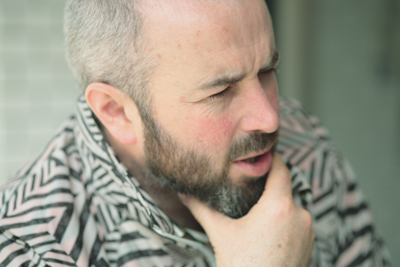
— Your designs seem to have a strong military influence. Is that accurate?
Looking back at the history of menswear, the archetypes are often derived from items used in warfare—for example, Burberry trench coats, Mackintosh, and Baracuta. These are all brands that were used during wartime, and the core of their designs originated from military wear developed during conflict.
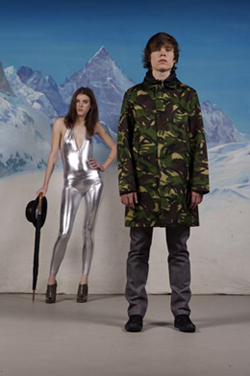
Collaboration coat with Mackintosh
In my GRIFFIN collections, I'm not simply replicating vintage military items. Instead, I'm 'reinterpreting' them to suit contemporary tastes.
For instance, with the Baracuta items from this season's collaboration with GRIFFIN, we're using the latest military fabrics. Similarly, with the Mackintosh coat, while its origin is a classic military garment, by applying camouflage patterns and using cutting-edge materials, we express a more modern aesthetic. Furthermore, the materials we use are the latest ones actually employed by the British military, for which we have received special permission.
That's how I incorporate military influences.
For me, it's akin to an 'Andy Warhol-esque pop art sensibility.'
— The brand's mark, a peace symbol within a heart, what does it signify? War and peace?
I find it interesting in itself that military-inspired garments feature a love and peace symbol (laughs).
Also, stemming from my experience of having to escape from skinheads, it also carries the meaning of 'let's all get along!' (laughs).

JEFF GRIFFIN
Born 1967
1988-1990 Excelled in Fashion Design at Central Saint Martins School of Art, earning a Master of Arts degree.
1990 Worked at GMV Gian Marco Venturi in Italy.
1991-1992 Worked on projects for Little Italy Family, T/A Voyage, GIAN MARCO VENTURE, VALENTINO, 18-18, Ferre, and Americanino.
1992 Returned to London and worked at Voyage.
1993 Began designing for the fashion brand 'GRIFFIN' with passion.
Official Website | http://www.griffin-studio.com