
March 11, 2015
(2) "Creation, New Arrivals, and Concerns for Vintage Clothing"
Interview with Rin Tanaka
Creation, New Releases, and Concerns for Vintage Clothing (3 Parts, Part 2)
Rintaro Tanaka has established a small photo studio in Los Angeles equipped for portraits and product shots, where he works on his unique lighting. This is the second part of his latest interview, in which he discusses his deep affection for American vintage clothing.
Summary by Yasuhiro Takeishi (City Lights)Narration by Rintaro Tanaka

Harley-Davidson's Historic Archives Revealed for the First Time
—By the way, what kind of photography do you like?
I love documentary photography, like that of Magnum, for example. Photos that gain meaning over time as 'records.' In that sense, the book I'm currently working on about Harley-Davidson is similar. Harley-Davidson has been producing a member magazine called 'The Enthusiast' for owners since 1913, and they've hired professional photographers from that era. The vast collection of original photographs is stored at Harley-Davidson headquarters, and while they've been scanned and archived, I was the first outsider in the world to be shown this confidential data. It was a magnificent record.
—Isn't nearly 100 years of material an enormous amount?
It was truly a 'black hole' (laughs). I spent every day for two months straight in front of the computer. But my job is to sort through and compile that material. It's like restoring an ancient ruin. I realized that when an overwhelming amount of data accumulates on a computer, it becomes unmanageable by human hands. Harley-Davidson didn't know how to process it either, so it came to me. While the history of Harley-Davidson motorcycles themselves has been documented and compiled into books, perhaps the culture of Harley is something even Americans can no longer fully grasp. In that regard, this book is a major project. It's a commemorative book for the Harley-Davidson Museum opening in Milwaukee, where the company headquarters is located, celebrating its 105th anniversary this year.
—That sounds like an incredible project. Was it a direct commission from Harley-Davidson?
Yes. A representative from Milwaukee came specifically, and I immediately flew to Milwaukee. Karen Davidson, the head of Harley-Davidson's apparel division, is an acquaintance, and she apparently introduced me to the museum side. It must have taken courage to commission a Japanese person like me for such a quintessential American culture (laughs).
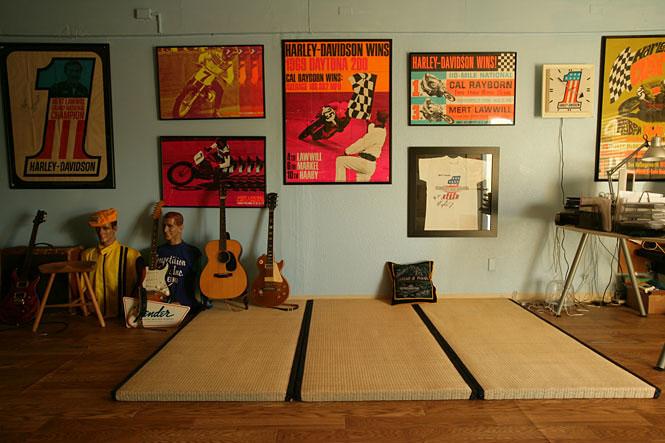
The recently completed photo studio
The Full Picture of Motorcycle Fashion's Early Days, Largely Unknown
—So, will the content be a compilation of Harley-Davidson's company history?
No, the title will be 'Genuine Harley-Davidson Fashions,' so strictly speaking, it's a book compiling the history of Harley-Davidson's fashion. This covers the period from around 1910 to the 1950s. One of the reasons I felt compelled to go to America to research the history of leather jackets was precisely the scarcity of materials from this era in Japan. Pre-war photographs, in particular, are almost impossible to find. The 1930s are the most interesting period for leather jackets, but to research it, I had no choice but to go to America. However, I still couldn't find materials from before the 1930s. My previous books also tend to focus from the 1940s onwards. So, that material was truly fascinating.
—Indeed, motorcycle wear from that era is largely unknown until now, isn't it?
It goes all the way back to the 1910s. The fashion of this period has never been deciphered by anyone before. Furthermore, Harley-Davidson fashion is essentially American fashion, making it the origin of American casual wear.
—What kind of fashion did people wear when riding motorcycles in the 1910s?
It seems they often wore sporty suits made of tweed and similar materials. After all, people of that era were immigrants from Europe. America began adapting the clothing they brought with them into what we know as American casual wear from around the 1930s onwards, and seeing the transition before and after that was groundbreaking and rewarding. I discovered that the prototypes of leather jackets I had assumed were from the 1930s actually existed as early as the 1920s. I also learned that motorcycle clubs like the Hells Angels, which peaked from the 1950s to the early 1970s, actually existed from the early 1900s. I realized my predictions were off by about 30 years.
—So the materials surpassed even your expectations?
It was a shock to find my expectations were so far off. I was keenly aware of my own research's shortcomings.
—Still, it's astonishing how advanced Harley-Davidson was, to be producing apparel to match their motorcycles even from that era.
It seems they started producing them gradually around 1912. By 1914, Harley-Davidson was producing 10,000 motorcycles annually, which is almost the same number of motorcycles that Harley-Davidson Japan sells in the current market. This means they already had a considerable market back then, and consequently, a market for selling accessories like apparel.
Creation, New Releases, and Concerns for Vintage Clothing (3 Parts, Final Part)to be continued
