March 11, 2015
(1) "Creation, New Works, and a Concern for Vintage"
Interview with Rin Tanaka
Creation, New Releases, and a Concern for Vintage Clothing (Part 1 of 3)
Rintaro Tanaka is currently working on a new installment of "My Freedamn!" and another project simultaneously. In this interview, we delve into his recent activities and the details of his lesser-known project. Over three installments, we bring you his latest interview, covering his personal creative process, behind-the-scenes stories, and his profound affection for American vintage clothing.
Summary by Yasuhiro Takeishi (City Lights)Narration by Rintaro Tanaka

New Release: A Book Celebrating Harley-Davidson's 105th Anniversary!
— We'd like to hear about your latest endeavors. What kind of books are you working on right now?
Rintaro TanakaI'm currently working on "My Freedamn! Vol. 7" and a commemorative book commissioned by Harley-Davidson. Both are scheduled for completion around the spring of 2008. "My Freedamn! Vol. 7" focuses on Hawaiian shirts, so it makes sense to release it in spring; no one feels like wearing Hawaiian shirts in winter, after all (laughs).
— So the new release centers on Hawaiian shirts? We'll have to discuss "My Freedamn!" in more detail closer to its publication. Are you still traveling frequently?
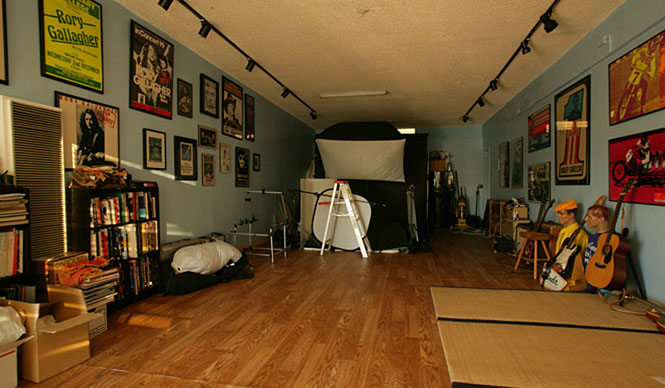
I'm still traveling as much as ever. My monthly schedule is split evenly between being away and being home – two weeks on the road, two weeks at home. This month I'm in Japan for two weeks, and next month I'll be in Hawaii for two weeks. So, I'm always traveling somewhere each month. The biggest recent change is that I've set up a small photo studio in Los Angeles. I've equipped it for both portraits and product shots, and installing a large lightbox has been a significant improvement.
— This sounds like it will elevate the quality of your publications.
Indeed. Large lights provide better light distribution, which instantly solves lighting issues I've struggled with. I believe simple lighting is best in photography. All photographers probably feel the same way. The sun is singular, and using two or three lights makes shooting increasingly difficult, creating various shadows. Therefore, I've always felt one light is ideal, and it represents the origin of photography. I imagine photographers like Richard Avedon shot this way. Back then, he must have innovated with limited equipment and developed his own lighting systems, which remain largely unrevealed. While he touches upon it in interviews, such systems are inherently secret for photographers.
The Reason for "Strength Training" in a Photo Studio
— I see. So, your unique lighting approach is part of a photographer's artistic signature.
Most equipment is fairly standard. However, lighting techniques are unique to each individual, so I'm reluctant to reveal my own system. Incidentally, Hollywood is the mecca for such visual lighting. Hollywood film studios have a constant demand for lighting, making it a viable business. They've been researching lighting techniques since the 1920s and '30s, and people worldwide look to them as a benchmark. Visiting Hollywood allows you to witness these techniques up close, but without a studio, I couldn't practice them.
— And now you're practicing that lighting in your own studio.
Currently, it's at zero productivity (laughs). It's in the research phase. However, I feel I can't improve if I don't engage in this. Fundamentally, I believe creators hone their skills through their work. While that's important, there are limits, and at my age, there's less I can absorb through work alone. That's why I need to do "strength training" to improve my skills. American creators invest in this kind of training, even if they're struggling financially. I feel I can't compete or reach the next level without doing it, even if it means reducing my income.
— So, as a photographer, you're constantly striving for improvement.
My assistant and I experiment daily. My assistant taught me about cameras and is knowledgeable about lighting. We research and experiment together. My expression is inherently two-dimensional, so capturing three-dimensional photos that powerfully draw the viewer in is quite challenging. I want to re-study aspects like shadow rendering. I aim to make the magazine pages more impactful and compelling.
— The work of top photographers certainly has a powerful impact.
Yes. When I worked at an advertising agency, I visited Kazumi Kurigami's studio to pick up photos. He was checking them by projecting them large onto a wall with a slide projector. That's when I realized that true masters visualize and check their work on such a scale. Top artists, I believe, possess these unique methodologies. For instance, Avedon would line up ten Rollei SLRs and shoot rapidly. Bruce Weber and others also have their own distinct approaches.
Creation, New Releases, and a Concern for Vintage Clothing (Part 2 of 3)to be continued
