March 12, 2015
Volume 6: The Making of nine SIXty Jewelry (Part 1)
nineSIXty Hiroaki Kato
The 6th: nineSIXty's Jewelry Production Process (1)
nineSIXty jewelry captivates with its unique designs that reflect the wearer's personality and its meticulously crafted, intricate details.
This time, we'll share the production process of a signature model, along with the tools favored by designer Hiroaki Kato.
Text by Taishi Sato (Gringo)Photos by Kei Uzawa
Custom Rings Crafted from Engraving

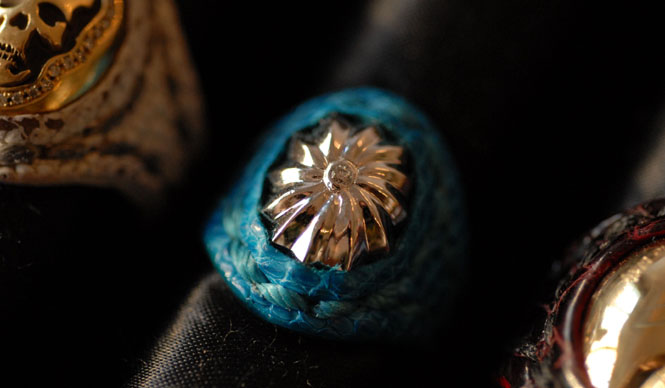
The model we're creating today is called 'Two Crosses,' which involves wrapping leather around pink gold metal featuring a cross relief.
When creating a new model from scratch, we begin by making a mold for the metal parts.
We start by roughly shaping a wax base, then cut out details like star motifs to bring it closer to the final form.
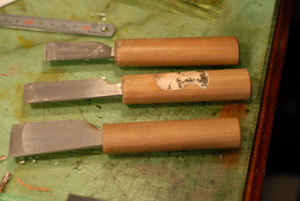
I particularly like using a tool called 'Masamune,' which resembles a sword. Originally designed for openwork carving in crafts, not metal engraving or dentistry, it's invaluable for expressing fine, delicate nuances.
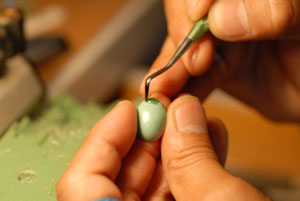
In contrast to carving away material, there's also a method of building up the wax in three dimensions.
This technique, familiar in dental work, involves using a heated metal instrument to melt and sculpt the wax into a three-dimensional shape. We often combine both carving and building-up methods.
For items like buckles, the process begins by carving from a large block of wax, which requires considerable time and effort.
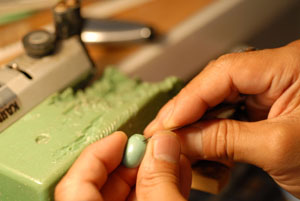
Using the finished wax as a model, we create a casting mold, and then engrave the silver or gold base using that mold.
We keep the original master molds to allow for minor design changes or customizations.
The next step is to fit the polished metal base into the leather.
For this type of model, we typically use two layers of leather. If using lizard for the surface, it requires three layers. For dot-pattern models, it's one to two layers. The amount of leather varies depending on the design.
Incidentally, the piece currently being made is a men's size 21.
nineSIXty rings are constructed by sewing and pressing the leather to compress it, so it's essential to leave some allowance. Wrapping the leather around a ring mandrel, for a size 21, we typically allow for about five sizes larger, around a size 26, before cutting.
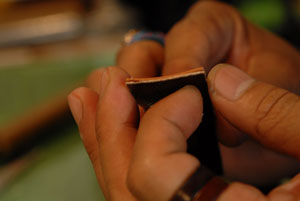
The Strength of Jewelry Born from Self-Taught Techniques
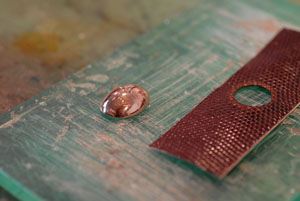
The cut leather is repeatedly wrapped around the ring mandrel to shape it into a perfect circle.
Since the leather edges are joined to form a cylinder, both ends need to be thinned with a blade, like a chisel. Otherwise, the glued surface won't be smooth and will become uneven.
All these processes were developed through self-study.
The order of steps and processing methods subtly change depending on the quality of the leather used and the base material, such as stone or wood.
Depending on the nature of the custom order, the production flow can be infinitely subdivided.
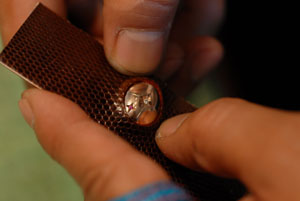
nineSIXty rings are shaped by various physical forces.
• The frictional force generated when the cut leather surfaces are joined.
• The pressure from the thread applied during hand-stitching.
• The expansive force as the compressed leather, secured by stitching, attempts to return to its original shape.
• The restorative force as the leather, curved into a radius, pushes back against it.
These carefully calculated forces, acting from multiple directions on the small ring, are the source of its strength, preventing the metal or stones from ever coming loose and the leather from peeling, even after years of wear.
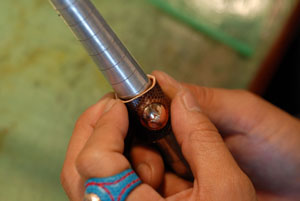
For example, a common diamond ring held by metal prongs can have the stone dislodged if pried with significant force.
However, with nineSIXty, the interplay of various forces from multiple directions makes the base exceptionally secure.
It is paramount to individually adjust the applied force and the angle of the stitching based on the material—be it stone or wood—and its shape, for each unique piece.
