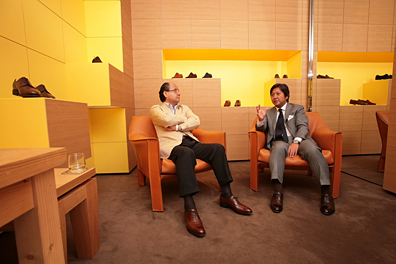
(2) Hiroshi Ogawa of Baccarat Pacific: "Tradition and the Future"
A Conversation with Hiroshi Ogawa, President of Baccarat Pacific
(2) Tradition and the Future
In the first installment, we primarily discussed President Ogawa's personal interests. This time, we delve into the brand "Baccarat." We explore the allure of a "venerable establishment" that continues to evolve while carrying a significant history.
edit by Daisuke Hata (City Writes)Photo by JAMANDFIX
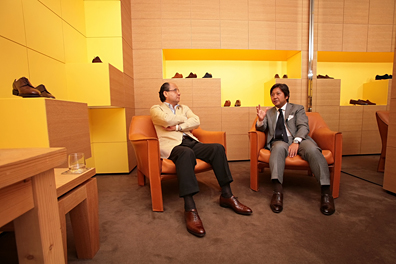
Modenity With Roots
Tomoaki MatsudaIt's something said about any brand today, isn't it? The balance between "tradition and innovation" is considered important. Baccarat, while a brand with a rich tradition, also does innovative things, such as appointing Philippe Starck as a designer. What are your thoughts on this, President Ogawa?
Hiroshi OgawaI believe "modernity" is a key word. I think the primary objective for any company is to "continue to exist." To continue to exist means to contribute properly to shareholders, to be supported by the employees who sustain the company, and finally, to be recognized and supported by society.
Many people refer to Baccarat as a brand with 240 years of tradition and history, but I believe Baccarat is entirely about modernity. It is precisely because we have continuously pursued modernity that we have been able to gain support from shareholders, employees, and society, and thus continue to exist.
This is a term I coined: "modernity with roots." It's the "modernity with roots" that is essential. Modernity alone can become tiresome, and clinging solely to roots prevents us from conveying new messages.
Also, to put it plainly, for today's consumers, a brand must be perceived not as "my parents' brand" but as "my brand." Some brands have become "my grandparents' brands."
Like John Lobb, Baccarat has a grand history. That's precisely why my operational approach has been to "pursue modernity."
For example, from 1998 to 1999, we held an art exhibition titled "Baccarat: Eternal Radiance" at four museums in Japan, showcasing over 400 historical masterpieces from the Baccarat museum. The museum staff and I discussed how we didn't want to present the past as merely the past, but rather as a message for the future. Therefore, instead of opulent interiors like those at the Palace of Versailles, we commissioned architect Christian Biecher to create incredibly modern and sophisticated interiors for the exhibition setup. We even pursued modernity in our direct mail.
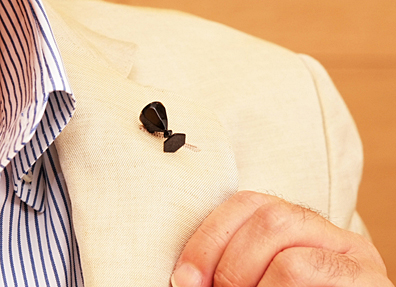
Incidentally, the lapel pin I'm wearing today, shaped like a wine glass, is from the "Harcourt" series, a design that originated 166 years ago. The fact that it remains a bestseller today indicates that it was a design that looked far into the future. The same can be said for the Kelly bag.
Product Value for Consumers
MatsudaJapan is a country that values the culture of objects, isn't it? As an added value to objects, the spirituality imbued within them is cherished. It's sometimes called brandism, but I believe it's a nation with a very firm grasp on recognizing quality.
OgawaI agree. I believe every brand has consumers who understand its core essence. John Lobb is a brand that is truly supported by customers who appreciate its quality. Having such customers is a great strength.
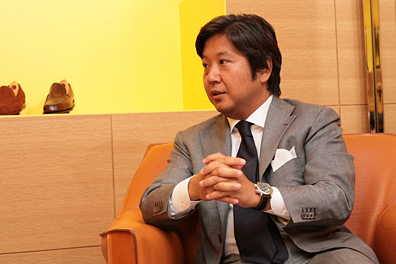
MatsudaIt is truly something to be grateful for.
OgawaAnd for new customers, the challenge is how to get them to wear their first pair.
MatsudaJohn Lobb has many classic styles, and until around 2004, they only released about two new models per season. From 2005 onwards, we began releasing about ten new models each season. While some customers feel that new designs are not quite "John Lobb-like," the classic styles that have been maintained are, of course, still a cornerstone. I believe the balance between the two is crucial.
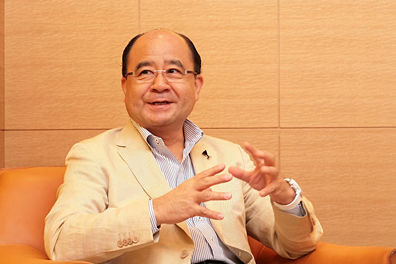
—Baccarat recently appointed Arik Levy, also known as the "magician of light," as a designer. Do you feel a change in Baccarat because of this?
OgawaYes, naturally, a change in designer brings about a change in taste. However, my theory is that Baccarat's roots are not so shallow that a change in taste would fundamentally alter the brand itself. Therefore, I perceive it not as a change in taste, but as an expansion of new offerings.
What's remarkable about Arik Levy is that, while being a designer, he doesn't just impose his own designs. He spent a long time at the Baccarat factory, learning its manufacturing processes in detail. Crystal glass is handcrafted and is an exceptionally specialized product, so each step of the craftsmanship affects the cost. For consumers, some items might seem inexplicably expensive. He therefore concluded that "if craftsmanship that is difficult for consumers to understand is reflected in the price, does it truly have value as a product?" He then incorporated this into his own designs, keeping the prices reasonable.
MatsudaThat's something ordinary designers can't do.
Profile
President, Baccarat Pacific Co., Ltd.
Hiroshi Ogawa
Born in Kanagawa Prefecture in 1948. Graduated from Keio University, Faculty of Law, Department of Law. Joined Esso Sekiyu (now Exxon) in 1970. Participated in the establishment of Baccarat Pacific in 1983, served as Managing Director, and assumed his current position in 1994. He also concurrently serves as representative of the Singapore subsidiary and director of the US subsidiary.
In 1997, he was awarded the Chevalier of the National Order of Merit by the French government.
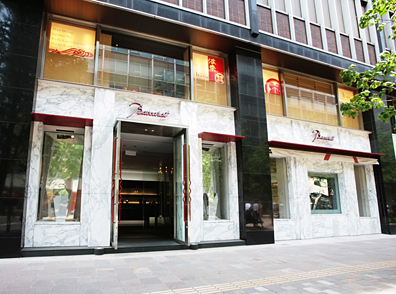
Baccarat Shop Marunouchi
1F, Kokusai Building, 3-1-1 Marunouchi, Chiyoda-ku
Tel. 03-5223-8868
Weekdays 10:00–20:00, Weekends & Holidays 11:00–20:00
http://www.baccarat.com
B bar Marunouchi
(Basement of Baccarat Shop Marunouchi)
Tel. 03-5223-8871
Weekdays & Saturdays 16:00–4:00 the next day, Sundays & Holidays Closed