January 28, 2015
Serialized Series: Taishi Shinkoku | Part 15: Not So Much Declaring Myself a Poet as Declaring I Always Was One
Series | Taishi Nobukuni
One Day, Words Began to Flow from My Heart
I Debuted as a Poet
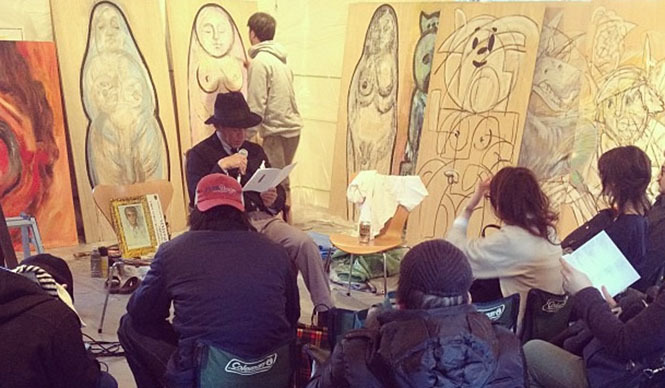
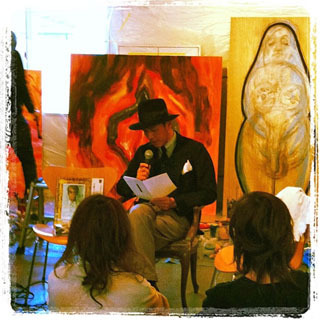
Recently, I debuted as a poet at the "Nonsense 2013 Exhibition" held at Dictionary Club in Jinnan. The photo shows me during a reading; I'm hiding my face because, frankly, I'm a bit embarrassed (laughs). The paintings in the background, by Masaya Yoshioka and Kou Itsu Ueda, were created on-site over three days during the exhibition. My reading took place against the backdrop of their brushstrokes and the sounds they made.
Text by TAISHI NOBUKUNI
So, why did I embark on such a bizarre and eccentric act?
And why did I declare myself a poet?
It's an indirect expression of the thought that perhaps everyone is a poet. Rather than becoming a poet, it's a declaration that I have always been one.
Furthermore, poets exist largely independent of economic activity; it's less a profession and more a declaration of being somewhat useless. Conversely, it also poses questions about what constitutes a profession and what is economics.
However, I didn't set out to become a poet, nor did I decide to write poetry. It was one day that words simply began to well up from my heart.
It wasn't a feeling of being moved by a sunset, but rather a sudden understanding of the non-existence of all phenomena and the arbitrariness of words and things (that there is no absolute match between a name and its meaning).
Was Francis Bacon truly mad? Is Yosui Inoue lyrical?
While one might interpret them that way, Bacon intentionally distorted the connections between his painting motifs to prevent them from having meaning or generating narratives. I believe Inoue chooses his words entirely at random.
There's also the implication that a poet is not a prose writer. Except for individuals like Burroughs, prose, by its nature of being multiple sentences, inherently contains a timeline, characters, and a narrative. Poetry, therefore, can be considered non-narrative. However, with tanka, which I've recently become fascinated by, it's possible to tell a person's life story within 31 syllables. While not universally true, this paradox might be part of what draws me to tanka.
Yet, while a life story can be told in 31 syllables, once one grasps this, there's a desire to break away from the prose-like nature of poetry, to deconstruct it further. This led me to create what I call 'ultra-tanka,' born from my own misunderstandings of words, which end after 5-7 syllables. For example:
The sound of the sea,
seeping into the wind,
That's it. There's no 'so what?' to it, and I like this style.
Combine two or three words, and you have poetry. And if you play Garcia Lorca or Spanish guitar, anything you read there will sound like poetry.
At the Nonsense exhibition, I also read works by others. A rapper named Oni recited a piece about daily life in the Onahama housing complex, and I found the contrast with somber classical music quite interesting.
It's that simple, so why don't you all give it a try?
Speaking of which, I've already come up with what could be considered my final poem, or rather, a poem that signifies there's nothing more to say, so I'd like to share it.
It makes me as shy as reading aloud, so in English...
Nothing to see
nor
nothing to be seen
That place,
I am already there
because there isn't even no one to go