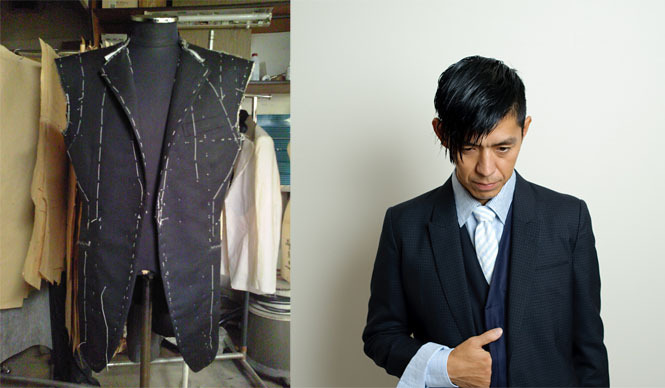
Series: Taishi Nobukuni | Part 11: What I Should Learn from Artisans Now
Series | Taishi Nobukuni
Those who have only tasted grape candy cannot understand the flavor of grapes.
Part 11: What I Should Learn from Artisans Now (1)
Months into my tailoring apprenticeship. My days were a bizarre mix: by day, I was "planning my own brand and deciding the breakdown of colors, materials, and shapes for thousands of garments for a certain brand," and in the late afternoon, I was "scolded by artisans for how I held a needle."
Text by Taishi NobukuniPhotos by Emiko Hara (Portrait)
Seriously Being Admonished by Seamstresses
You might think, "He studied in London, didn't he?" But compared to the meticulous artisans here, London tailors are quite rough. I can confidently say that it is here in Tokyo where a unique passion for research and refined techniques, some now lost even in London, still remain.
With that in mind, I've decided to brand my own label "TOKYO CLASSICO" starting next season. The "tailors" and "cutters" who are so stylishly called that in Britain correspond to "seamstresses" and "cutters" in post-war Japan. Japanese seamstresses are even more stubborn in their craftsmanship than Savile Row tailors. Many seamstresses, who don't even know I'm a designer, worry about my future as a peculiar, career-changing unemployed person trying to relearn from scratch at my age, and they earnestly scold me, trying to retrain me from the basics.
The average age of these seamstresses and cutters is in their 70s. The younger ones are in their 60s. Apparently, there are none in their 50s. I am witnessing firsthand the decline of professions and skills established during the boom of bespoke tailoring. In essence, we are heading towards a world where there are no longer people who can understand a single customer's body shape, cut the fabric, and sew the garment.
For those who will teach or learn in fashion schools from now on, I highly recommend deeply teaching and learning the process of perfecting a garment for a single individual. This encompasses everything: design, pattern making, sewing, and fitting.
Conversely, the current world is flooded with products made with vague designs and vague fittings for no one in particular, or rather, for everyone and no one. Ultimately, as the craft of primitive tailoring becomes democratized, the resulting products change.
Those who have only tasted grape candy cannot understand the flavor of grapes.
Series | Taishi Nobukuni
Those who have only tasted grape candy cannot understand the flavor of grapes.
Part 11: What I Should Learn from Artisans Now (2)
The Integration of Hands, Brain, and Senses is Remarkable
Interacting with these earnest artisans, whose age is comparable to the Japanese scholars recently awarded the Nobel Prize, I feel a sincerity unique to this generation, or perhaps, inherent to humanity. When I see an artisan become agitated over a 5mm seam allowance being 7mm, as if the world would turn upside down, I realize that what I should learn is perhaps not the technique itself, but this spirit.
Among these artisans, there is one I immediately identified as "my guru." This person, Mr. Y, has an impeccable posture and a wonderful work rhythm. From the moment I first met him, just watching him was a pleasure. Our relationship began when Mr. Y suddenly started talking to me about what he considered the crucial points.
Mr. Y, with eyes that see in 360 degrees, immediately corrects me if he notices anything amiss during my work. Someone who has mastered a skill over decades can sense, with a sixth sense, any deviation from the norm. The integration of hands, brain, and senses is truly remarkable.
He asked me, "Are you trying to apply the method of bespoke tailoring to ready-to-wear (which, in my time, was simply called 'clothing' with no distinction)?" I replied, "Well, after living for decades and experiencing various enjoyments and businesses, I realized there's nothing more fascinating than creating something with my own hands..." To which he responded, "I see. Indeed, there is joy in that." He, who had sewn thousands of jackets, murmured this weighty statement, and from then on, he began to teach me various things.
Mr. Y apparently worked for six years as an apprentice, which was essentially unpaid labor (two years for trousers, four for jackets), before moving to Tokyo from Shikoku in pursuit of higher skills. He is a remarkable man who supported his family solely through his craft until he had grandchildren. Ultimately, his high aspirations must have led him to his current atelier. The catalyst for finding this place was a newspaper job advertisement. Nowadays, you'd be hard-pressed to find advertisements for seamstresses.
These artisans live simple lives, working diligently. Their way of life is reminiscent of our grandfathers from a bygone era, and they still refer to computers as "piko-piko," unaware of their function.
Beauty Born from the Hands of Unsung Artisans, Not Celebrated Creators
Yet, the unfinished jackets lying beside their workbenches possess a profound beauty, with their drape on hangers, the character of their sleeves, and the harmonious pairing with the fabric.
I recall that some of Jil Sander's ready-to-wear pieces in the past had excellent tailoring. But seeing a more beautiful cashmere jacket hanging next to an elderly artisan's workspace, I feel that beauty is born not from mere taste, but from pure skill honed over years of dedication.
This is a testament to Soetsu Yanagi's philosophy of Mingei, that beauty arises from the hands of unknown artisans, not celebrated creators. I too wish to stop being a "creator" and become a skilled artisan like Mr. Y.
But I must quickly absorb these disappearing techniques.—I feel a sense of urgency, so I'm working hard, enjoying the process of accomplishing in one year what normally takes three, and in three years what normally takes ten. The reason for my haste is their advanced age. Around this time, Mr. T, who works from home and lets me use his workbench (the youngest here, in his late 60s), passed away. He used to scold me if I used the needle-puller on his bench, saying, "That's T's!" Now that the owner is gone, I will use it with care.
The last time I saw Mr. T was when he delivered a finished cashmere jacket with a Prince of Wales check for Mr. Shigeo Nagashima. I was amazed by the beautiful drape of the shoulder blades. However, he was ordered by the master to redo it because the pattern on the sleeve and body, which should not have matched according to the pattern drawing, did match. I may reveal more about this strict master someday.