Fabric Founder Keith Reilly Interview | KEITH REILLY
VOLVO OCEAN RACE 2011-12
The Tough Volvo
While Volvo is recognized in Japan as a brand that prioritizes safety, it also sponsors a grueling yacht race that circles the globe for nine months to add a sporty image to its brand. Tatsuya Kushima reports on the event.
Text by KUSHIMA Tatsuya
A World-Class Adventure Race
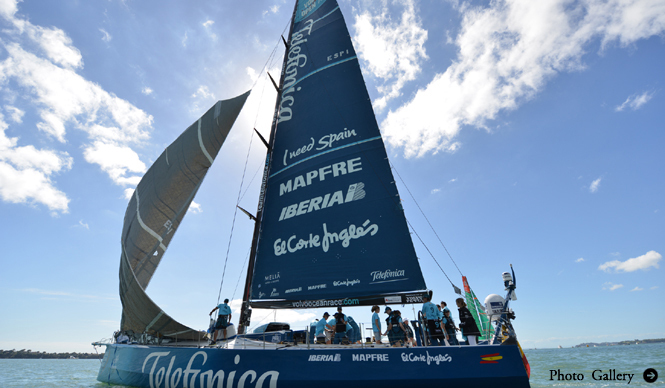
Iker Martínez, skipper of Team Telefónica, answered questions with a smile. This was taken in a corner of the press conference venue the day before departing for Leg 5.
The location is a marina in Auckland, the capital of New Zealand. It was near the end of the race week, about a week long, after docking from Leg 4 from Sanya, China.
Although he is an Olympic medalist, his consistently positive attitude in answering each question one by one, and the way he spoke about the race with apparent enjoyment, left a strong impression.
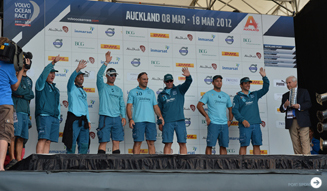
This race, competing for a circumnavigation of the globe, involves 10 stops and 9 legs. In other words, results are announced and awards are given at each port of call. It's a cycle of reveling in victory immediately after arriving and building tension as the departure date approaches. And it is customary in the race to celebrate thoroughly. Sailors, staff, and fans all get into the spirit. This might be one of the reasons the race has garnered so many fans.
Are you familiar with the “Volvo Ocean Race”? It’s a yacht endurance race that circumnavigates the globe over approximately nine months. While sprint-style races like the America’s Cup are more well-known in Japan, this race itself has a long history and is quite widely known in Europe.
It was once sponsored by a British beer company and was called the “Whitbread Round the World Race.” In the 1993-94 edition, a Yamaha boat even participated under the Japanese flag.
Currently, the race is organized by a management company funded by Volvo Cars, the popular Swedish car manufacturer, and Volvo Penta, its truck division.
VOLVO OCEAN RACE 2011-12
The Tough Volvo (2)
Formula 1 of the Seas
Now, let's touch upon the race's overview.
Six teams compete in the 2011-12 edition. In addition to “Team Telefónica” mentioned earlier, there are “Groupama sailing team,” “Camper with Emirates Team NZ,” “Puma Ocean Racing by BERG,” “Abu Dhabi Ocean Racing,” and “Team Sanya.”
They set sail from Alicante, Portugal, in November of the previous year, heading for Galway, UK. Currently (late June), Leg 8 from Lisbon, Portugal, to Lorient, France, has just concluded. Groupama leads in overall points, followed by Puma.
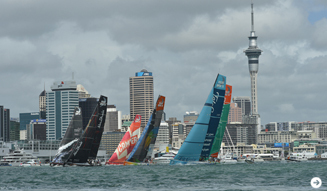
While it is an offshore yacht race, there are also in-port races held within harbors. These take place the day before departing for the next leg, and their appeal lies in being able to watch them up close.
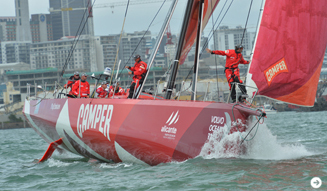
Some watch from the dock with binoculars, while others charter boats to follow their favorite team. The crew's movements as they rapidly change sail angles with a tremendous sound are captivating.
Speaking of the racing yachts themselves, the more you learn, the more astonishing they become. The hull is an ultra-lightweight body made almost entirely of carbon fiber. It's a structure that utilizes cutting-edge technology.
The design is truly the “Formula 1 of the Seas.” Setting aside the engine for a moment, everything from the aerodynamic body structure to the parts supply system is high-tech. In fact, I was allowed to board a race boat for about an hour in Auckland harbor and was impressed by how meticulously it was built. Its stripped-down form was even beautiful.
VOLVO OCEAN RACE 2011-12
The Tough Volvo (3)
From "Safety" to "Safe and Sporty"
So, why does Volvo organize this yacht race instead of a car competition?
Naturally, there's a corporate image strategy behind it. By having Volvo's name repeatedly mentioned in connection with such world-class adventure races, they aim to shift the brand image slightly in that direction. Specifically, words like “adventure,” “challenge,” and “toughness” come to mind. In Japan, the brand is often associated with “safety” and “Scandinavian design,” but this race instills words that are, in a sense, the opposite.
As a result, I hear that in Europe, the desired image for Volvo has already taken hold. This is particularly true for the model lineup from the XC60 onwards. If the impression of the yacht race is added to the safety and sporty driving, it's a successful strategy for Volvo.
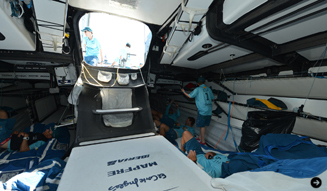
The hull, made of carbon fiber, resembles a spaceship base. Inside, multiple sails lie waiting for their turn, and the crew's sleeping quarters are in the remaining space. With four-hour shifts during navigation, it's a harsh environment.
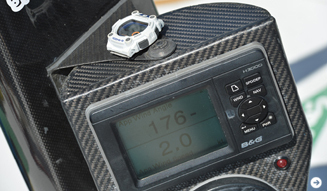
High-tech equipment is also a feature within the boat. A dedicated person uses a PC to plot the course, working with the skipper to determine the route by exploring all possibilities.
This race is truly incredible. Ten professional sailors board a 70-foot (approximately 21-meter) yacht, and one of them, the media crew member, records the entire race process on video. It’s remarkable how they can manage this while competing in such a tough race. This aspect truly feels like a next-generation competition. The footage can be viewed on the Volvo Ocean Race official website (www.volvooceanrace.com).