July 31, 2015
An Interview with Junichi Abe, Designer of Kolor
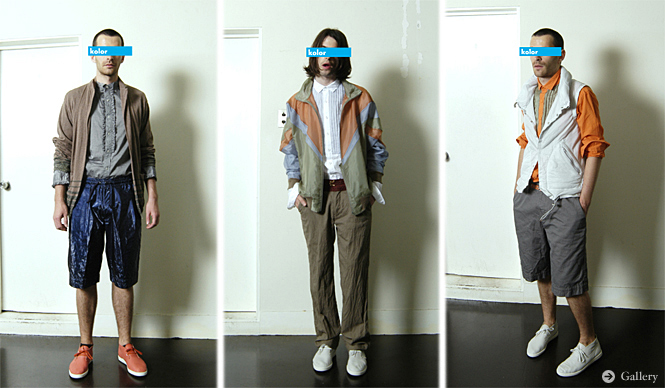
Kolor 2009 Spring/Summer Collection
The feeling when worn, the texture of the material, clothes with a balanced silhouette
Interview with Junichi Abe, Designer of Kolor
The Kolor Spring/Summer collection is featured in the gallery above, but I recently visited the showroom for next season's Autumn/Winter collection.
There were many buyers at the venue, all enthusiastically trying on samples and discussing them. When I greeted designer Abe, he smiled and encouraged me, 'Please try them on!'
Lately, I often visit showrooms and see samples that are like works of art, but it's rare for a designer to actively encourage you to 'try them on!' That's where I felt Abe's confidence.
Compiled by Makoto Kaji (This magazine)
Materials and shapes as simple as possible, using good materials to showcase good shapes simply
— Please tell us the origin of the brand name.
It doesn't have a special meaning. I wanted a foreign word that sounded familiar when heard, like 'white' or 'green' – short, easy to remember words. I preferred something that was too broad to easily visualize, rather than something too specific.
— Kolor is very popular overseas. In how many countries is it sold?
For the collection, we present the clothes twice a year in a hotel room in Paris. Overseas, we sell in about 20 stores, including London, Paris, New York, Boston, LA, Italy, Russia, Amsterdam, Singapore, South Korea, and Hong Kong.
The buyers' reactions vary, and they tend to choose pieces that match their store's aesthetic rather than prioritizing trends.
— Do you consider Japan or the world when designing?
Even when doing business overseas, I don't particularly focus on Tokyo. I don't think being a Japanese designer allows me to do anything different. I'm not particularly conscious of tradition either; it's simply my own interpretation of blazers and cardigans based on my life experiences.
Clothes are an expression of the wearer's aesthetic, just as they are for the creator. What one prefers is a reflection of their values. In that sense, my own feelings are conveyed as a message through my clothing.
— What has remained unchanged since Kolor's debut Spring/Summer collection in 2005?
When I decided to launch Kolor, it wasn't about leaving my previous brand and starting anew. It was more about returning to zero and finding my own place.
I had been with my previous brand for 10 years, and while I was mindful of differentiating myself, I didn't set specific targets or think strategically. I just thought, 'Let's be honest, express my feelings through clothes,' and 'Let's do what I believe is right.'
— That's the most difficult part...
Especially for the first collection, I knew I would be compared to my previous brand. But I decided to avoid using gimmicks. I wanted to keep the materials and shapes as simple as possible, using good materials to showcase good shapes in a simple way.
— If that's what hasn't changed, what has changed?
Of course, I strive to change with every season. I believe I must change and should change, but it's not something that can be forced. I also don't want to change in a way that feels inauthentic.
(↑ To the Photo Gallery)
(↑ To the Photo Gallery)
The balance of shape (pattern), material, and sewing specifications is what I cherish
— Do you set a theme for each collection?
I don't have specific sales-oriented themes to announce to everyone. However, we do have conceptual phrases that create a shared understanding among the staff, or vague guiding principles that ensure direction remains consistent.
Our approach to these themes can sometimes involve expanding on concrete ideas, like 'that style from that scene in that movie I saw long ago,' or sometimes it's more symbolic words that serve as a starting point, such as abstract concepts like 'lightness' or 'chemical.'
— What was the theme for Spring/Summer 2009?
Since the first season, Spring/Summer 2005, I've wanted to honestly express the beauty of natural materials. This season, I've become interested in hybrid materials like polyester and cotton blends. I'm focusing on material textures by mixing natural materials with synthetic ones, or by combining them within an outfit.
When the materials change, the way the clothes move when worn, the feel, and the visual impression all differ, which in turn changes the perception they give to others.
— Could you please explain some of your recommended looks?
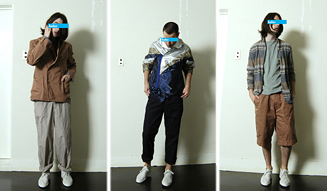
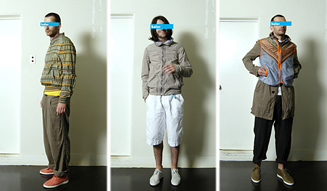
Previously, we often favored a balance of tight tops and wide bottoms. This season, however, we're frequently using silhouettes that are narrow at the bottom, contrasting with voluminous tops. We're also creating looks by pairing dress shirts with synthetic pants, or by incorporating colors that have a sheen resembling synthetic fibers.
Many items are also garment-dyed or garment-washed. The touch and feel of the material are important. I want people to feel a sense of freshness, like, 'I thought this was wool, but it feels light and crisp, and it's so comfortable to wear.' To convey such nuances, I pay close attention to the balance of the three elements: shape (pattern), material, and sewing specifications. Through this balance, I hope people can feel the mood and nuance that we consider 'good.'
— Do you have any favorite colors?
For basics, navy and brown. I don't use black very often. For the past few seasons, I've favored colors like blue-gray, muted burgundy, and dull orange.
— What about the future of the brand?
I believe that clothes which possess a balance of functionality and quality as a product, along with a sense of the times, can evoke new feelings and change perceptions in people. That aspect remains constant. However, while it's easy to say this, actually creating it is incredibly difficult.
— Thank you very much.
Junichi Abe
After graduating from Bunka Fashion College and working at several brands, he established his own in May 2004. The first collection was presented in July of the same year, marking the debut of Kolor.
The brand's extensive collections, spanning from formal to casual wear, are highly regarded internationally for their uniquely original cutting techniques, meticulous material selection, and incorporation of contemporary trends, all aimed at achieving the ultimate form for each item.