February 26, 2015
LOOPWHEELER | Ordering a Special Lumoz Model Sweat Hoodie! An Interview with Representative Satoshi Suzuki
LOOPWHEELER
LOOPWHEELER | Ordering a Special Edition Sweat Hoodie from rumors!
Founder Satoshi Suzuki Discusses His Commitment to "Made in Japan" (1)
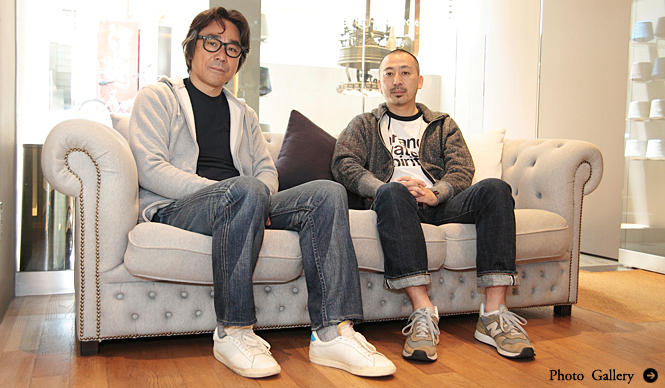
Fashion changes with the times, adapting to the prevailing trends. Everyone is sensitive to new styles proposed by brands, and we marvel at the shifts. Satoshi Suzuki, the representative of LOOPWHEELER, is the man who has been working behind the scenes. The product lineup consists solely of items made from fabric knitted on loopwheel machines. Over a decade since the brand's inception, new releases sell out instantly in stores, and custom orders from popular brands and select shops are constant. Now, LOOPWHEELER and the online shopping site "rumors" have collaborated to create a special edition. The release is scheduled for March next year. OPENERS will introduce the journey to the completion of this special edition over several installments. In this first part, Hiroyuki Matsumoto, the director of "rumors," interviews Suzuki about the brand's origins and his philosophy.
Text by FUJITA Mayu (OPENERS)
"Loopwheel Machine"
—What prompted you to start the brand?
Originally, our work was behind the scenes, in planning and production, where we manufactured cut-and-sew items for various apparel brands. This lasted for about 15 years. It involved material selection, pattern making—what is known as "production management." Since graduating from university, I've been involved in all sorts of materials and products in this industry. From socks to performance-oriented sportswear, I believe I've made everything except tailored garments. While gaining experience behind the scenes, I encountered manufacturers (artisans) who shared my appreciation for the rich texture and value of fabric knitted on loopwheel machines. I was involved in product planning and "manufacturing."
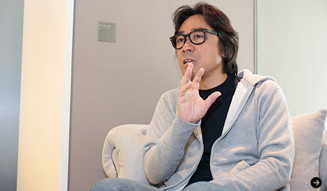
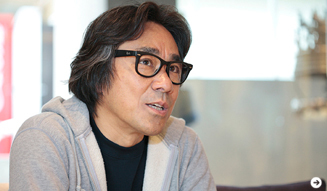
Satoshi Suzuki
—What is the difference between a loopwheel machine and other knitting machines?
Until the mid-1960s, loopwheel machines were common worldwide. Why did they decline? Simply put, they were inefficient. For sweat fabric, for example, depending on the material and other conditions, a loopwheel machine could only knit about one meter per hour. The 1960s and 70s were a period of rapid societal growth, and machine manufacturers developed modern, high-speed machines that were far superior to inefficient ones, capable of knitting 10 to 20 meters per hour.
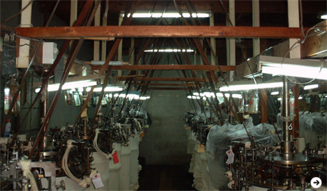
Kanekichi Kogyo, a factory in Wakayama
However, the fabrics produced by both machines are entirely different. A loopwheel machine knits with minimal tension on the yarn. While it varies depending on what is being knitted, the average speed is about 24 rotations per minute. It's a speed you can clearly follow with your eyes. The knitted fabric hangs down due to gravity and accumulates in a round tray, like a tub, placed below. In contrast, modern high-speed knitting machines operate at least 10 times faster, and some up to 30 times faster. Of course, you cannot follow their speed with your eyes.
Furthermore, to increase knitting speed, the yarn must be kept taut to prevent tangling. The fabric must also be wound up at the same speed it's produced, otherwise, it will bunch up at the exit and stop the machine. In short, to increase speed, constant tension must be applied to the yarn.
No machine surpasses this one. Not with current technology.
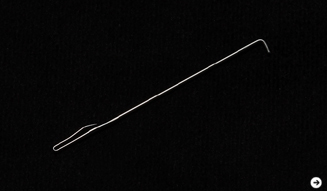
Needles of a loopwheel machine
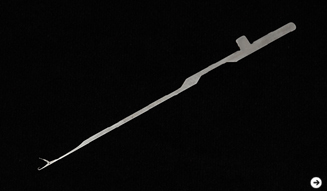
Needles of a high-speed knitting machine
The shape of the needles also differs. The needles of a loopwheel machine are shaped like fishing hooks; they merely catch the yarn, so the yarn can sometimes slip out. However, the needles of modern high-speed knitting machines have movable tips that firmly grip the yarn. This prevents the yarn from slipping even at high speeds, but it also means the yarn is constantly being pulled due to centrifugal force.
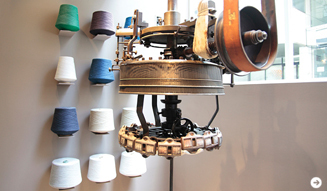
A loopwheel machine displayed at the Sendagaya store
—Does this damage the yarn?
If you have sewing thread at home, it's easy to understand by trying it. Suppose you have a thread that is 1 meter long and 1 mm in diameter. If you pull it with all your might, its length will likely increase to 1.01 meters, and its diameter will decrease to 0.9 mm. If you knit with it, the fabric will become denser due to the thinner yarn, resulting in a tight, firm fabric. Therefore, a high-speed knitting machine is superior for creating sweat fabric with a dense, firm texture.
However, if the goal is to create fabric while preserving the natural texture and inherent potential of the material, retaining the fluffy softness of the cotton yarn as much as possible, then fabric produced on a loopwheel machine is currently the best. With current technology, no knitting machine surpasses this one. Cotton fibers naturally have a hollow structure, which makes them fluffy and soft as they trap air, and also enhances their thermal insulation. You will notice the difference compared to fabric knitted on high-speed machines more with each wash.
LOOPWHEELER
LOOPWHEELER | Ordering a Special Edition Sweat Hoodie from rumors!
Founder Satoshi Suzuki Discusses His Commitment to "Made in Japan" (2)
My "normal" was a daily life wearing loopwheeled sweatshirts.
—Why do you insist on "Made in Japan"?
After the bubble burst, around 1995, production rapidly shifted to "Made in China." In the past, to my knowledge, there were about 10 loopwheel factories in Wakayama. Some went bankrupt, others closed down, and by the late 1990s, only two remained. Loopwheel factories in Japan were reduced to just two...
I have always been indebted to the people working in the factories in this industry, and I felt a sense of sadness as Japanese manufacturing declined. Amidst changes in production backgrounds and markets, I deeply considered whether we should also move production to China or remain in Japan, insisting on "Made in Japan," both for my work and for the company.
What could I do in that situation? What did I love the most? Returning to my roots, I realized, "I love these sweatshirts knitted on loopwheel machines."
Having worked surrounded by clothes, I wore garments from all sorts of brands. But ultimately, my "normal" was my daily life wearing the hoodies and sweatshirts made from loopwheeled fabric. I realized anew, "Ah, this is what I love the most. This is what feels most comfortable for me to wear."
Even if business increases, the industry itself will decline if there's no one to carry it on.
This might be a slight digression, but considering everything, if we create a brand using fabric knitted on loopwheel machines and plan production systematically throughout the year, we can pass on the culture of loopwheel knitting to future generations. This, in turn, will help preserve "Made in Japan"... though that might sound a bit presumptuous (laughs).
If we, as a "case study," are properly recognized by society, perhaps younger people will notice that such things exist and think, "Let's try making something with loopwheeled fabric." It's impossible to sustain this alone.
If it expands little by little and various brands get involved, perhaps this industry can become more vibrant. Not just brands, but maybe more young people will be drawn to working in factories.
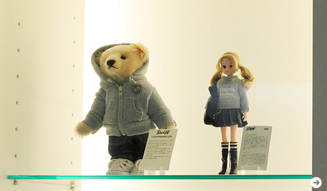
Just wear it, wash it, and spend time with it.
—What was the customer reaction when the brand first launched?
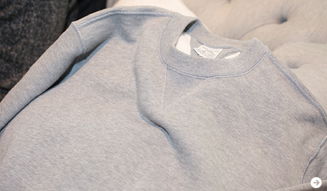
The first item created, "01"
Loopwheeled fabric doesn't have a distinctive "red ear" like denim that's easily recognizable, and its comfort cannot be conveyed visually. While I had some confidence as a manufacturer, I was a complete novice as a seller (laughs). How could I convey the merits of loopwheeled fabric through words? Initially, my job felt like explaining the fabric knitted on loopwheel machines. However, by honestly conveying the truth, allowing people to experience it, and earning their trust, those who understand will return. This approach remains unchanged today. By simply wearing it, washing it, and spending time with it, customers who appreciate it will visit again.
My role felt less about creating products and more about explaining the fabric knitted on loopwheel machines through the store.
LOOPWHEELER
LOOPWHEELER | Ordering a Special Edition Sweat Hoodie from rumors!
Founder Satoshi Suzuki Discusses His Commitment to "Made in Japan" (3)
I want to become the world's best sweatshirt maker.
—What prompted you to start thinking about overseas markets?
Actually, the launch overseas came first (laughs). Once you start something, you should aim to be the best in the world, to win a gold medal. Even if you might not achieve it, you should strive for it. So, when I started LOOPWHEELER, I told myself I wanted to become the world's best sweatshirt brand... and I face loopwheeled fabric every day with that in mind.
Having worked behind the scenes for so long, I had a professional awareness and a certain level of confidence in creating "sweatshirts." The question was whether my creations would be accepted. I thought it would be better to have them seen overseas, with a fresh perspective. A friend lived in London, so I took the products there first. That's how it began.
—What was the reaction at that time?
At that time, Japanese denim brands like Denime, FULLCOUNT, and EVISU JEANS were popular in the UK, and they looked at authentic manufacturing with a neutral perspective. However, because LOOPWHEELER products were expensive for sweatshirts, they were initially hesitant. Then, in 1999, the following year, 2000, was "Japan Year" in the UK. Events were held in various fields to introduce Japanese products. That year, the department store Selfridges took the lead.
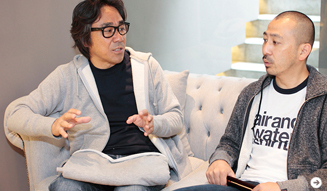
The relationship with colette began with a simple email of just three or four lines.
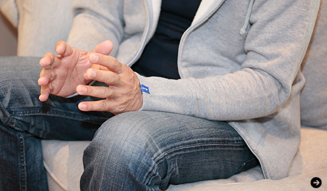
Around that time, we were also approaching Selfridges. The "Japan Year" led to a successful negotiation, and I remember it being a good start.
Furthermore, Sarah Lerfel, the buyer for colette (a select shop), saw our products at Selfridges and featured them in local magazines. Soon after, Sarah contacted us for a meeting, and our relationship with colette began. I believe colette was only about three years old at the time.
—What kind of items did you offer at Selfridges?
They particularly liked the ones with "Selfridges" printed in katakana on the chest. While we Japanese might think, "Hmm...", for them, katakana is a symbol, or perhaps it looks like a design.
A Sweatshirt Recommended for Adults, by Adults.
—So, what kind of item are you planning for the special edition with rumors?
SuzukiThe design itself is based on the hoodie model we offer at LOOPWHEELER, and we've essentially left the details to the rumors team. However, we plan to use a new material that hasn't been offered before.
MatsumotoWe're envisioning a fabric that's thicker than the "Extra Light" fabric released last spring and sold out instantly, but thinner than our standard "Light" fabric, with a bit of crispness. This is because, at rumors, we want to propose "Spring Sweatshirts for Adults," and for that, we needed a material with more body than what "Extra Light" can offer.
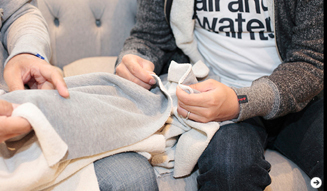
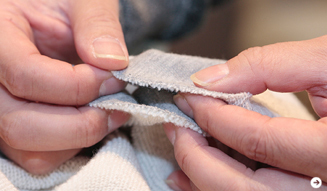
SuzukiThe base color is planned to be LOOPWHEELER's "Grey Melange." When we collaborate with other brands, we create a special color for the sleeve tag, unique to that brand.
MatsumotoFor rumors, we requested a tag with gray lettering on a black background. It creates a more chic image. The overall design is leaning towards a traditional style. While young people can certainly wear it, we want to create a sweatshirt for adults, one that we'd particularly recommend to them.
—Thank you very much.
Next time, we will introduce the design with actual samples in hand. Please look forward to it!