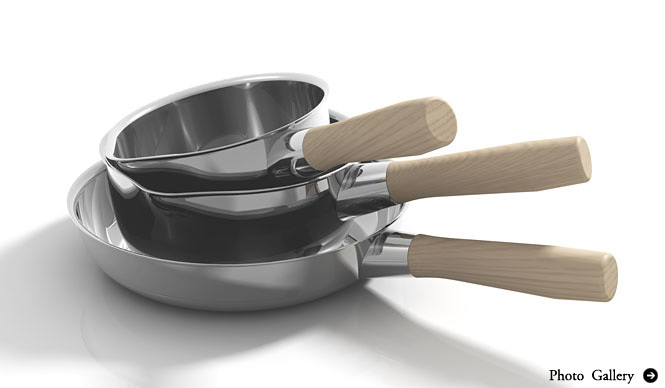
ALESSI | Naoto Fukasawa's "The 'Shiba' Series"
ALESSI
Naoto Fukasawa Designs Pots and Kettles!
“The Shiba Series” for Everyday Enjoyment
“When I thought of ALESSI, pots came to mind first,” says product designer Naoto Fukasawa. “I liked things that have become standard in daily life, especially those seen in cafes and restaurants, rather than designer pieces.” What he designed is a collection of pots and kettles called “The Shiba Series,” comprising nine products. Centered around pots, saucepans, and frying pans in various sizes, each is equipped with handles made of wood or synthetic resin, along with lids and accessories.
Text by OPENERSPhoto by ALESSI
“Simplicity and Humility” Born from a Japanese Approach
Alberto Alessi comments on Naoto Fukasawa, who becomes the third Japanese collaborator for ALESSI, following SANAA and Toyo Ito: “Naoto possesses the most important qualities of a designer, common to all the Japanese architects we have worked with. They are all wonderful poets!”
Before showing his pot designs to Alberto Alessi, Fukasawa searched for photos of Shiba Inu and Golden Retrievers. “I thought they were both cute and intelligent, and symbolic of the clear distinction between Japanese and Western styles. I showed them to convey simply, ‘This is the image I had in mind when creating this pot,’ and he immediately grasped the meaning. The name Shiba was decided upon because it also sounds good,” he explains the anecdote.
Handle Material Choice: Focusing on “Warmth, Deliciousness, and Replaceability”
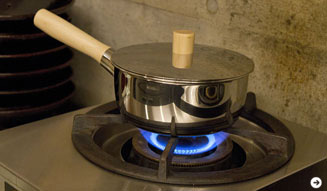
“The Shiba Series” consists of nine products, with the yukihira (traditional Japanese one-handled pot) being particularly distinctive. Fukasawa had long been interested in the idea of wooden handles for single-handled pots. “I like the feeling of them fitting comfortably in the hand, and the fact that they can be replaced. I wanted to create something for ALESSI that had the unadorned simplicity of Japanese knives and cutting boards, something that would improve with use. I wasn't specifically thinking of the yukihira, but I appreciated the functional beauty and unpretentious nature of Japanese one-handled pots, which feel like ‘tools for the hand,’” he says.
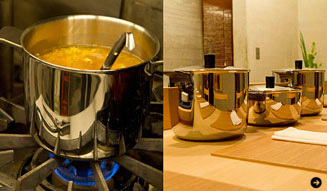
At first glance, they appear to be ordinary pots, but they feel satisfyingly heavy and substantial when held. The body is a three-layer construction with aluminum sandwiched between stainless steel, ensuring excellent heat conduction. The outwardly curved rim of the thick, three-layer structure not only adds visual comfort but also defines the pot's character. Handles are available in both wood and resin, while the lid features a hollow structure to prevent overheating, allowing for a simpler knob design.
Fukasawa states, “I want people to use them for any kind of cooking, regardless of whether it's Japanese or Western. Induction and electric stoves have flat, thick bottoms and are heavy, so you don't move pots around frequently. When I referred to them as ‘tools for the hand,’ I meant I wanted pots that could be used with more movement, which is why the bottom has a rounded shape. This gives the pots a charming and friendly impression.”
Regarding Fukasawa's design for “The Shiba Series,” Alberto Alessi expresses his expectations: “Compared to other ALESSI products, Naoto’s approach to design is austere. However, this is precisely why we wanted to work with him! I believe ALESSI’s corporate culture, which allows for the flexible integration of new ideas and languages into our product lines, is crucial. Furthermore, I am convinced that designs like Shiba can introduce users to different cultures, transporting them to distant lands. In this way, I believe European customers can learn something from Naoto’s Japanese approach to objects.”
ALESSI
http://www.alessi.com/en/