Shimozato Farm: Regional Revitalization Through Organic Farming
Frostpia Farm
From a Point to a Surface, and Towards a Circular Community Economy
Organic Farming at Frostpia Farm in Ogawa Town, Saitama, and its Community Revitalization Mechanism
Frostpia Farm in Ogawa Town, Saitama Prefecture, is a pioneer that began organic farming in the 1970s, when the term 'organic' was not yet widely recognized. Its initiatives, which consider not only food self-sufficiency but also energy self-sufficiency, are highly acclaimed both domestically and internationally, attracting a constant stream of trainees and visitors from Japan and abroad. The system at Frostpia Farm, which cultivates people and transforms communities, is brimming with hints for those considering the future of agriculture and regional regeneration.
Text by MINOWA Yayoi
Internationally Acclaimed Organic Farming at Frostpia Farm
“I want to teach organic farming to the villagers and help them become self-sufficient.” Bandit, from Laos, earnestly explains why he wants to learn organic farming over lunch.
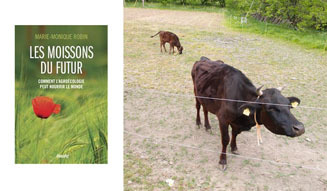
Frostpia Farm in Ogawa Town, Saitama Prefecture, is truly international. It's no wonder, as Frostpia Farm, managed by Yoshinori Kaneko, has been featured not only in domestic but also international media, having already accepted over 100 trainees from 41 countries. Recently, influenced by the TV program "Le moissons du Future (The Harvests of the Future)," broadcast in France and Germany in 2012, the farm has seen an increase in trainees from Europe and French-speaking regions.
The training program is typically one year long. After living on-site and learning the basics of organic farming, trainees disperse across the country and around the world. This is because the 'ideal form of circular organic agriculture' that the world is searching for exists here.
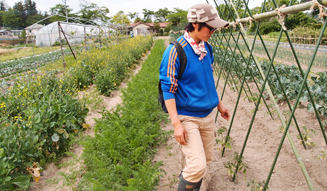
Frostpia Farm spans approximately 3 hectares. Amidst a tranquil rural landscape, the farm is lively with 5 cows, about 200 chickens, as well as ducks, and numerous dogs and cats. The farm aims for a self-sufficient agricultural method that utilizes readily available resources, including natural energy, to produce not only food but also energy, without relying on chemical fertilizers or pesticides.
Nothing is Wasted at Frostpia Farm
“This land has not seen pesticides for over 300 years,” shares Tomoko Kaneko, Yoshinori's wife. Originally, the Kaneko family's farm was involved in dairy and sericulture, so they never used any pesticides to grow grass and leaves for their animals and silkworms.
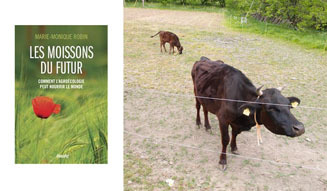
The current farm also has five cows. These cows not only provide milk but also eat weeds mown from paths and their manure is used as fertilizer and fuel. Ducks consume insects and weeds in the rice paddies, and their droppings also serve as fertilizer. All the animals have their roles and are important inhabitants of the small ecosystem that is Frostpia Farm.
Solar panels are installed on the main house, and small solar cells are found throughout the property. For instance, electricity from solar cells powers electric fences that protect the ducks and pumps used for watering.
Furthermore, biogas is produced from livestock manure and kitchen waste. In countries like Denmark and Sweden, some towns collect kitchen waste to produce biogas, which then powers public transportation such as buses.
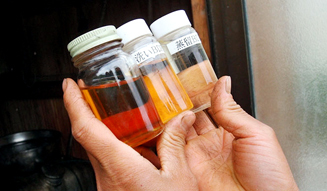
At Frostpia Farm, tractors and vehicles are powered not by biogas, but by a biofuel called SVO, which utilizes waste cooking oil (such as tempura oil). The waste cooking oil comes not only from the farm itself but also from a local tofu shop, where high-quality waste oil is filtered and used without further refinement.
“Nothing is wasted. Everything that comes from the earth returns to the earth,” says Kaneko.
A System Where Resources Circulate
Ingenious methods for cultivation using readily available resources are visible throughout the farm.
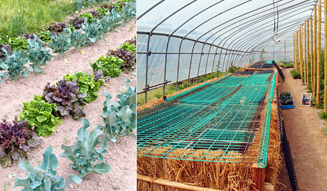
For example, the seedbeds used for growing seedlings and promoting germination are created using a "treading hotbed." This involves layering fallen leaves, rice bran, straw, and cow dung in multiple layers to form a bed. The heat generated by fermentation allows seedlings to sprout even in the dead of winter. This nutrient-rich soil is then left to mature for two years before becoming seedling soil. Heat is generated entirely without electricity or gas, and the materials produced using this heat eventually return to enrich the soil.
The crops grown here appear to be significantly different from those cultivated using conventional farming methods with pesticides and chemical fertilizers.
“Research by companies and university professors has confirmed that the vegetables at Frostpia have a successful symbiotic relationship with soil microorganisms, particularly mycorrhizal fungi,” Kaneko explains.
The system of effectively utilizing and circulating local resources is logical and natural, much like the workings of nature itself. It is not just the techniques of organic farming but the system of resource circulation that attracts many trainees and serves as a place of learning.
Organic Farming Boosts Regional Secondary and Tertiary Industry Development
The circular system established by Frostpia Farm is beginning to spread throughout the region.
Since 2001, collective cultivation of the Aoyama soybean, a local heirloom variety, using organic farming methods has been initiated. The entire harvest of soybeans is purchased by 'Tofu Kobo Watanabe,' a tofu maker in a neighboring town, and sold as Frostpia Tofu, achieving increasing sales.
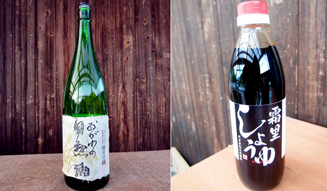
Organic cultivation has expanded to include wheat and rice in the area, with local craft beer breweries, sake breweries, and soy sauce manufacturers using these products to develop new offerings. Organic farm products, centered around Frostpia Farm, are contributing to the regional economy and fostering a circular economy.
Furthermore, the number of young farmers starting their careers in the region is increasing. Yuki Arai, who completed a two-year training program at Frostpia Farm, began farming in this area (Shimosato district). After studying international and environmental issues at university and engaging in NGO activities abroad, he chose the path of organic farming, seeking a life where he could be self-sufficient in both energy and food. He now lives with friends in a traditional Japanese house, growing and selling vegetables. Recently, they have also started making Japanese sake using the rice they grow. Arai's goal of "living in harmony with nature" is gradually taking shape.
In Ogawa Town, there are reportedly 45 individuals like Arai who have newly started farming through organic agriculture. Products bearing the Frostpia Farm name can be found in nearby shops.
The organic farming practices that Kaneko has cultivated and implemented over 40 years are nurturing people and spreading throughout the region. From a single point to a broader surface, and ultimately to a circular community economy. This may be the reason why not only Japan but the world is paying attention.
Frostpia Farm
http://www.shimosato-farm.com/
NPO Frostpia Gakko
http://shimozato.jp/
Tofu Kobo Watanabe
http://www.11-12å.co.jp/
Ogawa Town's Natural Sake Brewery: Seiun Shuzo
http://www.kumagaya.or.jp/~seiun/
MINOWA Yayoi
Environmental writer and board member of the NPO 'Sorabea Fund.' She writes articles and books on environmental topics and runs 'Fromae Café & Gallery,' a green café near Yanaka, Tokyo. Her activities focus on promoting and practicing renewable energy, organic food, and natural materials. Her books include 'Towards an Energy Shift: 123 Tips for Power Saving and Energy Conservation' and 'Recommendations for an Eco-Friendly Life' (Asuka Publishing).
http://gogreen.petit.cc/